Stock Analysis · News Corp B (NWS)
Overview
News Corp (Class B, ticker NWS) is a media and information services company. Its portfolio includes news and business publications, subscription-based digital real estate services, and book publishing. The company is known for brands such as Dow Jones (including The Wall Street Journal), Realtor.com, and HarperCollins, along with other newspaper and digital media assets.
Across these businesses, revenue generally comes from a mix of subscriptions, advertising, licensing and content sales, and transaction or referral-style fees in digital property listings. In practice, this creates a business profile that is partly “recurring” (subscriptions and long-term customer relationships) and partly cyclical (advertising and housing-related activity).
Main revenue sources (broadly, from largest to smallest; exact percentages vary by fiscal year and reporting):
- Subscription and recurring information services (notably Dow Jones products and professional information offerings)
- Digital real estate services (consumer traffic monetization, lead generation, and related services)
- Book publishing (print and digital book sales through HarperCollins)
- News media advertising and circulation (print/digital ads and reader revenue for newspaper brands)
From the company’s recent multi-year income flow, revenue has been relatively stable in the mid-single-digit billions, while profitability has moved around meaningfully year to year. Costs of revenue and operating expenses take the largest shares, with operating income and net income fluctuating based on mix, cyclical conditions, and company-specific items.
Key Figures
| Metric | Value | Industry ⓘ |
|---|---|---|
| Date | Feb 07, 2026 | |
| Context | ||
| Sector | Communication Services | |
| Industry | Entertainment | |
| Market Cap ⓘ | $14.24B | |
| Beta ⓘ | 0.97 | |
| Fundamental | ||
| P/E Ratio ⓘ | 33.31 | 50.96 |
| Profit Margin ⓘ | 13.80% | 4.93% |
| Revenue Growth ⓘ | 2.30% | 5.20% |
| Debt to Equity ⓘ | 32.39% | 80.15% |
| PEG ⓘ | 2.23 | |
| Free Cash Flow ⓘ | $652.00M | |
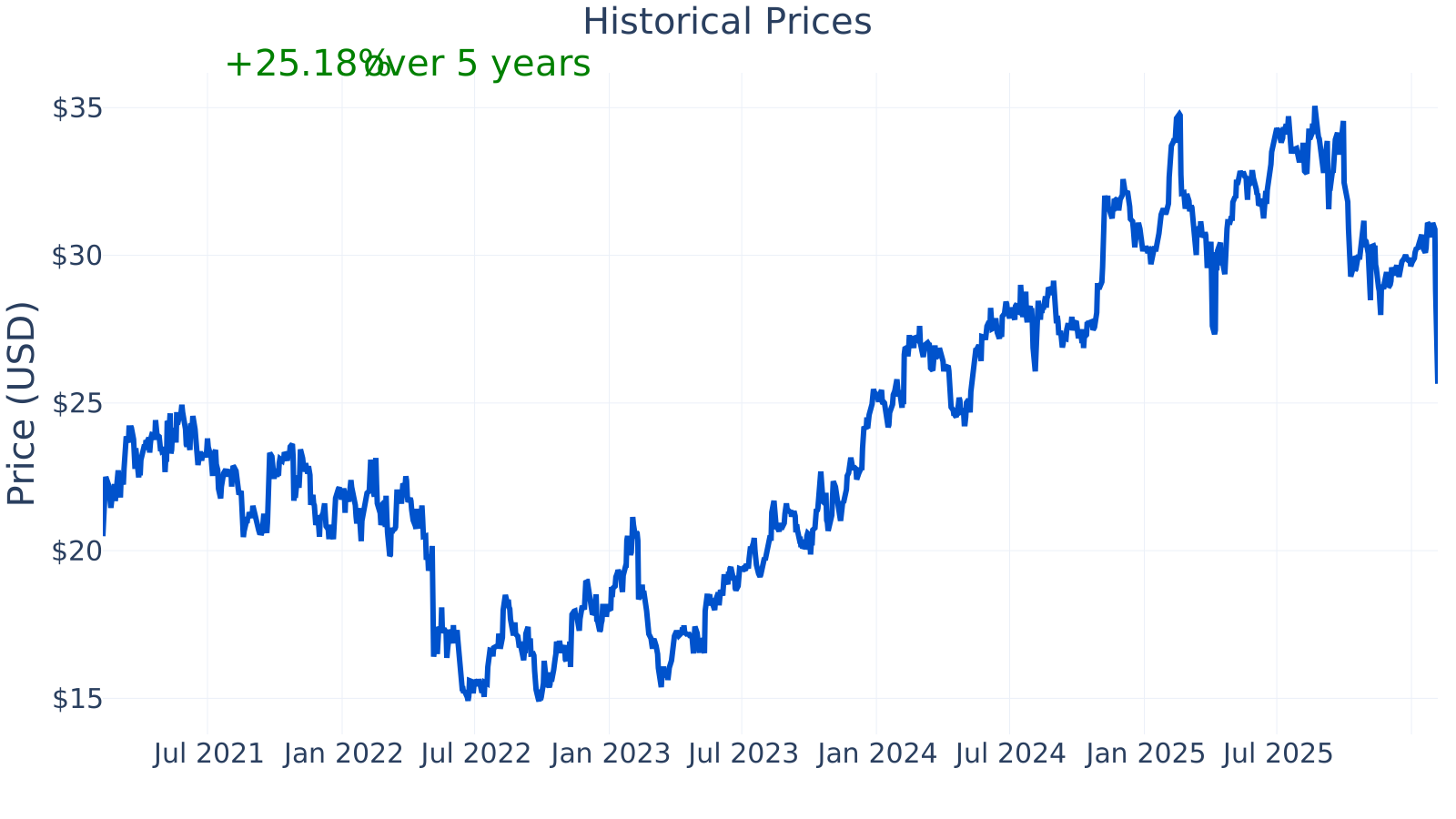
News Corp’s market capitalization is about $14.2B, with a beta of ~0.97 (historically, price moves roughly in line with the broader market). The company’s P/E ratio is ~33.3, which is below the industry median (~51.0) in the provided peer set, while its profit margin is ~13.8%, notably above the industry median (~4.9%). Year-over-year revenue growth is about 2.3% versus an industry median of ~5.2%. Leverage looks comparatively conservative: debt-to-equity is ~32% versus an industry median near ~80%. Free cash flow over the trailing twelve months is about $652M.
Growth (Medium)
News Corp operates in several mature areas (news publishing and traditional advertising) as well as segments that can grow faster (digital subscriptions/information services and digital real estate services). This mix matters: professional information products and subscription bundles tend to be more recurring, while advertising and housing-related activity can swing with the economy.
The year-over-year revenue growth pattern shows a clear cycle: strong growth earlier in the period, followed by a multi-quarter stretch of declines, and then a return to modest positive growth more recently (low single digits in the latest quarters shown). This suggests the company has been working through softer operating conditions (particularly relevant for ad markets and housing-related demand) and is now stabilizing, though not accelerating sharply.
Free cash flow has remained positive across the periods shown, but it has been uneven: roughly $1.0B (2021), then down to $753M (2022) and $462M (2023), before rebounding to $870M (2024) and easing to $807M (2025) on the dates shown. For a long-term business assessment, this points to a company that can generate cash but may experience meaningful swings depending on market conditions and operating mix.
Potential catalysts, based on the business model described in filings, tend to be tied to execution rather than a single “one-time” event: expanding digital subscriptions and professional products, improving monetization in digital real estate, and managing costs in legacy publishing operations. Macroeconomic improvements (advertising conditions, housing activity) can also act as external tailwinds.
Risks (Medium)
Leverage appears moderate versus peers, and it has trended down from the higher levels seen in 2022–2023 toward the low-30% range most recently (about 32% at the latest point), below the industry median across the period shown. Even with that, debt still matters in a media business: refinancing conditions and interest rates can affect financial flexibility, and acquisitions or restructuring can shift leverage quickly.
Profitability has improved materially from earlier quarters when margins were low (and briefly negative in early 2021). In the most recent period shown, the profit margin is about 5.1%, roughly in line with the industry median (~5.0%)—while the latest summary metric shows 13.8%, which is higher than peers. The gap between these views highlights an important risk for understanding News Corp: reported profitability can vary based on business mix and non-recurring items, so margins may not move in a straight line.
Business-model risks differ by segment:
- Advertising exposure: ad demand can weaken quickly in downturns, pressuring news and digital media revenue.
- Industry disruption: consumer attention continues shifting toward large digital platforms and aggregators, challenging traditional publishers.
- Housing sensitivity: the digital real estate segment is tied to real estate activity and marketing spend by agents and brokers, which can be interest-rate sensitive.
- Content and rights economics: book publishing results can vary with bestseller cycles, returns, pricing, and author advances.
- Regulatory and legal: media companies often face legal, regulatory, and reputational risks, which can create unpredictable costs.
Competitive positioning is mixed rather than “winner-takes-all.” The company has well-known brands and long-lived customer relationships (which can be an advantage for subscriptions and professional information), but it competes with:
- Large digital advertising platforms for marketing budgets and audience attention.
- Other publishers and information services providers for subscriptions and enterprise customers.
- Other housing portals and real estate marketing channels in digital real estate.
- Other global publishers in trade and educational publishing.
Overall, the company’s competitive advantages tend to come from brand strength and proprietary content/products, while its challenges come from structurally changing media consumption and cyclical end-markets.
Valuation
On earnings-based valuation, News Corp’s P/E ratio is ~33 in the latest snapshot, and the historical P/E has been volatile (rising to much higher levels in parts of 2023–2024 before coming down in 2025 on the dates shown). Compared with the provided industry median, the latest P/E is lower than the peer median even though the company’s revenue growth (about 2.3% YoY) is below the peer median. This combination can be interpreted as the market assigning value to factors beyond near-term top-line growth—such as profitability, cash generation, and perceived stability of certain segments.
The PEG ratio (~2.23) indicates the valuation is high relative to the company’s growth rate under standard PEG interpretation (where lower values typically indicate more growth per unit of price), though PEG is sensitive to how growth is estimated and may be less informative for a company with cyclical segments and changing mix.
With a diversified portfolio that includes both recurring subscription revenue and more cyclical lines of business, whether the current valuation is “expensive” or “cheap” depends heavily on (1) how durable margins and cash flows prove to be, and (2) whether the faster-growing parts of the portfolio can offset structural pressures in legacy publishing and cyclical swings in advertising and housing-related demand.
Conclusion
News Corp is a diversified media and information services company combining well-known publishing brands, subscription-oriented professional information products, digital real estate services, and book publishing. The business profile blends recurring revenue streams with cyclical exposure, which helps explain why growth and profitability can vary materially over time.
The recent picture is one of modest revenue growth, positive free cash flow, and moderate leverage versus peers, alongside a valuation that has fluctuated meaningfully over the last few years. The main long-term questions center on how effectively the company can expand and defend subscription and information offerings, improve digital real estate monetization across housing cycles, and manage the ongoing structural shift in advertising-supported news and print-related economics.
Sources:
- SEC EDGAR — News Corporation filings (Form 10-K and Form 10-Q)
- News Corp Investor Relations — Annual Reports and SEC filings (company-hosted)
- Wikipedia — “News Corp” (basic company background and business overview)
This article is for informational purposes only and does not constitute financial advice. Some content is AI-generated. See Disclaimer


