Stock Analysis · NetScout Systems Inc (NTCT)
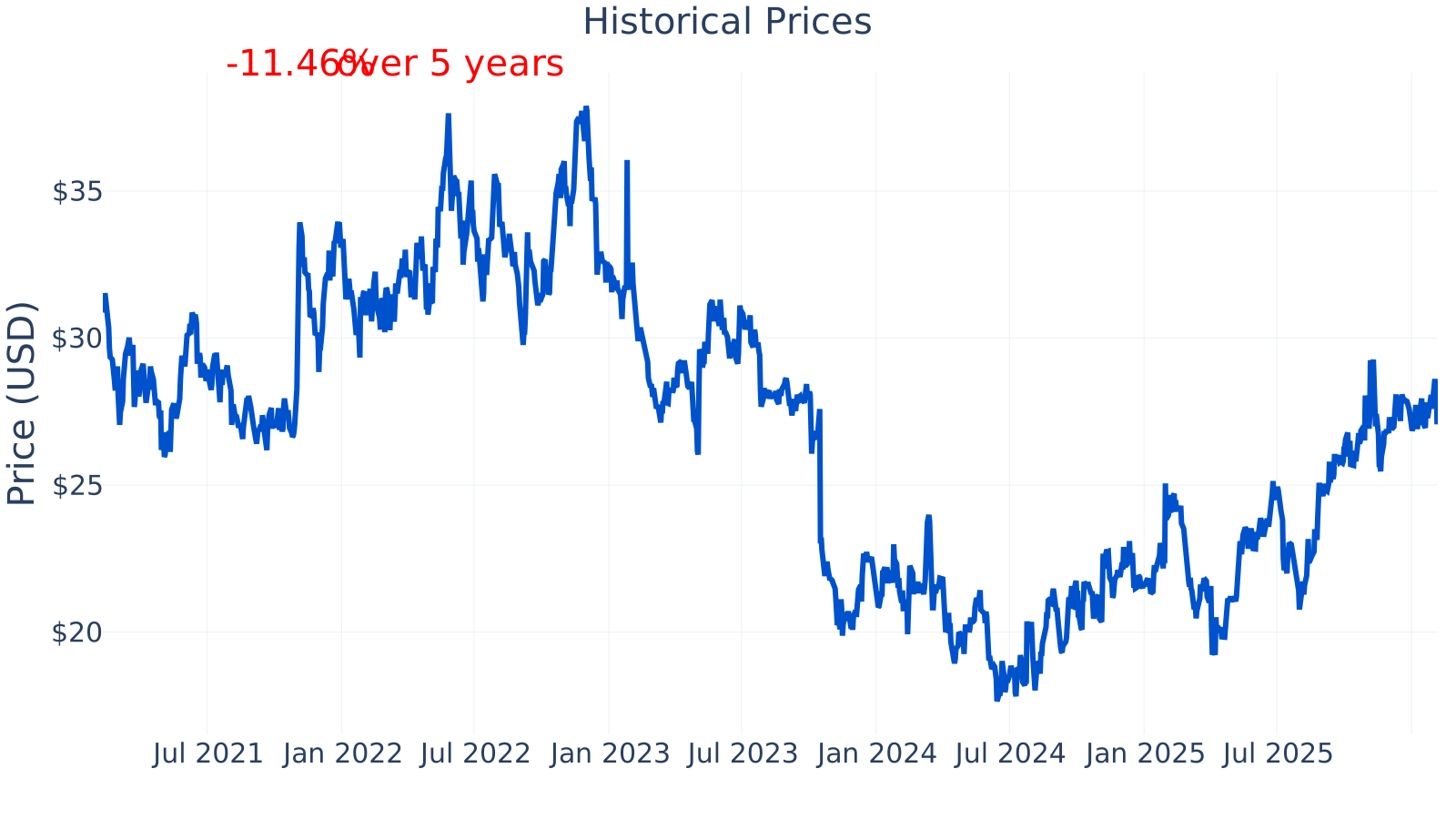
Overview
NetScout Systems, Inc. is a technology company focused on network and application performance monitoring and cybersecurity. In simple terms, its products help organizations (such as large enterprises, telecom operators, and public-sector agencies) keep critical digital systems running smoothly and detect or respond to disruptive events like outages and denial-of-service attacks.
The company’s business is commonly described in two main product areas that are referenced in its public reporting: service assurance (monitoring and troubleshooting networks and services) and security (including DDoS detection/mitigation and related protections). NetScout generally sells software and associated support/maintenance, and it also sells some hardware appliances used in monitoring/security deployments.
Main revenue sources are typically organized around these categories (largest to smallest may vary by year):
- Service assurance (network/service performance monitoring and analytics)
- Security (including DDoS-related products and threat detection/response)
- Maintenance, support, and other related services (often tied to product deployments)
In its filings, NetScout provides detailed breakdowns that can change over time (for example, by product line, customer type, or geography). Percentages are not included here because they should be taken directly from the most recent annual report section that presents the official revenue disaggregation.
At a high level, the longer-term income profile has shown periods of positive operating income and net income followed by unusually large losses in some fiscal years. That kind of swing often points to non-routine charges (for example, impairment or restructuring-related costs) rather than only day-to-day operating performance, so it is important to read the notes and management discussion in the annual report to understand what drove those years.
Key Figures
| Metric | Value | Industry ⓘ |
|---|---|---|
| Date | Feb 08, 2026 | |
| Context | ||
| Sector | Technology | |
| Industry | Software - Infrastructure | |
| Market Cap ⓘ | $2.00B | |
| Beta ⓘ | 0.64 | |
| Fundamental | ||
| P/E Ratio ⓘ | 20.80 | 25.67 |
| Profit Margin ⓘ | 11.13% | 6.91% |
| Revenue Growth ⓘ | -0.50% | 15.20% |
| Debt to Equity ⓘ | 2.55% | 19.82% |
| PEG ⓘ | 1.57 | |
| Free Cash Flow ⓘ | $275.48M | |
NetScout’s market capitalization is about $2.0B, placing it in the small-to-mid cap range. The stock’s beta of ~0.64 suggests it has historically moved less than the broader market on average (though that does not prevent meaningful price swings). The latest P/E ratio is ~20.8 versus an industry median around 25.7. The profit margin is ~11.1%, which is higher than the industry median shown (~6.9%).
On growth, the latest year-over-year revenue growth shown is roughly -0.5%, below the industry median displayed (~15.2%). Leverage appears low with debt-to-equity of ~2.5% versus an industry median near 19.8%. Free cash flow over the trailing twelve months is about $275.5M, which is a meaningful cash generation figure relative to the company’s size.
Growth (Medium)
NetScout operates in areas that are structurally important and likely to remain relevant: modern organizations depend on complex networks, cloud connectivity, and always-on digital services. As a result, demand for visibility (monitoring) and resilience/security tends to persist even when IT budgets fluctuate. In addition, large telecom operators and enterprises continue to face traffic growth, more encryption, and more distributed applications, all of which can increase the need for specialized monitoring and analytics.
Revenue growth has been uneven over time, with multiple quarters showing declines and some periods of recovery. The most recent value shown is close to flat year over year (about -0.5%), which indicates that, at least recently, NetScout has not been expanding at the pace implied by the broader industry median displayed in the chart. For long-term business momentum, this makes execution and product relevance especially important.
Cash generation has also been volatile, but the most recent trailing twelve months show stronger free cash flow (about $275M) compared with the prior year’s much lower level shown in the series. For a company like NetScout, sustained free cash flow can support ongoing R&D investment and provide flexibility during slower demand periods.
Potential catalysts (in a neutral, factual sense) typically come from: (1) increased focus on DDoS and network resilience by governments and critical infrastructure, (2) telecom network modernization cycles, and (3) broader adoption of advanced network observability practices. Whether these translate into measurable growth depends on competitive positioning and customers’ spending priorities.
Risks (Medium)
Balance-sheet leverage appears conservative. Debt-to-equity trends down significantly from earlier levels and sits around 2.5% most recently, below the industry median shown (~13.9%). Lower leverage can reduce financial risk, but it does not remove operating risks such as demand shifts or pricing pressure.
Profitability has been uneven. The latest profit margin is about 11.1%, above the industry median displayed (~7.2%). However, the historical series includes periods of very large negative margins before returning to positive territory. Large swings like this often reflect one-time accounting or restructuring impacts in addition to operational performance, and they can make it harder to judge “normal” earnings power without reading the underlying drivers in the annual report notes.
Key business risks described in company filings for businesses of this type typically include:
- Customer concentration and deal timing: large enterprise/telecom transactions can be sizable and lumpy, and procurement cycles can be long.
- Technology shifts: changes in network architectures (cloud, virtualized networks, encryption) can reduce the effectiveness of older approaches and require continuous product reinvention.
- Competitive pressure: customers may consolidate vendors, negotiate pricing, or shift to alternative platforms.
- Execution risk: delivering product upgrades, integrating offerings across assurance/security, and maintaining sales effectiveness across cycles.
Competitive advantages for NetScout often relate to deep expertise in high-scale network environments and installed-base relationships where monitoring and security tools are embedded in operational processes. That said, leadership depends on specific niches rather than broad dominance across all IT monitoring and cybersecurity categories.
Main competitor groups include:
- Large networking vendors with embedded telemetry and assurance capabilities (platform-based competition).
- Observability and performance monitoring vendors that cover applications and infrastructure (often software-first).
- DDoS and security specialists (including providers with cloud-delivered mitigation services).
NetScout’s positioning is generally strongest where customers require high-fidelity network visibility and proven operational tooling, but it competes against vendors that may bundle features into broader platforms or deliver security as a managed/cloud service.
Valuation
At the latest point shown, NetScout trades around a 20.8x price-to-earnings multiple versus an industry median near 25.7x. A lower-than-median P/E can reflect many things, including a market expectation of slower growth, greater uncertainty around earnings durability, or simply different business mix versus peers.
Context matters for interpreting this multiple. NetScout shows (1) recently positive profitability and (2) meaningful free cash flow, which can support valuation. On the other hand, the company’s revenue growth has been inconsistent and the profit history includes periods of severe losses, which can increase uncertainty about how repeatable earnings are across cycles. In practice, the justification for the valuation tends to hinge on whether revenue stabilizes and whether margins and cash generation remain durable without reliance on one-time factors.
Conclusion
NetScout is focused on infrastructure-critical areas—network performance visibility and security—where customers have ongoing needs tied to uptime and resilience. Financially, the latest snapshot shows low leverage, positive profit margin, and solid recent free cash flow, which are supportive fundamentals for a mature infrastructure software business.
The main open questions for a long-term assessment are the consistency of revenue growth and the stability of profitability across multi-year periods, given the historical swings visible in margins and the recent near-flat revenue trend. Competitive dynamics also matter because customers can favor broader platforms or cloud-delivered alternatives.
Sources:
- SEC EDGAR — NetScout Systems, Inc. Form 10-K (Annual Report)
- SEC EDGAR — NetScout Systems, Inc. Form 10-Q (Quarterly Reports)
- SEC EDGAR — NetScout Systems, Inc. Form 8-K (Current Reports)
- NetScout Investor Relations — Earnings releases and shareholder materials
- Wikipedia — “NetScout Systems” (basic company background)
This article is for informational purposes only and does not constitute financial advice. Some content is AI-generated. See Disclaimer


