Stock Analysis · National Vision Holdings Inc (EYE)
Overview
National Vision Holdings Inc. is a U.S. optical retail company focused on selling eyeglasses and contact lenses and providing eye exams through a network of retail locations. Its model combines (1) selling optical products and (2) offering optometry services, with an emphasis on value-oriented pricing and convenient access to vision care.
In general terms, the company’s revenue is primarily driven by sales to customers who purchase glasses and contacts, plus fees related to eye exams and other in-store services. Public filings typically describe revenue in broad categories rather than a simple “product A vs. product B” breakdown, and percentages can vary by period and reporting approach.
Main revenue drivers (from largest to smallest, high-level):
- Eyeglasses and related optical products (frames, lenses, lens options, protection plans)
- Contact lenses and related products
- Eye exams and other optometry-related services (often delivered through affiliated optometrists depending on the store format and state rules)
- Other items (e.g., accessories and miscellaneous)
Across recent years, the company’s total revenue has fluctuated around the roughly $1.6B–$2.1B range (as shown in the financial flow view below), highlighting that demand is present but results have not been steady year to year.
From 2021 to 2025, total revenue moved from about $2.08B (2021) down to about $1.64B (2022), then back above $2.1B (2023), before dipping again (2024) and rising to about $1.99B (2025). Over the same period, operating income swung from clearly positive (2021) to negative (2023–2024), then back to positive in 2025—suggesting that profitability has been sensitive to costs and/or pricing and mix changes rather than moving in a straight line.
Key Figures
| Metric | Value | Industry ⓘ |
|---|---|---|
| Date | Mar 09, 2026 | |
| Context | ||
| Sector | Consumer Cyclical | |
| Industry | Specialty Retail | |
| Market Cap ⓘ | $2.21B | |
| Beta ⓘ | 1.42 | |
| Fundamental | ||
| P/E Ratio ⓘ | N/A | 22.01 |
| Profit Margin ⓘ | 1.49% | 6.27% |
| Revenue Growth ⓘ | 15.10% | 5.10% |
| Debt to Equity ⓘ | 79.88% | 103.28% |
| PEG ⓘ | N/A | |
| Free Cash Flow ⓘ | $73.45M | |
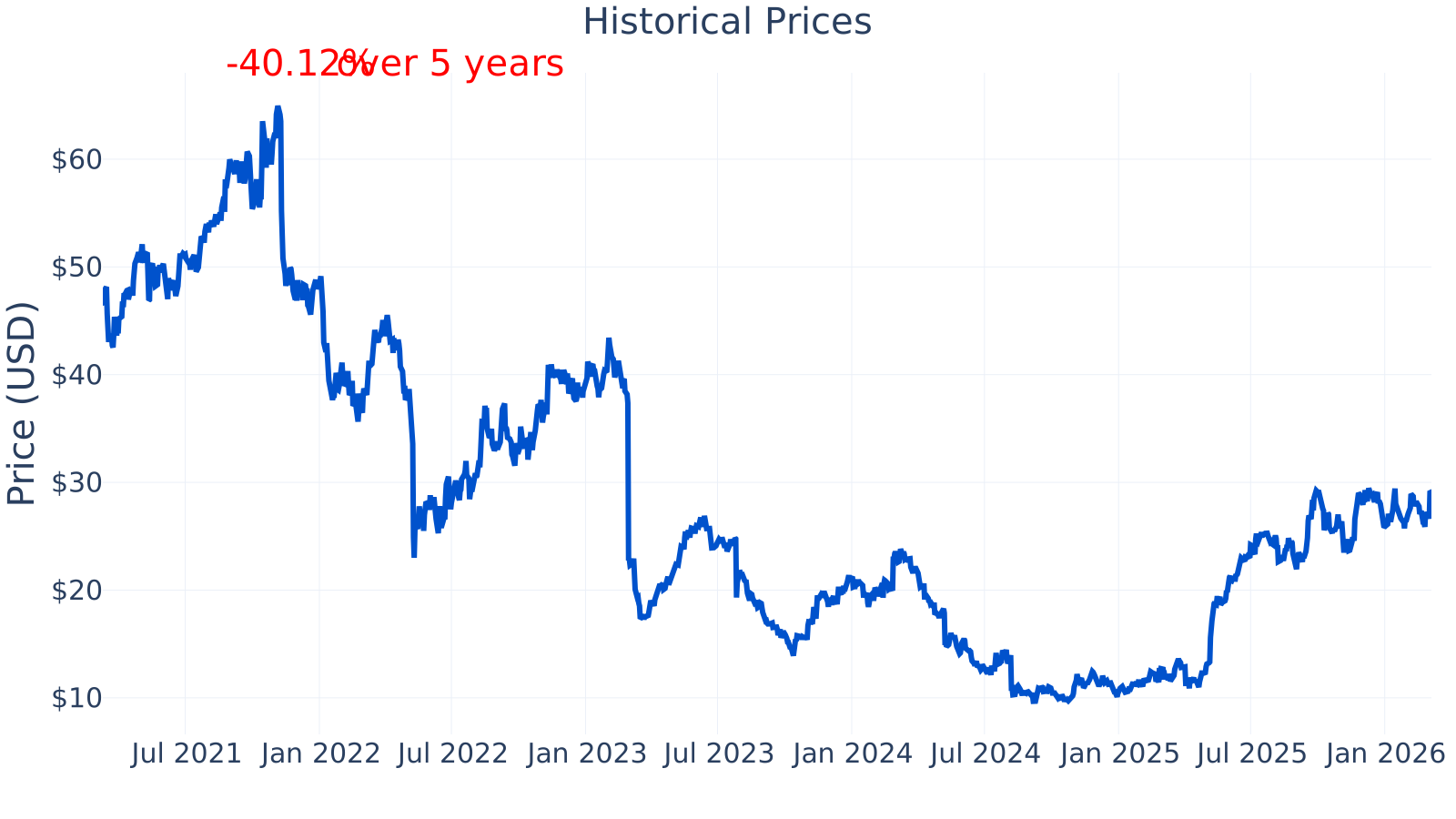
National Vision’s equity value is about $2.2B, and the stock has shown relatively high sensitivity to market moves (beta ~1.42). The latest profit margin is about 1.49%, below the specialty retail industry median near 6.27%, while the latest year-over-year revenue growth is about 15.1%, above the industry median near 5.1%. Debt-to-equity is about 79.9%, below the industry median near 103.3%. Trailing twelve-month free cash flow is about $73.5M, indicating the business generated cash after operating needs and capital spending over the last year.
Growth (Medium)
Vision care is tied to long-term factors that tend to support ongoing demand: eyesight needs often increase with age, and many customers replace glasses periodically or maintain recurring contact lens purchases. That said, near-term results can still be cyclical because optical retail is influenced by consumer spending, promotional intensity, and the competitive landscape.
For National Vision specifically, the recent pattern points to uneven growth: the company returned to positive year-over-year revenue growth in 2025 after weaker and sometimes negative comparisons across parts of 2022–2024. If sustained, this kind of rebound can matter because retail cost structures include meaningful fixed expenses (store labor, occupancy, distribution), so incremental sales can have an outsized impact on profits—though the reverse is also true when sales soften.
The year-over-year revenue growth line shows a period of declines (notably through parts of 2022–2024), followed by a more consistent recovery in 2025, ending at about 15.1% year-over-year—above the industry median shown (about 5.1%). The key question for long-term business momentum is whether that improvement reflects durable demand and execution, or a shorter-term rebound from earlier weakness.
Cash generation is another practical indicator of business flexibility (ability to reinvest, reduce debt, or absorb volatility). National Vision’s free cash flow fell substantially from 2021 levels and then improved more recently.
Free cash flow trended down from about $166.4M (2021) to roughly $15.9M (2024), then improved to about $46.2M (2025) and is about $73.5M on a trailing twelve-month basis in the latest metrics snapshot. The direction is favorable recently, but the longer view shows that cash generation has been inconsistent.
Risks (High)
The main risk visible in recent fundamentals is profitability stability. While the company returned to a small positive profit margin most recently, margins were negative for multiple quarters in 2023–2025 before improving at the end of 2025. In retail, margin pressure can come from promotions/discounting, product and insurance mix, higher labor and occupancy costs, supply chain and input costs, and the need to invest in staffing and service levels.
Profit margin moved from mid-single digits in 2021 to near/below zero during 2023–2025, before recovering to about 1.49% at the end of 2025. That remains below the industry median shown (about 5.57% at the same time point), indicating that, relative to peers, the company has recently been operating with less pricing power and/or a less favorable cost structure.
Another risk is competitive positioning. Optical retail is crowded and spans:
- Large brick-and-mortar chains with national scale and strong brand awareness
- Warehouse clubs and mass merchants that bundle optical with broader retail traffic
- Online-focused eyewear sellers competing on price and convenience
- Independent optometrists and local optical stores competing on service and relationships
National Vision’s competitive strengths tend to come from scale, store footprint, and a value-oriented proposition. However, the margin history suggests that competing on value can be difficult when costs rise or promotional activity increases across the category.
Financial leverage is a separate consideration. Debt can amplify results in both directions: it can help fund growth, but it also increases required cash commitments (interest and principal), especially if operating performance weakens.
Debt-to-equity has improved meaningfully over time, declining from roughly 127% (early 2021) to about 80% (end of 2025). That is also below the industry median shown (about 101% at end of 2025). The downward trend suggests a less leveraged balance-sheet profile than a few years ago, though leverage remains material and profitability swings can still matter for credit metrics.
Valuation
One commonly used valuation metric is the price-to-earnings (P/E) ratio, but it only works cleanly when earnings are consistently positive. National Vision’s P/E was very high in several earlier periods and then becomes not meaningful in periods where earnings were negative (often shown as blank/zero in simplified charts).
Historically, the company’s displayed P/E frequently sat well above the industry median during 2021–2023, while later periods are not meaningful due to losses (and therefore do not produce a usable P/E). In contexts like this, valuation discussions often shift toward questions such as: whether earnings have normalized, how durable the margin recovery is, and whether cash flow is consistently positive—because small changes in operating performance can lead to large changes in earnings-based multiples.
Given the combination of (1) a recent revenue growth rebound, (2) a return to a small positive profit margin, and (3) improved leverage versus earlier years, the valuation picture depends heavily on whether profitability can continue to improve toward peer levels. Without that, earnings-based valuation metrics can remain volatile or uninformative.
Conclusion
National Vision operates in a category with structural demand for vision care, and its integrated retail-and-services model provides multiple ways to generate revenue from a store visit. Recent results show a rebound in year-over-year revenue growth and an improvement in free cash flow, alongside a return to a small positive profit margin after a period of losses.
The main long-term questions center on consistency: whether the company can sustain growth while improving profitability closer to industry norms, and how it performs in a competitive retail environment where pricing and costs can shift quickly. Balance-sheet leverage has improved over time, which may reduce financial risk relative to earlier periods, but operating swings remain a key driver of outcomes.
Sources:
- SEC EDGAR — National Vision Holdings, Inc. filings (Form 10-K, Form 10-Q)
- National Vision Holdings, Inc. — Investor Relations materials (press releases and shareholder communications)
- Wikipedia — “National Vision Holdings” (company background and general description)
This article is for informational purposes only and does not constitute financial advice. Some content is AI-generated. See Disclaimer