Stock Analysis · National Vision Holdings Inc (EYE)
Overview
National Vision Holdings, Inc. is a U.S. optical retailer focused on offering eye exams and eyewear (frames, lenses, and contact lenses) through a large network of stores and affiliated eye care professionals. The company’s model combines retail locations with optical labs and supply chain capabilities, aiming to keep prices accessible while driving volume through store traffic and repeat customer needs (such as prescription renewals and replacements).
Revenue mainly comes from selling optical products and providing (or facilitating) eye exam-related services. Based on the company’s reporting, its business is often discussed through broad “product vs. service” categories rather than a long list of separate product lines.
Main revenue sources (typical breakdown used in filings):
- Product revenue: eyeglasses (frames and lenses) and contact lenses (generally the largest share)
- Service and other revenue: primarily exam-related and other fees (generally the smaller share)
The company’s recent income statement pattern shows how profitability has been pressured even when revenue has been substantial. Total revenue was about $2.08B (2021), $1.64B (2022), $2.13B (2023), and $1.82B (2024). Over the same period, operating profit moved from positive to negative, reflecting higher operating costs relative to gross profit.
From 2021 to 2024, revenue remained in the roughly $1.6B–$2.1B range, but operating income shifted from about +$175M (2021) to -$45M (2023) and around -$10M (2024). This indicates that controlling operating expenses (such as store labor, occupancy, marketing, and corporate costs) has been a key swing factor in results.
Key Figures
| Metric | Value | Industry ⓘ |
|---|---|---|
| Date | Feb 08, 2026 | |
| Context | ||
| Sector | Consumer Cyclical | |
| Industry | Specialty Retail | |
| Market Cap ⓘ | $2.29B | |
| Beta ⓘ | 1.39 | |
| Fundamental | ||
| P/E Ratio ⓘ | N/A | 23.78 |
| Profit Margin ⓘ | -0.12% | 6.27% |
| Revenue Growth ⓘ | 7.90% | 5.20% |
| Debt to Equity ⓘ | 80.76% | 103.28% |
| PEG ⓘ | N/A | |
| Free Cash Flow ⓘ | $82.95M | |
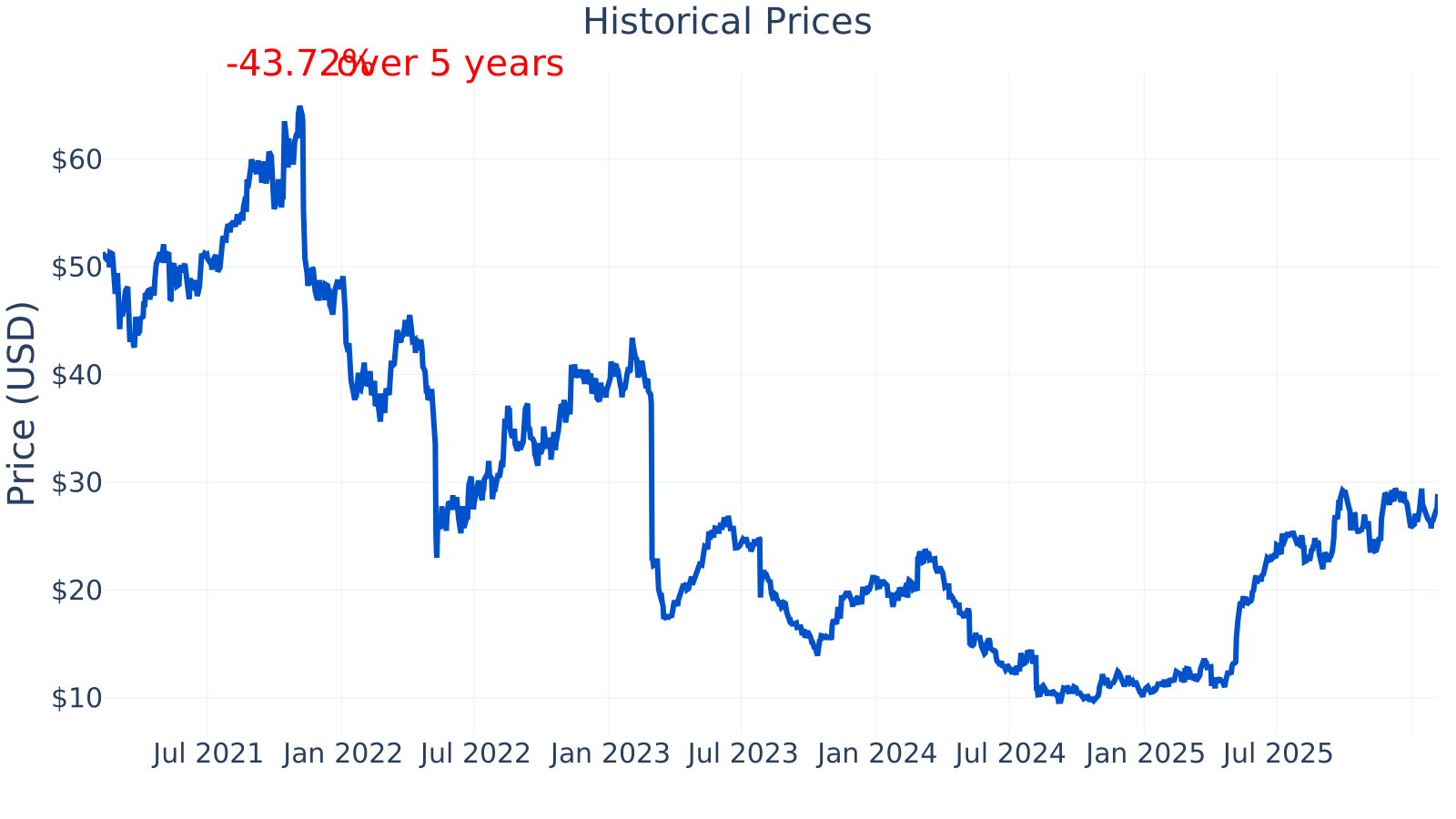
National Vision’s equity value is about $2.29B. The stock’s beta (~1.39) suggests it has tended to move more than the broader market. Recent profitability has been very thin, with a profit margin near -0.12% versus an industry median around 6.27%, while year-over-year revenue growth (~7.9%) is above the industry median (~5.2%). Leverage is moderate for the peer set, with debt-to-equity ~80.8% versus an industry median around 103.3%. Trailing twelve-month free cash flow is about $83.0M, which matters because cash generation can help fund store investments and absorb periods of weaker earnings.
Growth (Medium)
The optical retail and eye care market is supported by steady, long-term demand drivers: vision correction needs are widespread, prescriptions renew over time, and consumers replace or upgrade eyewear. In addition, demographics can matter—vision care needs often rise with age, and routine eye exams can also serve as a health screening touchpoint. These factors typically create a resilient baseline of demand compared with more discretionary retail categories.
National Vision’s strategy is centered on scale and value positioning—operating many locations, supporting them with centralized capabilities (such as labs and distribution), and using pricing and convenience to drive customer volume. If execution is strong, this kind of model can support growth through a mix of new stores, improved performance at existing locations, and product mix expansion (for example, encouraging multiple pairs, upgrades, or contact lens repeat purchases).
Revenue growth has been uneven quarter to quarter. There were periods of declines (notably across several quarters in 2022–2024), followed by more recent positive comparisons. The latest year-over-year reading shown (~7.9%) is above the industry median, which can be a constructive sign for top-line momentum, but consistency over time is important for a retail model with meaningful fixed costs.
Free cash flow over the last several years shows a drop from ~$166M (2021) to much lower levels in 2023–2024, with improvement by 2025 (~$46M as of 2025-03-31 on the chart, and ~$83M in the latest metrics table). For long-term business building, more stable cash generation can help fund growth investments and reduce financial strain during weaker profitability cycles.
Risks (High)
This article is for informational purposes only and does not constitute financial advice. Some content is AI-generated. See Disclaimer