Stock Analysis · NCR Atleos Corporation (NATL)
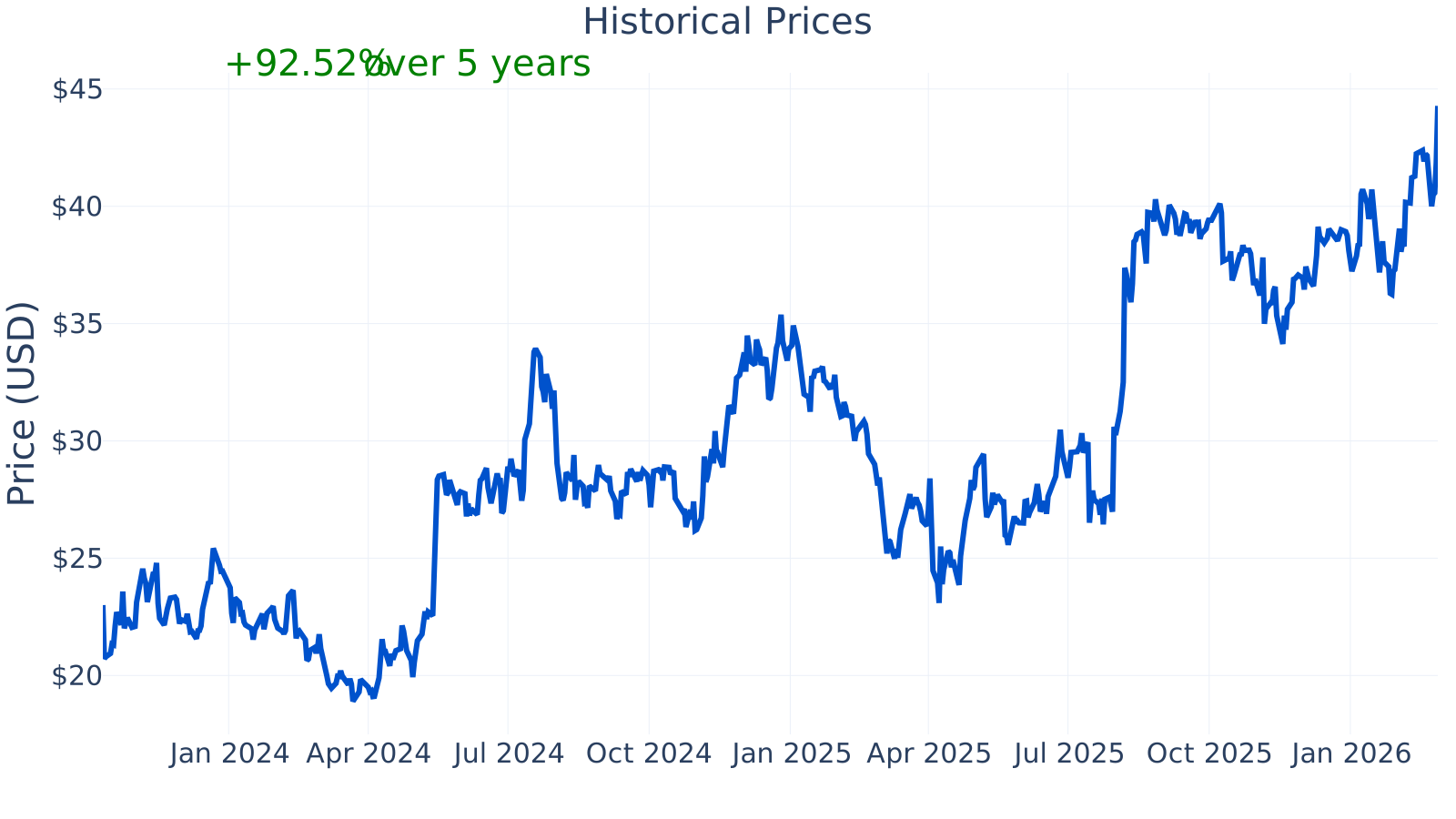
Overview
NCR Atleos Corporation is a company focused on self-service financial access, best known for operating and supporting ATM-related services. In simple terms, it helps banks, credit unions, retailers, and other organizations provide cash access and related services through ATMs and self-service devices. Its activities generally include running ATM networks, providing managed services (such as monitoring, cash management coordination, and maintenance), and offering technology and software that help customers operate these self-service channels.
Because Atleos operates in a service-heavy business, a meaningful part of its economics can depend on long-term customer relationships, service reliability, and the scale of its installed base (the number of devices and locations it supports). The company’s filings typically describe revenue in a few broad categories tied to ATM/network services and related solutions. Exact category percentages can change by period and depend on how the company groups and reports them.
Main revenue sources (typical reporting categories):
- ATM/network and transaction-related services (fees tied to transactions and network participation)
- Managed and support services (operational services such as monitoring, maintenance, and field services)
- Software / platform and other solutions (technology enabling self-service and channel operations)
- Hardware and installation-related revenue (where applicable, depending on contracts and reporting)
The company’s recent revenue level appears relatively stable year to year, with changes driven more by execution, pricing, customer volume, and cost structure than by rapid market expansion.
From the multi-year income flow shown above, total revenue increased from about $3.55B (2021) to about $4.35B (2025). Operating income improved notably after 2023, while interest expense became a much larger line item in 2024–2025, which matters because interest costs can reduce the portion of operating profit that ultimately becomes net income.
Key Figures
| Metric | Value | Industry ⓘ |
|---|---|---|
| Date | Mar 02, 2026 | |
| Context | ||
| Sector | Technology | |
| Industry | Software - Application | |
| Market Cap ⓘ | $3.27B | |
| Beta ⓘ | 0.97 | |
| Fundamental | ||
| P/E Ratio ⓘ | 25.30 | 25.64 |
| Profit Margin ⓘ | 3.72% | 7.25% |
| Revenue Growth ⓘ | 4.00% | 16.65% |
| Debt to Equity ⓘ | 55.83% | 24.64% |
| PEG ⓘ | N/A | |
| Free Cash Flow ⓘ | $200.00M | |
NCR Atleos has a market capitalization of about $3.27B and a beta of ~0.97, which indicates the stock has historically moved roughly in line with the broader market (though actual volatility can differ by period). Its P/E ratio is ~25.3, close to the industry median (~25.6) in the provided peer set. Profitability is present but relatively thin: profit margin is ~3.7% versus an industry median of ~7.2%. Recent year-over-year revenue growth is ~4.0%, below the industry median (~16.7%) shown. Leverage is higher than the peer median: debt-to-equity is ~55.8% versus an industry median of ~24.6%. Trailing twelve-month free cash flow is about $200M, which can be important for debt service and reinvestment.
Growth (medium)
Atleos operates in a mature part of financial infrastructure: cash access and ATM services. While digital payments continue to grow, cash usage persists in many day-to-day contexts, and ATMs remain a critical distribution channel for many financial institutions and retailers. This creates an environment that often looks more like steady, operationally focused growth than high-speed expansion.
For future growth, the company’s strategy typically centers on expanding and deepening managed services relationships, improving uptime and efficiency (which can help margins), and using scale to deliver services across a broad footprint. In mature industries, execution—cost control, contract renewals, service quality, and disciplined capital allocation—can be a bigger driver of outcomes than market growth alone.
The year-over-year revenue growth shown is modest and uneven across quarters, including a period of contraction (around -6.7%) followed by a stronger quarter (about +7.6%). This pattern is consistent with a business influenced by contract timing, transaction volumes, and customer mix rather than a smooth, high-growth trajectory.
Free cash flow trends upward in the periods shown (from about $164M to about $186M) and is listed at about $200M on a trailing basis in the latest table. For a service-oriented company, sustained free cash flow can be a meaningful catalyst over time because it supports investment in operations and technology and provides flexibility to reduce debt.
Risks (high)
A key risk for Atleos is that it operates in a space tied to long-term trends in how people pay and bank. If cash usage declines faster than expected in certain regions or customer segments, transaction volumes and demand for some services could face pressure. Even in a stable cash environment, pricing pressure from large customers or competitors can also limit growth.
Another major risk is financial: interest expense is a prominent line item in the company’s recent results. Higher debt levels can amplify both upside and downside by increasing fixed obligations that must be paid regardless of business conditions.
The debt-to-equity picture changes dramatically over time in the chart, dropping from very elevated levels to about 55.8% most recently. Even after that improvement, it remains above the industry median (about 27.1% at the latest point shown for the peer set). This suggests leverage is still an important factor to monitor alongside interest expense and refinancing needs.
Profitability is another area to watch. While the company has been profitable recently, its margins have been below the peer median, which can leave less room for error if costs rise or pricing tightens.
The profit margin trend improves from negative territory in mid-2024 to positive and rising levels, reaching roughly 3.9% by late 2025. However, this remains below the peer median shown (about 7.4% at that time). A sustained gap like this can indicate either structurally higher costs, different revenue mix, or ongoing investment needs.
On competition and positioning, Atleos faces a mix of:
- Other ATM operators and managed service providers competing for bank and retailer contracts
- Banks and large retailers operating portions of ATM fleets in-house (a “do it yourself” alternative)
- Fintech and digital-first alternatives that reduce some needs for cash access over time
Competitive advantages in this type of business usually come from scale, operational reliability, a large installed base, and long-term customer relationships. Those strengths can support retention and efficiency, but they do not fully eliminate risks from pricing pressure, customer concentration, or technology change.
Valuation
The valuation picture shown by the P/E ratio suggests the stock trades around the peer-set median on this single metric. The company’s P/E values in 2025–2026 (mid-teens to low-20s in the points shown) are below the industry median displayed on the chart for those same dates, while the latest table places the company’s P/E very close to the industry median. Differences like this can happen depending on timing and how peer medians move.
Interpreting whether this level is “high” or “low” depends heavily on business quality and durability. Here, several fundamentals pull in different directions: profit margins are improving but still below peers, revenue growth is modest versus the peer median, and leverage is higher than the peer median. On the other hand, the business produces meaningful free cash flow, and operating income has improved compared with earlier years. In practical terms, the current valuation appears more consistent with a steady, execution-driven business than with a high-growth software profile.
Conclusion
NCR Atleos is a cash-access and ATM services company operating in a relatively mature segment of financial infrastructure. The company’s recent history shows improving operating performance and a return to positive net income after a weaker 2023, alongside meaningful free cash flow generation.
At the same time, the business profile suggests that long-term outcomes may depend more on operational execution than on broad market expansion. Key items to monitor over time include leverage and interest costs, the sustainability of improving profit margins, customer retention and pricing dynamics, and how cash usage trends affect transaction-related activity. On valuation, the P/E ratio shown is broadly in line with the peer median, which places greater weight on whether the company can continue improving margins and maintaining cash generation.
Sources:
- SEC EDGAR — NCR Atleos Corporation filings (Form 10-K, Form 10-Q)
- NCR Atleos Investor Relations — Press Releases and SEC Filing archive
- Wikipedia — “NCR Atleos” (company background and basic history)
This article is for informational purposes only and does not constitute financial advice. Some content is AI-generated. See Disclaimer


