Stock Analysis · NCR Atleos Corporation (NATL)
Overview
NCR Atleos Corporation (NATL) provides technology and services that help financial institutions, retailers, and other organizations operate and manage ATM networks. In simple terms, it supports “cash access” infrastructure: running fleets of ATMs, keeping them available, and providing the software and services behind transactions, monitoring, maintenance, and related operations.
The business is often described as more service-oriented than a typical software company: it tends to combine ongoing services (such as operating and servicing ATMs) with technology and payments-related capabilities. This type of activity can produce relatively recurring revenue when customers sign multi-year outsourcing or managed-services agreements, but it can also face volume sensitivity (for example, changes in cash usage patterns and transaction activity can matter).
Based on how the company discusses its business in official filings, revenue generally comes from a mix of ATM-related services and technology. Exact percentages can vary by period and depend on how the company reports segments.
- ATM and network-related services (managed services, operations, maintenance, processing, monitoring)
- Software and platform capabilities supporting ATM and self-service operations
- Hardware and related professional services (where applicable, depending on offerings and reporting)
One notable trend in the multi-year profit “flow” is that revenue increased from 2021 to 2024, while operating income improved significantly in 2024. At the same time, interest expense is shown rising sharply in 2024, which can matter for how much operating improvement ultimately reaches net income.
Key Figures
| Metric | Value | Industry ⓘ |
|---|---|---|
| Date | Feb 08, 2026 | |
| Context | ||
| Sector | Technology | |
| Industry | Software - Application | |
| Market Cap ⓘ | $2.97B | |
| Beta ⓘ | 0.97 | |
| Fundamental | ||
| P/E Ratio ⓘ | 22.95 | 27.79 |
| Profit Margin ⓘ | 3.03% | 6.02% |
| Revenue Growth ⓘ | 4.50% | 15.80% |
| Debt to Equity ⓘ | 62.73% | 25.15% |
| PEG ⓘ | N/A | |
| Free Cash Flow ⓘ | $55.00M | |
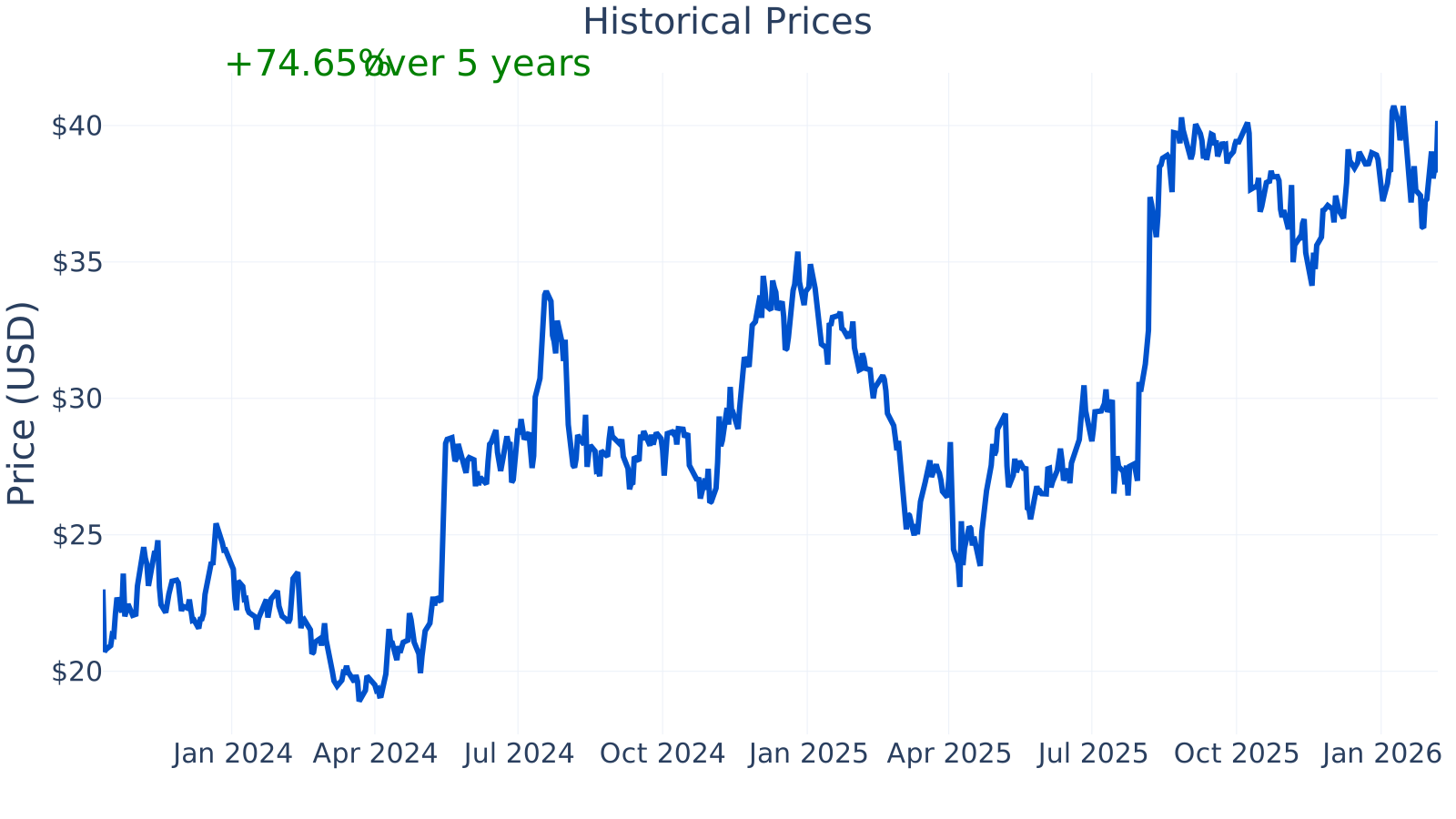
NCR Atleos has a market capitalization of about $3.0B and a beta of ~0.97, which is close to the broader market’s typical day-to-day volatility. The latest P/E ratio is ~23.0 versus an industry median near 27.8, while the company’s profit margin is ~3.03% versus an industry median around 6.03%. Revenue growth year-over-year is about 4.5% compared with an industry median near 15.8%. The latest debt-to-equity is ~62.7% versus an industry median near 25.2%. Trailing twelve-month free cash flow is about $55M (noting that free cash flow can move meaningfully over time).
Growth (Medium)
The company operates in the “cash access” and ATM services ecosystem, which is shaped by two opposing forces. On one hand, many economies continue shifting toward digital payments, which can reduce cash usage over long periods. On the other hand, ATMs remain important infrastructure in many regions, and large financial institutions and operators often look for ways to reduce cost and complexity by outsourcing operations—an area where managed services providers can benefit.
A strategy focused on operating services, reliability, uptime, and long-term customer agreements can support steadier results than a purely transactional model, especially if the company continues shifting toward higher-value services and software-enabled capabilities. From a fundamentals perspective, the most visible “growth lever” tends to be expanding wallet share with existing customers (more services per network) and winning additional managed-services contracts, rather than relying only on broad market growth.
The year-over-year revenue growth shown is modest and uneven over the periods displayed (including a negative quarter). That pattern is consistent with a business that may be more operationally driven than hyper-growth oriented, where contract timing, renewals, and customer activity levels can influence reported growth.
Free cash flow is positive in the periods shown, though the latest trailing twelve-month figure shown is lower than an earlier period in the chart. For long-term business durability, the key question is often whether cash generation remains consistently positive after capital needs and whether it grows as the company scales services and improves efficiency.
Risks (High)
This article is for informational purposes only and does not constitute financial advice. Some content is AI-generated. See Disclaimer