Stock Analysis · N-Able Inc (NABL)
Overview
N-able, Inc. is a software company focused on tools that help IT service providers manage and secure their customers’ technology. In simple terms, it sells software that supports day-to-day “behind the scenes” work such as monitoring computers and networks, deploying updates, backing up data, and improving cybersecurity. A key part of its positioning is serving managed service providers (MSPs), which are businesses that run IT operations for other organizations (often small and mid-sized companies).
The company’s products are commonly delivered as cloud-based subscriptions, which typically means customers pay recurring fees to keep using the platform and receiving updates. This business model tends to create revenue that renews over time, but it also means results can be sensitive to customer retention and the pace of new customer sign-ups.
Based on its public filings, N-able’s revenue is primarily tied to subscription software and related services, with a meaningful portion associated with maintenance/support and other recurring arrangements. Public filings often describe revenue in categories such as subscriptions and other recurring revenue versus services; exact mix percentages can vary by period and reporting format, and may not always be presented as a single clean split across all product lines.
Main revenue sources (high-level):
- Subscription / recurring software revenue (typically the largest component)
- Maintenance and support / recurring platform-related revenue
- Professional services and other services (generally smaller and more variable)
Over the years shown, total revenue rises (from about $346M in 2021 to about $495M in 2025), while research and development and sales/administration expenses also increase. Net income is positive in 2022–2024, then turns negative in 2025 (about -$17M), which suggests that higher costs and/or other items (such as interest expense) outweighed the year’s gross profit and operating performance.
Key Figures
| Metric | Value | Industry ⓘ |
|---|---|---|
| Date | Feb 23, 2026 | |
| Context | ||
| Sector | Technology | |
| Industry | Information Technology Services | |
| Market Cap ⓘ | $890.58M | |
| Beta ⓘ | 0.60 | |
| Fundamental | ||
| P/E Ratio ⓘ | N/A | 19.56 |
| Profit Margin ⓘ | -3.33% | 4.91% |
| Revenue Growth ⓘ | 11.80% | 5.70% |
| Debt to Equity ⓘ | 5.03% | 78.25% |
| PEG ⓘ | N/A | |
| Free Cash Flow ⓘ | $73.69M | |
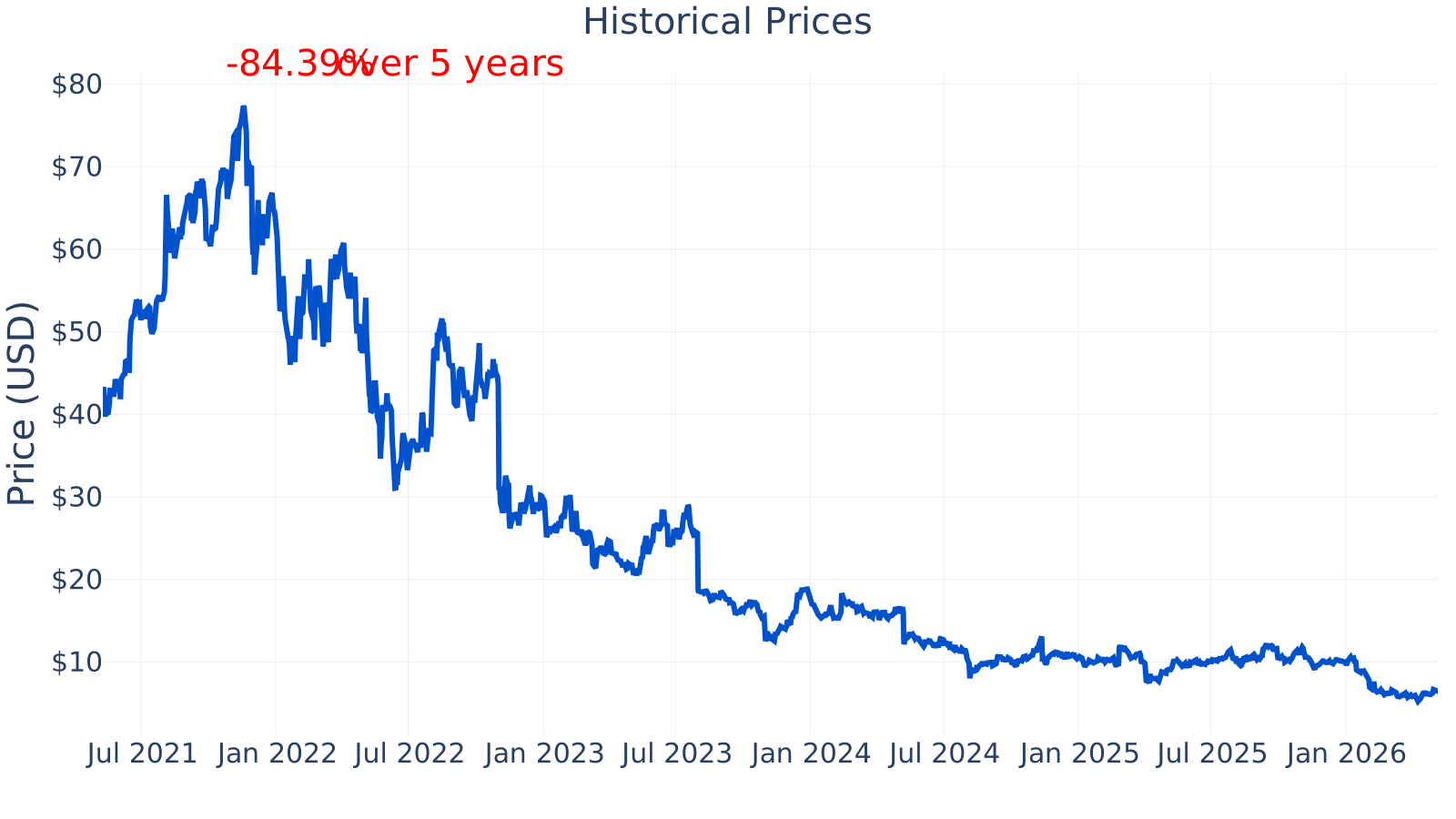
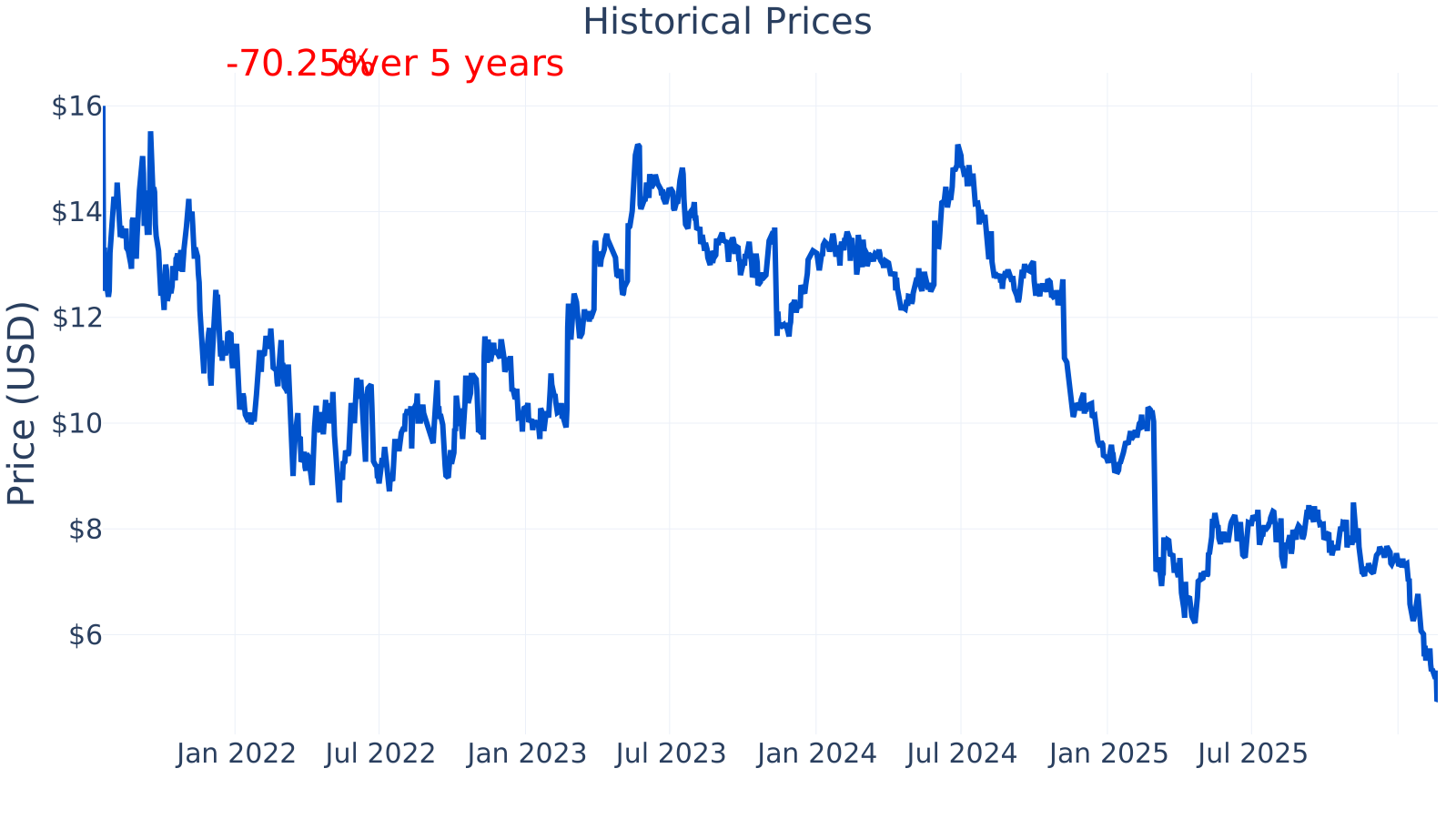
N-able’s market capitalization is about $0.89B, placing it in the small-cap range. The stock’s beta of ~0.60 indicates it has historically moved less than the broader market on average (though any single stock can still be volatile). Recent profitability is a notable point: the latest profit margin is about -3.33% versus an industry median near 4.91%, indicating the company is currently less profitable than many peers on this measure.
On growth, the latest year-over-year revenue growth shown is ~11.8%, above the industry median of ~5.7% in the table. Leverage appears modest on the latest snapshot: debt-to-equity is ~5% versus an industry median near 78%. Free cash flow over the trailing twelve months is shown at roughly $73.7M, which can matter for flexibility (funding product development, acquisitions, debt reduction, or other corporate needs).
Growth (medium)
N-able operates in the IT management and cybersecurity software ecosystem, where demand is influenced by long-running trends: more cloud usage, more devices to manage, and a persistent need for security and reliable backup. MSPs and similar IT providers often look for platforms that help them manage many customer environments efficiently, which can support ongoing demand for automation, monitoring, and security tooling.
The company’s strategy—selling recurring software to service providers who, in turn, serve many end customers—can scale if partners add end clients or expand the number of tools they use. In this model, future growth is often tied to (1) retaining partners, (2) expanding usage within existing partners, and (3) continuing to release products that reduce workload and improve security outcomes.
The year-over-year revenue growth trend shown is positive for most quarters, but it is not perfectly steady and includes a recent negative quarter (about -2.6% in 2025-09-30). That kind of slowdown can happen for several reasons (customer budget pressure, higher churn, pricing changes, or a mix shift), and it can be important because subscription businesses often rely on consistent renewals and expansions to sustain growth.
Free cash flow over time trends upward in the period shown (from roughly $11.2M at the end of 2021 to roughly $71.2M by early 2025, and about $73.7M on the latest metric snapshot). Sustained free cash flow can support continued investment in product development and operations, even when accounting profits fluctuate.
Risks (high)
A key risk for N-able is that its recent profitability has weakened, with the latest profit margin shown turning negative. Software companies can show volatility in profits due to changes in spending on research and development, sales and marketing, and the ongoing costs to support cloud delivery—so monitoring whether margins stabilize (or deteriorate further) is important when evaluating business quality over a long period.
The profit margin chart shows a meaningful swing: margins improved into 2024 (reaching around 8.1% in 2024-09-30) and then declined through 2025, reaching roughly -3.2% by 2025-09-30. Compared with the industry median (generally positive in the periods shown), this recent drop suggests either rising costs, softer revenue efficiency, or both.
Balance-sheet leverage appears low on the latest reading, but trends matter because capital structure can change through acquisitions, refinancing, or shifts in cash generation.
The debt-to-equity chart shows a long decline from roughly the low-60% range in 2021 toward about 5% most recently (2025-09-30). This is substantially below the industry median for the same date, which may reduce financial strain from debt. However, interest expense is still a real cost line item in the company’s financials, and changes in rates or refinancing terms can still affect net results.
Competition is another central risk. N-able participates in markets that overlap with larger and smaller technology vendors. Competitors can include broad IT management and endpoint/security platforms, as well as specialized monitoring, remote access, backup, and security providers. Larger competitors may have broader product suites and greater marketing budgets, while smaller specialists may compete aggressively on niche capabilities. In addition, MSP-focused platforms face switching costs and integration complexity: customers may be reluctant to change tools once embedded, but they also expect continued innovation and reliable service.
In terms of competitive advantages, N-able’s differentiation is often associated with its MSP-centric approach, integrations, and the ability to manage many end-client environments. Whether it is a “leader” depends on the specific subcategory (monitoring, remote management, backup, security) and the peer set being used; in many of these areas, the market is fragmented with multiple credible vendors rather than a single dominant provider.
Finally, as a software company serving IT operations, N-able also faces operational risks such as outages, security incidents affecting its own systems, and the need to keep pace with fast-changing cybersecurity threats. Any loss of trust can be particularly damaging when the product is used to manage and secure other organizations’ systems.
Valuation
Price-to-earnings (P/E) ratios can be difficult to interpret for a company with fluctuating earnings, because the “E” (earnings) can swing with margins, interest expense, and other items. In the periods shown, N-able’s P/E is often well above the industry median (for example, frequently in the double- or triple-digit range versus an industry median commonly in the 20s). That pattern typically indicates that the market price has been high relative to reported earnings at those times, or that earnings were temporarily low.
Given the most recent profit margin turning negative, a P/E-based view can become less meaningful (and the chart reflects gaps where the ratio is not displayed). In that situation, valuation discussions often lean more heavily on other lenses—such as revenue growth durability, free cash flow consistency, and margin trajectory—because near-term earnings may not represent steady ongoing profitability.
Conclusion
N-able is a software business serving IT service providers with recurring, subscription-oriented tools for monitoring, management, and security. The company has shown revenue expansion over multiple years and rising free cash flow in the period presented, which can support continued product investment and operational flexibility.
At the same time, recent profitability pressure stands out: profit margins declined sharply in 2025 and turned negative on the latest reading, while competition in IT management and security remains intense. The company’s low latest debt-to-equity level reduces one category of financial risk, but it does not remove the need for improvement in operating efficiency and sustained customer demand.
Overall, the long-term picture depends heavily on whether revenue growth can remain durable while margins recover to more consistently positive levels, and whether the company can maintain differentiation in a crowded vendor landscape.
Sources:
- SEC EDGAR — N-able, Inc. Form 10-K (Annual Report)
- SEC EDGAR — N-able, Inc. Form 10-Q (Quarterly Reports)
- N-able Investor Relations — SEC filings and shareholder materials
- Wikipedia — “N-able” (company background overview)
This article is for informational purposes only and does not constitute financial advice. Some content is AI-generated. See Disclaimer