Stock Analysis · Murphy USA Inc (MUSA)
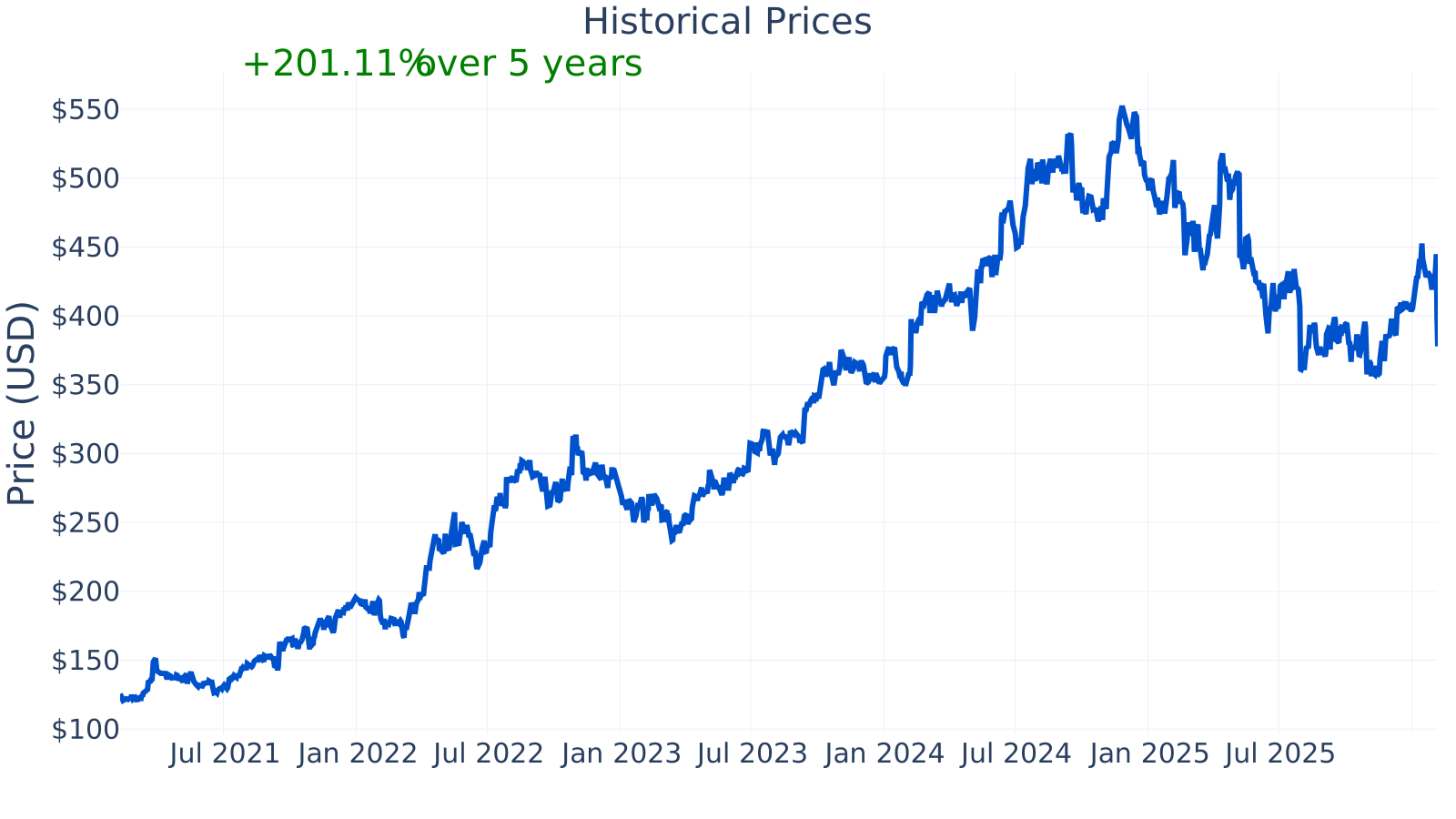
Overview
Murphy USA Inc. operates a large network of retail fuel stations and convenience stores in the United States. The company focuses on value-oriented locations, often near big-box retail traffic, and aims to drive frequent customer visits through competitively priced fuel and everyday convenience items (snacks, beverages, tobacco and nicotine products, and other in-store merchandise).
In simple terms, the business model is built around two repeat-purchase categories: (1) selling high volumes of gasoline and diesel at retail, and (2) selling higher-margin convenience products inside the store. Fuel tends to generate the majority of total revenue because gasoline prices are high per transaction, while in-store merchandise often contributes an outsized share of profit relative to its revenue.
Main sources of revenue (typical structure for this business model, with fuel usually being the largest):
- Retail fuel sales (largest portion of revenue; price-driven, lower margin per dollar of sales)
- In-store merchandise (smaller portion of revenue; typically higher margin than fuel)
- Other income (smaller items such as certain service/commission-type revenues, depending on company disclosures)
The company’s results are influenced by fuel demand, fuel price movements, and the “margin” it earns per gallon (the spread between its selling price and its costs), plus the ability to grow and defend profitable in-store sales.
Across recent years, total revenue has moved meaningfully up and down (a common pattern when fuel prices change), while net income has remained positive each year shown. This highlights how headline revenue can be volatile for fuel retailers even when the underlying business stays profitable.
Key Figures
| Metric | Value | Industry ⓘ |
|---|---|---|
| Date | Feb 07, 2026 | |
| Context | ||
| Sector | Consumer Cyclical | |
| Industry | Specialty Retail | |
| Market Cap ⓘ | $7.08B | |
| Beta ⓘ | 0.39 | |
| Fundamental | ||
| P/E Ratio ⓘ | 15.67 | 23.78 |
| Profit Margin ⓘ | 2.77% | 6.27% |
| Revenue Growth ⓘ | 0.20% | 5.20% |
| Debt to Equity ⓘ | 521.54% | 103.28% |
| PEG ⓘ | 1.51 | |
| Free Cash Flow ⓘ | $374.30M | |
Murphy USA’s market capitalization is about $7.1B, and the stock’s beta (~0.39) suggests it has historically moved less than the broader market on average (though any individual stock can still be volatile). The current P/E ratio is ~15.7, below the industry median (~23.8). Profit margin is about 2.8% versus an industry median around 6.3%, which is consistent with fuel-heavy retail where a large share of revenue comes from lower-margin gasoline sales. Year-over-year revenue growth is close to flat (~0.2%) versus an industry median near 5.2%. The company shows a high debt-to-equity (~522%) compared with the industry median (~103%), and trailing twelve-month free cash flow is about $374M.
Growth (Medium)
Murphy USA operates in the U.S. convenience store and retail fuel market, a mature industry where long-term growth is usually driven more by execution than by rapid market expansion. Over time, demand is supported by large installed bases of gasoline-powered vehicles and the convenience-driven nature of quick-stop retail. However, the industry also faces gradual long-term pressure from improved fuel efficiency and the shift toward electric vehicles, which may change fuel volumes and alter the economics of the “fuel + store” model over many years.
Within that environment, Murphy USA’s growth efforts typically come from a mix of:
- Store network optimization (new sites, rebuilds/relocations, and improving the performance of existing stores)
- Richer inside-the-store offer (expanding food and beverage options, improving merchandising, and loyalty initiatives)
- Fuel margin and volume management (competitive pricing to maintain traffic while protecting per-gallon profitability)
Revenue growth has been highly variable over the period shown, including strong increases earlier (consistent with periods of higher fuel prices) followed by several quarters of decline and a return to roughly flat growth most recently. For a fuel retailer, this pattern can reflect changes in fuel prices as much as (or more than) changes in store count or customer demand.
Free cash flow has remained positive in each period shown, but has trended down from the early-2022 level (about $562M) to roughly $370M more recently. For long-term monitoring, investors often watch whether free cash flow stabilizes or grows through a combination of steady fuel volumes, resilient in-store profit, and disciplined capital spending.
Risks (High)
A key risk is that Murphy USA’s results are sensitive to fuel market dynamics. Changes in wholesale costs, competitive pricing, and regional demand can affect fuel margins. Even if gallons sold are steady, profitability can move if margins compress. In addition, broader economic slowdowns can reduce discretionary trips and in-store purchases, while inflation can shift what consumers buy inside the store.
Another important long-term risk is the gradual transition in transportation energy. Over many years, higher electric vehicle adoption and improvements in fuel efficiency could pressure gasoline volumes. The industry may adapt through expanded foodservice, alternative fuels, or other services, but the pace and economics of that transition are uncertain.
The company’s debt-to-equity ratio has increased over time and is high relative to the industry median, reaching roughly 522% in the latest period shown. Higher leverage can amplify outcomes: it may support returns in strong periods, but it can also reduce flexibility when conditions are unfavorable (for example, if margins weaken or borrowing costs rise).
Net profit margin has stayed in a relatively tight band around the mid-2% range in recent years, ending near 2.4%–2.8%, and it has generally been below the industry median. This does not automatically indicate weaker operations—fuel-heavy revenue mixes naturally produce lower net margins—but it does mean that small changes in margin drivers (fuel spreads, shrink, wage costs, credit-card fees, or product mix) can have an outsized impact on earnings.
Competitive advantages in this business are typically based on location quality, local scale, efficient fuel sourcing and logistics, strong store-level execution, and loyalty programs that reinforce repeat visits. Murphy USA competes against large, well-capitalized operators, and the market is fragmented and intensely price-competitive.
Main competitors generally include:
- Large convenience and fuel chains (national and regional operators)
- Warehouse/club and mass retail fuel offerings (where fuel is used to drive traffic)
- Oil major / branded fuel station networks (often operated by dealers or distributors)
Relative positioning tends to be strongest where Murphy USA has dense regional presence and can leverage a value-oriented fuel offer to drive in-store traffic. The main challenge is that competitors can respond quickly on price, making durable differentiation difficult.
Valuation
The company’s current P/E ratio (about 15.7) is below the industry median shown in the chart and table. Over the displayed period, Murphy USA’s P/E has moved from lower double digits to higher levels around 2024, then back down toward the mid-teens more recently. In plain language, the market has recently been valuing the company at a lower multiple of earnings than many peers in the same industry grouping.
Whether that valuation level is “high or low” in context depends on how the market weighs several fundamentals at once: (1) the stability of fuel and in-store profitability, (2) the company’s ability to generate and sustain free cash flow, (3) leverage levels (which are elevated versus the median), and (4) the longer-term uncertainty around fuel volumes as transportation evolves. The current multiple suggests the market is not pricing the company like a high-growth retailer, and it is also reflecting the sector’s cyclical and competitive characteristics.
Conclusion
Murphy USA is a U.S. retail fuel and convenience store operator whose revenue is heavily influenced by fuel sales, while in-store merchandise is typically important for profitability. The business operates in a mature, competitive landscape where long-run outcomes depend on execution, cost control, location strategy, and maintaining strong customer traffic.
The company has remained profitable in the periods shown and has generated positive free cash flow, but revenue growth has been uneven and most recently close to flat. Two factors stand out for long-term analysis: the company’s relatively low net profit margins (common in fuel-led retail) and its high leverage compared with the industry median, which can increase sensitivity to weaker operating conditions.
From a valuation-description standpoint, the stock’s P/E ratio is currently below the industry median, indicating the market is applying a lower earnings multiple than many peers. Interpreting that gap typically requires balancing the company’s cash generation and operating consistency against leverage and longer-term fuel-related uncertainties.
Sources:
- U.S. SEC EDGAR — Murphy USA Inc. filings (Form 10-K, Form 10-Q)
- Murphy USA Investor Relations — SEC filings and investor materials (as posted by the company)
- Wikipedia — “Murphy USA” (basic company background)
This article is for informational purposes only and does not constitute financial advice. Some content is AI-generated. See Disclaimer


