Stock Analysis · Motorola Solutions Inc (MSI)
Overview
Motorola Solutions Inc. (MSI) builds communications and software used mainly by public safety agencies and other organizations that need reliable, secure operations. In simple terms, the company helps police, firefighters, emergency medical teams, and enterprise customers communicate, coordinate, and manage information—especially in high-stakes situations where networks and devices must keep working.
Motorola Solutions generally combines mission-critical devices (such as two-way radios and related infrastructure), software (such as command center tools and evidence management), and services (maintenance, managed services, and support). A key part of the business model is that, once a customer deploys Motorola’s equipment and software across a city or agency, switching systems can be time-consuming and expensive, which tends to create longer-term customer relationships.
From an operating-results view, the company has expanded revenue over time, and profitability has been supported by gross profit dollars rising faster than cost of revenue in recent years.
Across the period shown, total revenue increased from about $8.2B (2021) to about $11.7B (2025), while operating income rose from roughly $1.8B to roughly $3.1B. Research and development spending also increased (from about $734M to about $971M), which can be relevant because the company competes on product reliability, security, and ongoing feature improvements.
Main sources of revenue (high-level, simplified):
- Products and systems (devices and network infrastructure for communications)
- Software (command center and workflows, video and evidence management, analytics)
- Services (support, maintenance, and managed/hosted offerings)
Public filings break revenue into specific segments and categories; the mix can vary by year and depends on large customer deployments and multi-year service arrangements.
Key Figures
| Metric | Value | Industry ⓘ |
|---|---|---|
| Date | May 04, 2026 | |
| Context | ||
| Sector | Technology | |
| Industry | Communication Equipment | |
| Market Cap ⓘ | $72.45B | |
| Beta ⓘ | 0.99 | |
| Fundamental | ||
| P/E Ratio ⓘ | 34.24 | 52.85 |
| Profit Margin ⓘ | 18.44% | 3.98% |
| Revenue Growth ⓘ | 12.30% | 17.90% |
| Debt to Equity ⓘ | 405.23% | 78.48% |
| PEG ⓘ | 2.38 | |
| Free Cash Flow ⓘ | $2.57B | |
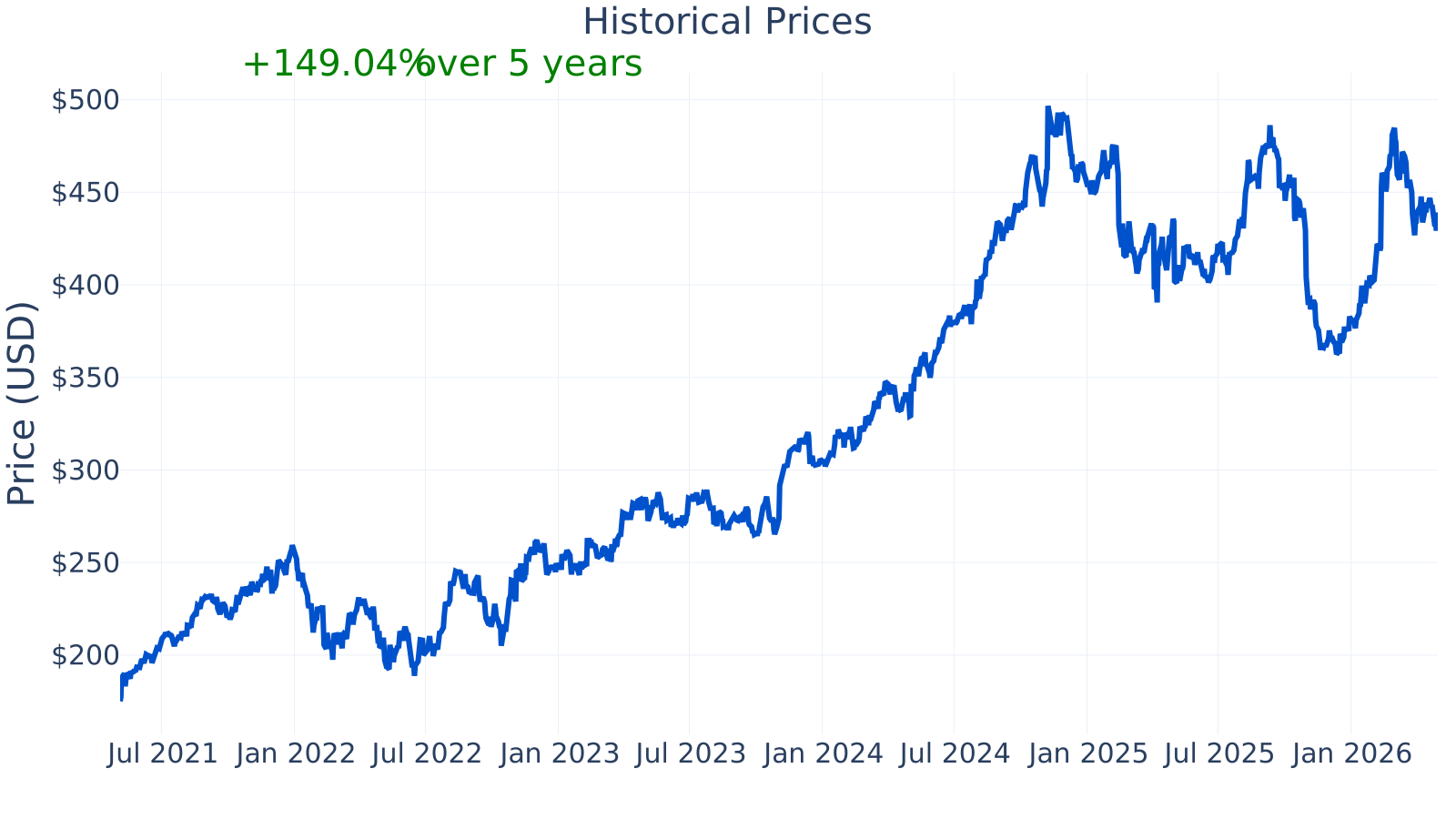
Motorola Solutions has a market capitalization of about $72.4B and a beta of ~0.99, which indicates the stock has tended to move broadly in line with the overall market. The current P/E ratio is ~34.2, below the shown industry median (~52.9), while the profit margin is ~18.4%, well above the shown industry median (~4.0%). Recent year-over-year revenue growth is ~12.3% (below the industry median shown at ~17.9%). The debt-to-equity ratio is ~405%, which is much higher than the shown industry median (~78%), and is a central point to understand when assessing balance-sheet risk. Trailing twelve-month free cash flow is about $2.57B.
Growth (Medium)
Motorola Solutions operates in an industry tied to long-term demand for public safety modernization and secure communications. Governments and agencies tend to upgrade systems gradually, but once upgrades begin, deployments and service contracts can extend for years. This creates a business environment that often emphasizes reliability and long operating lifecycles more than rapid consumer-style product turnover.
The company’s strategy appears designed to support steadier, multi-year expansion by combining equipment with software and recurring services. This “platform” approach matters because it can increase the amount of value delivered per customer over time (for example, an agency may start with radios and later add software modules, cloud services, or video tools), rather than relying only on one-time hardware sales.
The revenue growth pattern shown is positive but not uniform. After stronger growth earlier in the period, year-over-year growth moderated into mid-single digits during parts of 2024–2025, and then accelerated again to about 12.3% by the most recent point shown. This profile can be consistent with a business influenced by project timing, contract cycles, and comparisons against prior-year periods.
Free cash flow (a rough measure of cash left after operating needs and capital spending) increased from about $1.37B (2022) to about $2.27B (2025) on the timeline shown, with the latest figure listed at about $2.57B. For many long-term business models, rising cash generation can support debt service, acquisitions, and shareholder-return programs, although it does not eliminate the risks that come with leverage and contract concentration.
Risks (Medium-High)
A major risk factor is balance-sheet leverage. Motorola Solutions’ debt-to-equity is high, and the historical series includes periods with unusual readings (including negative equity at times), which can happen when accumulated buybacks and accounting effects reduce equity. Regardless of the accounting mechanics, higher leverage can increase sensitivity to interest costs, refinancing conditions, and unexpected downturns in operating performance.
In the more recent periods shown, debt-to-equity moved to a range around 385%–427%, far above the industry median line on the chart. That does not automatically imply distress, but it does mean the capital structure is materially more debt-heavy than many peers, so execution consistency and access to financing remain important.
Another risk is customer and budget exposure. A meaningful portion of demand is linked to government and public safety budgets, procurement processes, and multi-year award timing. Large programs can shift between quarters or years, and political or fiscal changes may affect purchasing priorities.
Competition is also relevant. Motorola Solutions competes with a mix of communications equipment providers and software/video solutions vendors. The company’s competitive advantages often cited in public filings include its installed base, reputation for reliability in mission-critical use, and the switching costs of replacing an agency-wide system. However, competitors can win on price, specialized capabilities, or newer architectures, particularly in software categories where barriers to entry can be lower than in specialized radio networks.
Margin stability is another area to watch. Motorola Solutions shows higher profitability than the industry median, but margins can be affected by product mix, supply-chain costs, service delivery expenses, and the timing of large projects.
The profit margin trend shown improved meaningfully into 2025, reaching about 18%–19%, while the industry median line stayed much lower. This gap can reflect the company’s mix (including software and services), scale, and operating discipline, but it is still important to monitor whether margins remain durable across cycles and competitive pressure.
Valuation
The P/E ratio shown for Motorola Solutions has typically been in a range around the low 30s to low 50s over the period displayed, with a recent value around 32.8–34.2. The industry median on the same chart moved widely as well, and Motorola’s multiple has at times been above and at times below that median.
In plain language, a P/E in the 30s often implies the market is assigning meaningful value to the company’s earnings consistency, margin profile, and expected longer-term growth. At the same time, the company’s PEG ratio (~2.38) suggests that—relative to typical “PEG≈1” shorthand—the price may be less supported if growth slows versus expectations, although PEG is a simplified metric and can vary based on how growth is estimated.
Valuation context for Motorola Solutions also ties back to fundamentals discussed earlier: higher-than-industry profitability can support a higher multiple, while higher leverage can increase the importance of steady execution. For long-term analysis, it is often helpful to compare valuation alongside multi-year revenue growth consistency, cash flow generation, and the balance between recurring services/software and more project-driven product sales.
Conclusion
Motorola Solutions is a communications and software company focused on mission-critical environments, with demand supported by long-cycle public safety modernization and the need for secure, reliable operations. Financially, the company shows a combination of rising revenue over time, strong profit margins relative to the industry median, and growing free cash flow in the period shown.
The central trade-offs visible in the information reviewed are profitability and cash generation versus a more leveraged capital structure than many peers, along with the inherent timing and budgeting dynamics of government and large-agency procurement. The valuation multiples shown indicate the market is pricing in a degree of durability and continued performance; whether that pricing remains justified over time depends heavily on maintaining margins, executing on multi-year customer programs, and managing debt and interest costs through different economic conditions.
Sources:
- U.S. Securities and Exchange Commission (SEC) EDGAR — Motorola Solutions, Inc. filings (Form 10-K, Form 10-Q)
- Motorola Solutions — Investor Relations materials (Annual Report and SEC filings section)
- Wikipedia — “Motorola Solutions” (company background overview)
This article is for informational purposes only and does not constitute financial advice. Some content is AI-generated. See Disclaimer