Stock Analysis · Mohawk Industries Inc (MHK)
Overview
Mohawk Industries, Inc. is a global manufacturer and distributor of flooring products used in homes and commercial buildings. Its portfolio spans “soft surface” flooring (carpet and rugs) and “hard surface” flooring (ceramic tile, laminate, vinyl, and wood), sold through a mix of retail channels, distributors, and professional customers. Because flooring purchases tend to be tied to housing activity and renovation cycles, Mohawk’s results are often influenced by broader trends in construction, remodeling, and consumer spending.
In its filings, Mohawk describes its business through operating segments that reflect both product type and geography. Across these segments, revenue is primarily generated from the sale of finished flooring products and related accessories, with demand coming from new construction as well as replacement/remodel projects.
Main revenue sources (as described by the company’s operating segments in its annual filings):
- Global Ceramic (ceramic tile and related products)
- Flooring North America (carpet, laminate, vinyl, wood, and other flooring products in North America)
- Flooring Rest of World (primarily hard surface and other flooring products outside North America)
The company’s scale across multiple flooring categories and regions is a central part of its business model, with the intent to serve different price points and end markets (residential and commercial) while balancing regional cycles.
Across recent years, total revenue has been roughly in the $10.8–$11.7B range, while profitability has swung meaningfully, including a loss year followed by a return to positive earnings. That pattern highlights how changes in costs, pricing, and volumes can flow through to operating income and net income in this industry.
Key Figures
| Metric | Value | Industry ⓘ |
|---|---|---|
| Date | Apr 27, 2026 | |
| Context | ||
| Sector | Consumer Cyclical | |
| Industry | Furnishings, Fixtures & Appliances | |
| Market Cap ⓘ | $6.59B | |
| Beta ⓘ | 1.25 | |
| Fundamental | ||
| P/E Ratio ⓘ | 18.17 | 23.43 |
| Profit Margin ⓘ | 3.43% | 3.93% |
| Revenue Growth ⓘ | 2.40% | 4.30% |
| Debt to Equity ⓘ | 32.96% | 100.56% |
| PEG ⓘ | 0.64 | |
| Free Cash Flow ⓘ | $616.20M | |
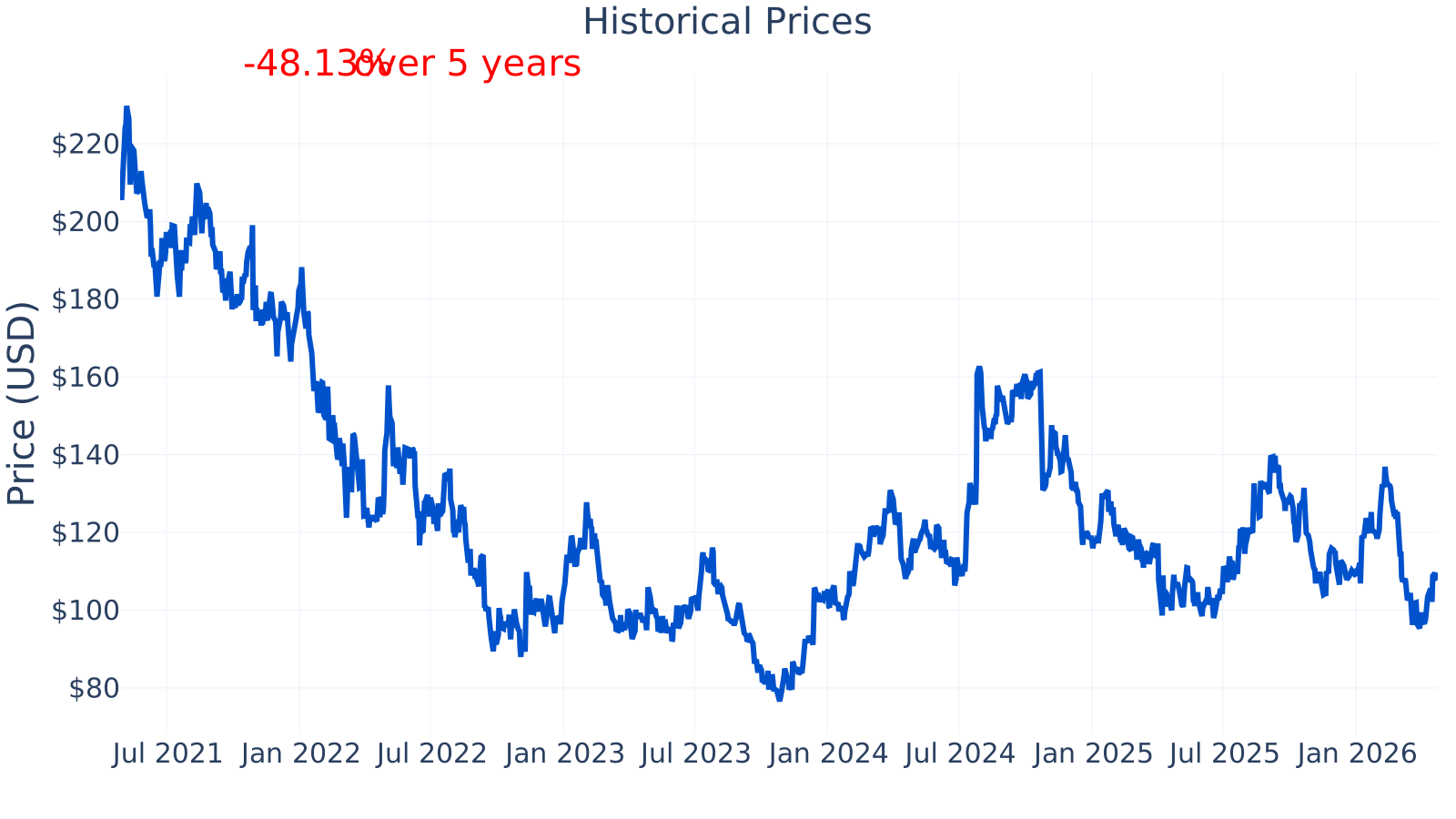
Mohawk’s market capitalization is about $6.6B. The stock’s beta of ~1.25 suggests it has tended to move more than the broader market. On valuation, the company’s P/E ratio is ~18.17 versus an industry median of ~23.43. Profitability and growth are currently somewhat below the industry medians shown here: profit margin ~3.43% (industry median ~3.93%) and year-over-year revenue growth ~2.4% (industry median ~4.3%). Balance-sheet leverage appears lower than the peer median, with debt-to-equity ~33% versus an industry median of about 101%. Trailing twelve-month free cash flow is about $616M.
Growth (Medium)
Flooring is a large, established end market closely linked to residential construction and repair-and-remodel spending, which can be cyclical rather than steadily expanding year after year. In that context, Mohawk’s long-run growth profile is typically shaped by: (1) housing turnover and renovation activity, (2) mix shifts between flooring categories (for example, consumers choosing different hard-surface products), (3) the company’s ability to differentiate through brand, design, quality, service, and manufacturing efficiency, and (4) cost control and productivity programs during weaker demand environments.
Recent quarters show a transition from negative year-over-year revenue growth to modestly positive growth by late 2024 into 2025 (ending near ~2.4%). This pattern is consistent with a business that is recovering from a downturn rather than compounding at high rates.
Free cash flow has remained positive over the periods shown, reaching ~$616M on a trailing basis in the latest metric set. For a manufacturing business, sustained free cash flow can matter because it provides flexibility to reinvest in plants and equipment, reduce debt, or return capital—especially when end-market demand is uneven.
Potential catalysts, based on the company’s business exposure described in filings, generally include a stronger housing and remodeling environment, easing cost pressures (raw materials, energy, freight), and improved utilization of manufacturing capacity. Because Mohawk sells into both residential and commercial channels and across geographies, recoveries may not be perfectly synchronized.
Risks (High)
Mohawk operates in a competitive and cyclical industry where results can change quickly with housing demand, interest rates, and broader economic conditions. When volumes fall, fixed manufacturing and logistics costs can weigh more heavily on margins. In addition, flooring demand can be sensitive to consumer confidence and big-ticket discretionary spending patterns.
Debt-to-equity is currently about 33%, which is below the industry median shown (about 101%). That relatively lower leverage can reduce financial strain during downturns, but it does not remove business-cycle risk (earnings and cash flow can still fluctuate with demand).
Profit margins have been volatile. After strong margins in 2021 (around 9–10% in the periods shown), margins compressed sharply and turned negative through much of 2023 and into mid-2024, before returning to positive territory. Most recently, profit margin is about 3.43%, slightly below the industry median displayed. This history matters because it shows that pricing, costs, and volume changes can materially impact bottom-line results.
Competitive positioning in flooring is influenced by manufacturing scale, product breadth, distribution reach, brand recognition, and the ability to innovate in design and performance. Mohawk is widely described as one of the largest flooring companies globally, which can support purchasing power, manufacturing efficiency, and broad customer coverage. However, size alone is not a guarantee of stable returns, especially when competitors can compete aggressively on price or when customers shift preferences between product categories.
Main competitors vary by product category and geography, but typically include other large global and regional flooring manufacturers and importers (for example, major players in carpet, ceramic tile, luxury vinyl tile, and laminate). Competitive pressure can show up through promotions, lower pricing, and the need for continued investment in product development and capacity.
Additional risks commonly disclosed by manufacturers in this space include input-cost volatility (materials and energy), operational execution (manufacturing disruptions, plant efficiency), supply chain complexity, and regulatory or environmental compliance requirements. Foreign currency effects can also influence reported results for a global company.
Valuation
At around 18x earnings, Mohawk’s current P/E ratio is below the industry median shown in the table (about 23x). The historical pattern indicates the multiple can shift substantially over time, including periods where the P/E becomes less meaningful (for example, when earnings are depressed or negative). As a result, the interpretation of today’s P/E depends heavily on how sustainable current earnings are through a full housing cycle.
With profit margin currently in the low single digits and revenue growth recently modest, a key valuation question is how the market is weighing (1) the company’s recovery from a weak profitability period, (2) the durability of margins as volumes normalize, and (3) the cyclicality of demand. The comparatively lower leverage profile shown by debt-to-equity may be a relevant context point for valuation because it can affect resilience in downturns, but it does not eliminate earnings volatility.
Conclusion
Mohawk Industries is a large, diversified flooring manufacturer whose performance is closely tied to housing and remodeling cycles. The company’s recent financial picture combines modestly positive revenue growth, positive free cash flow, and a return to positive profitability after a period of losses and margin pressure. At the same time, the history of sharp margin swings illustrates meaningful operating leverage and sensitivity to demand and costs.
From a long-term perspective, the core facts to track are whether margins stabilize at healthier levels through the cycle, whether revenue growth can remain consistently positive without heavy discounting, and how effectively the company maintains cost discipline and product competitiveness across its major categories. The stock’s valuation level (as reflected by the P/E shown) is best interpreted alongside these fundamentals and the inherently cyclical nature of the flooring industry.
Sources:
- Mohawk Industries, Inc. — SEC Form 10-K (Annual Report)
- Mohawk Industries, Inc. — SEC Form 10-Q (Quarterly Report)
- SEC EDGAR Database — Mohawk Industries, Inc. filings
- Mohawk Industries — Investor Relations materials (press releases and company-hosted information)
- Wikipedia — “Mohawk Industries” (basic company background)
This article is for informational purposes only and does not constitute financial advice. Some content is AI-generated. See Disclaimer