Stock Analysis · Modine Manufacturing Company (MOD)
Overview
Modine Manufacturing Company designs and makes thermal management products—equipment that moves heat in or out of systems to keep them operating safely and efficiently. In practice, that includes engineered cooling and heating solutions used in vehicles and off-highway equipment, as well as in buildings and industrial applications. The business model is largely “engineer + manufacture,” meaning performance, reliability, and long customer qualification cycles can matter as much as unit price.
Based on the company’s public reporting, Modine organizes its operations into two main reporting segments, which are the primary way it discusses how revenue is generated:
- Climate Solutions (includes heating solutions and HVAC-related products for buildings and other end markets)
- Performance Technologies (includes thermal management products for vehicles and industrial/off-highway applications)
Public filings typically provide the most reliable breakdown by segment and geography. Percentage shares can vary by fiscal year and depend on how the company reports segment results in its latest annual report.
Over the last several fiscal years, the company’s total revenue increased while operating income moved from negative to positive, indicating that profitability improved alongside growth. Gross profit expanded meaningfully as well, suggesting improved pricing, mix, and/or operational execution relative to earlier periods.
Key Figures
| Metric | Value | Industry ⓘ |
|---|---|---|
| Date | Feb 07, 2026 | |
| Context | ||
| Sector | Consumer Cyclical | |
| Industry | Auto Parts | |
| Market Cap ⓘ | $11.38B | |
| Beta ⓘ | 1.70 | |
| Fundamental | ||
| P/E Ratio ⓘ | 117.88 | 25.56 |
| Profit Margin ⓘ | 3.40% | 3.38% |
| Revenue Growth ⓘ | 30.50% | 4.95% |
| Debt to Equity ⓘ | 54.89% | 66.87% |
| PEG ⓘ | 0.90 | |
| Free Cash Flow ⓘ | $7.40M | |
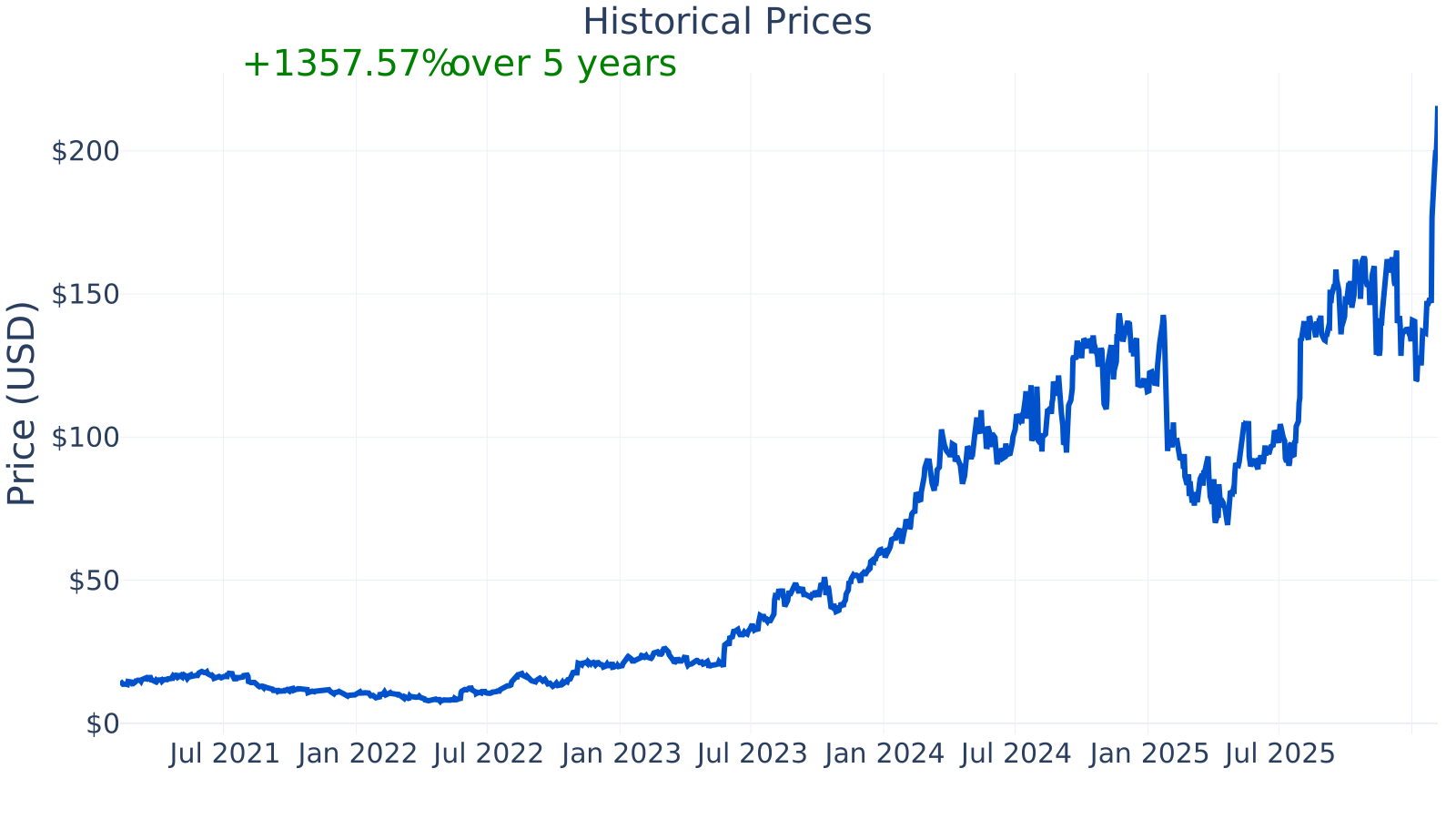
Modine’s market capitalization is about $11.4B, and the stock’s beta of ~1.7 indicates it has tended to move more than the overall market (both up and down). The latest P/E ratio is ~117.9 versus an industry median near 25.6, which signals a much higher earnings multiple than many peers at the same point in time. Profit margin is about 3.4%, roughly in line with the industry median (~3.38%). The most recent year-over-year revenue growth is ~30.5%, well above the industry median (~4.95%). Debt-to-equity is about 54.9%, below the industry median (~66.9%). Trailing twelve-month free cash flow is about $7.4M, which is positive but relatively small compared with the company’s size.
Growth (Medium)
Thermal management is tied to several long-running trends: tighter energy-efficiency standards in buildings, broader electrification and higher power density in equipment, and rising cooling needs in certain industrial settings. These themes can support demand for more advanced heat-transfer products over time, although the pace can be uneven because end markets (especially vehicle-related demand) tend to be cyclical.
From a company-specific perspective, Modine’s recent financial trajectory shows material improvement in scale and profitability. Total revenue rose from about $1.81B (FY2021) to about $2.58B (FY2025), and operating income improved from roughly -$100M to about $280M over the same span. This shift suggests that execution (mix, pricing, productivity, and/or restructuring effects) has been a meaningful contributor to recent results.
Year-over-year revenue growth has been volatile, which is common in industrial and vehicle-exposed businesses, but the most recent reading is a sharp acceleration (about 30.5%). That stands out versus the broader auto parts peer group median in the table, though a single period can be influenced by timing, acquisitions/divestitures, or unusually strong demand in specific programs.
Free cash flow (cash left after operating needs and capital spending) has fluctuated in recent years. It moved from negative in FY2022 (about -$28.8M) to strongly positive in FY2024–FY2025 (about $126M–$129M), and the latest trailing value shown is $7.4M. In plain terms: cash generation has improved versus earlier years, but it has not been consistently high every period, which matters for funding growth investments and reducing debt.
Risks (Medium-High)
Modine operates in competitive, cost-sensitive markets where results can swing with volumes, customer production schedules, and input costs. Parts of the business are linked to vehicle and industrial activity, which can weaken during economic slowdowns. Another recurring risk in manufacturing is execution: ramping programs, maintaining quality, and managing supply chain and commodity-price variability.
The balance sheet leverage shown by debt-to-equity improved substantially from around 96%–109% in 2021 to about 55% most recently. This is also below the industry median in the latest snapshot. Even with improvement, debt remains relevant because interest expense is a real cash cost (interest expense is shown rising from about $19M (FY2021) to about $26M (FY2025) in the income-flow figures), and higher rates can increase the cost of refinancing.
Profitability improved markedly compared with earlier years. Net profit margin was negative in parts of 2021, then became positive and generally strengthened into 2023–2025. The latest margin shown is about 3.4%, close to the industry median. One important detail for long-term analysis is that margins can compress quickly in downturns if volumes fall or if pricing can’t fully offset cost inflation, particularly in OEM-heavy supply chains.
Competitive positioning is typically shaped by engineering know-how, manufacturing scale, customer relationships, and the ability to meet performance specifications over long product lifecycles. Modine competes with a wide set of thermal management and HVAC suppliers depending on end market (vehicle thermal systems, industrial heat exchangers, and building HVAC components). Because competition varies by product line, “leadership” is usually product- and customer-specific rather than a single global share position. A practical advantage for established suppliers is qualification and switching costs: once designed into a platform or building solution, replacements can be inconvenient, but price and performance still matter during new program bids.
Valuation
The valuation picture looks mixed when viewed through common multiples. The latest P/E ratio (~117.9) is far above the auto parts industry median shown (~25.6), and the historical P/E trend also shows a step-up from the single digits/teens earlier in the period to levels around the 30–40 range more recently (with the latest snapshot notably higher). In general terms, higher P/E ratios imply the market is placing a higher value on each dollar of current earnings, which is easier to justify when earnings are expected to grow quickly or when profitability is expected to structurally improve.
At the same time, Modine’s PEG ratio (~0.90) suggests that, relative to an assumed growth rate embedded in that metric, the earnings multiple may not be as extreme as the P/E alone implies. Still, PEG ratios are sensitive to growth assumptions and can change quickly when growth normalizes. Another important cross-check is cash generation: with trailing free cash flow shown at $7.4M (and historically much higher in FY2024–FY2025), it highlights that earnings-based valuation and cash-based valuation can send different signals depending on timing and working-capital swings.
Conclusion
Modine is a thermal management manufacturer with exposure to multi-year efficiency and electrification themes across vehicles, industrial applications, and building-related markets. Financially, the recent multi-year pattern shows higher revenue and a large improvement in operating profitability compared with earlier years, alongside meaningfully lower leverage than in 2021.
The main trade-offs visible in the metrics are (1) cyclicality and execution risk typical of industrial and auto-linked supply chains, (2) margins that have improved but remain relatively modest in the latest period, and (3) a valuation that—based on P/E—appears substantially higher than the peer median, making future outcomes more sensitive to whether growth and profitability improvements persist. A long-term assessment typically depends on how durable the company’s margin gains and cash generation prove to be across a full cycle.
Sources:
- U.S. SEC EDGAR — Modine Manufacturing Company filings (Form 10-K, Form 10-Q, Form 8-K)
- Modine Manufacturing Company Investor Relations — Annual Report materials and investor presentations (company-hosted)
- Wikipedia — “Modine Manufacturing Company” (basic background information)
This article is for informational purposes only and does not constitute financial advice. Some content is AI-generated. See Disclaimer


