Stock Analysis · Mobileye Global Inc (MBLY)
Overview
Mobileye Global Inc. develops driver-assistance and automated-driving technology used by automakers. In simple terms, it sells the “brains” (software and chips) that help cars understand what is happening around them—such as detecting other vehicles, pedestrians, lane markings, and road signs—so the vehicle can warn the driver or take limited actions like braking or steering support.
The company is best known for advanced driver-assistance systems (often abbreviated as ADAS). These features are increasingly common in new vehicles and can range from basic safety alerts to more advanced “hands-free” capabilities, depending on how an automaker designs and markets the vehicle.
Mobileye’s revenue is primarily tied to the automotive production cycle and to how widely safety and assisted-driving features are adopted across new car models. While automakers and suppliers can design vehicles with different sensor mixes (camera, radar, lidar), Mobileye has historically had a strong position in camera-based perception and related software.
Mobileye’s filings typically describe revenue in terms of product and technology offerings rather than a simple consumer-style breakdown. Percentages can vary year to year and by customer program timing, but the major sources can be summarized as:
- ADAS solutions (EyeQ-based systems) sold to automakers and Tier 1 suppliers (the core, largest revenue driver in many periods).
- Software and advanced autonomy offerings (including mapping-related technology and higher-level automated-driving stacks), which are more dependent on multi-year development and production ramps.
Across the years shown, total revenue rose from about $1.386B (2021) to $1.869B (2022) and $2.007B (2023), then declined to about $1.654B (2024) before improving to about $1.894B (2025). A notable theme is that research and development spending is very large relative to revenue, reflecting the long timelines and high engineering intensity of automotive software and semiconductor-related work.
Key Figures
| Metric | Value | Industry ⓘ |
|---|---|---|
| Date | Apr 27, 2026 | |
| Context | ||
| Sector | Consumer Cyclical | |
| Industry | Auto Parts | |
| Market Cap ⓘ | $7.76B | |
| Beta ⓘ | 0.74 | |
| Fundamental | ||
| P/E Ratio ⓘ | N/A | 24.61 |
| Profit Margin ⓘ | -203.97% | 3.56% |
| Revenue Growth ⓘ | 27.40% | 5.40% |
| Debt to Equity ⓘ | 0.56% | 76.35% |
| PEG ⓘ | 0.57 | |
| Free Cash Flow ⓘ | $482.20M | |
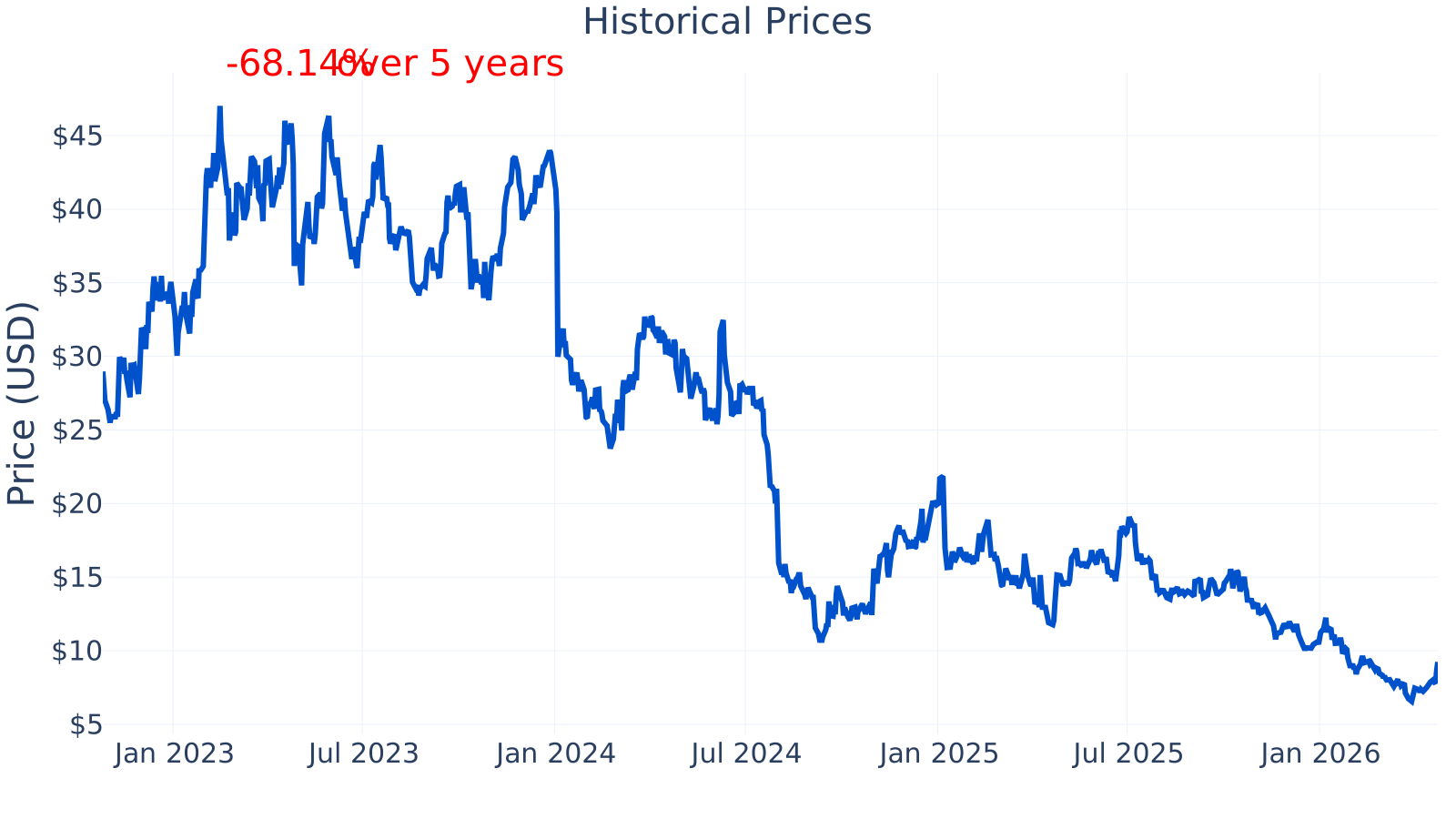
Mobileye’s market capitalization is about $7.8B. The stock’s beta of ~0.74 indicates that, historically, its price has tended to move less than the overall market (though individual stocks can still be volatile for company-specific reasons).
The table also shows a negative profit margin for the most recent period, which contrasts with a positive industry median. At the same time, the company shows positive trailing free cash flow (about $482M), meaning that after operating costs and capital spending, the business generated cash over the trailing period shown.
Growth (Medium)
Mobileye operates in a long-term growth area: vehicle safety and automated-driving capability. Over time, regulators, consumer safety ratings, and competitive pressure among automakers have pushed more assisted-driving features into mainstream vehicles. That creates a structural tailwind for suppliers that can deliver reliable perception and driving policy software at automotive-grade cost and quality.
That said, growth in any single year can be uneven because vehicle programs are planned years in advance, and production volumes can be affected by broader auto industry cycles and inventory adjustments.
The year-over-year revenue growth pattern shown is volatile: it includes periods of contraction (for example, several quarters in 2024 show negative growth) and periods of sharp recovery (for example, a large rebound in early 2025), followed by more mixed results. The most recent point shown is about 27.4% year-over-year growth, which is above the industry median of ~5.4% in the comparison provided. This kind of variability is common when revenue depends on customer production schedules and the timing of new model launches.
Free cash flow improved from about $169M (2024) to about $482M (most recent trailing period shown). In plain language, the business generated more cash after expenses and investment than it did earlier, which can matter because automotive technology programs require sustained spending for many years before reaching peak volume production.
Potential catalysts for longer-term growth typically come from (1) wider adoption of advanced safety/assistance features across more vehicle trims and geographies, and (2) successful launches of more capable systems that carry higher content (more value per vehicle). Because automotive product cycles are slow, these catalysts often play out over multiple years rather than quarters.
Risks (High)
Mobileye faces several risks that can matter for long-term outcomes. First, it is exposed to the auto production cycle: when automakers reduce production, delay model launches, or manage inventory, technology suppliers can see abrupt changes in shipments and revenue timing.
Second, Mobileye’s results show that profitability can be pressured. Large research and development spending is normal in this field, but it raises the bar for future revenue scale and/or gross margin improvement to reach sustained profitability.
The profit margin displayed is negative across the period shown, and the latest value is around -204.0%, compared with an industry median near 3.4%. Extremely negative margins can be influenced by items that are not purely “day-to-day operations” (for example, significant accounting charges), but regardless of cause, the chart indicates that profitability has been a key challenge versus typical auto parts peers.
Third, competition is intense and comes from multiple directions:
- Automotive semiconductor and ADAS platform providers that offer chips plus software ecosystems (competing on performance, cost, power efficiency, and developer tools).
- Tier 1 suppliers building integrated ADAS systems for automakers, sometimes with in-house software layers.
- Automakers developing more software internally, aiming to control core driving features and the user experience.
Mobileye’s competitive advantages often discussed in company materials include long experience in automotive-grade computer vision, a large installed base across vehicle programs, and a product roadmap that spans basic ADAS to more advanced automated-driving solutions. The key question is execution: converting technology leadership into durable production wins, attractive unit economics, and sustained profitability while competitors invest heavily.
The balance sheet leverage shown is very low: the latest debt-to-equity value is about 0.56%, compared with an industry median near 76.35%. Lower leverage can reduce financial risk during industry slowdowns, although it does not remove operating risks such as pricing pressure, program delays, or changes in automaker strategy.
Valuation
A common valuation shortcut is the price-to-earnings (P/E) ratio, but the P/E values shown for Mobileye are not meaningful in the period displayed (they appear as 0, which typically happens when earnings are negative or when the ratio is otherwise not interpretable). In contrast, the industry median P/E shown is generally in the mid-teens to low-20s range over time, reflecting that many peers have positive earnings.
In practice, when a company has negative earnings, valuation discussions often shift toward other yardsticks (such as revenue multiples, gross profit trends, cash generation, and the credibility of a path to sustained profitability). The figures in this article show a business that can generate positive free cash flow while also reporting weak net profitability in the period shown, which can make simple comparisons to traditional “profitable peer” valuation metrics less straightforward.
Conclusion
Mobileye is positioned in a long-term theme: making vehicles safer and progressively more automated. The company’s business is tied to multi-year automaker programs, which can support growth when new systems scale into high-volume production, but can also create uneven results across quarters and years.
The main points that stand out from the information discussed are: (1) revenue has grown over multi-year periods but with noticeable variability, (2) research and development spending is substantial, consistent with an innovation-heavy strategy, (3) profitability has been weak in the period shown (with very negative margins), and (4) balance sheet leverage appears very low compared with industry norms, while free cash flow has recently improved.
Whether the current stock price is “expensive” or “cheap” cannot be concluded from a standard P/E comparison here because earnings-based valuation is not currently informative. A more complete assessment typically depends on how one weighs long-term adoption of advanced driver-assistance, Mobileye’s competitive position versus alternative platforms, and the company’s ability to translate its technology roadmap into sustained profitability over time.
Sources:
- SEC EDGAR — Mobileye Global Inc. Form 10-K (Annual Report)
- SEC EDGAR — Mobileye Global Inc. Form 10-Q (Quarterly Reports)
- Mobileye Investor Relations — SEC Filings & Shareholder Materials (company-hosted)
- Wikipedia — “Mobileye” (basic company background)
This article is for informational purposes only and does not constitute financial advice. Some content is AI-generated. See Disclaimer