Stock Analysis · Mister Car Wash Inc (MCW)
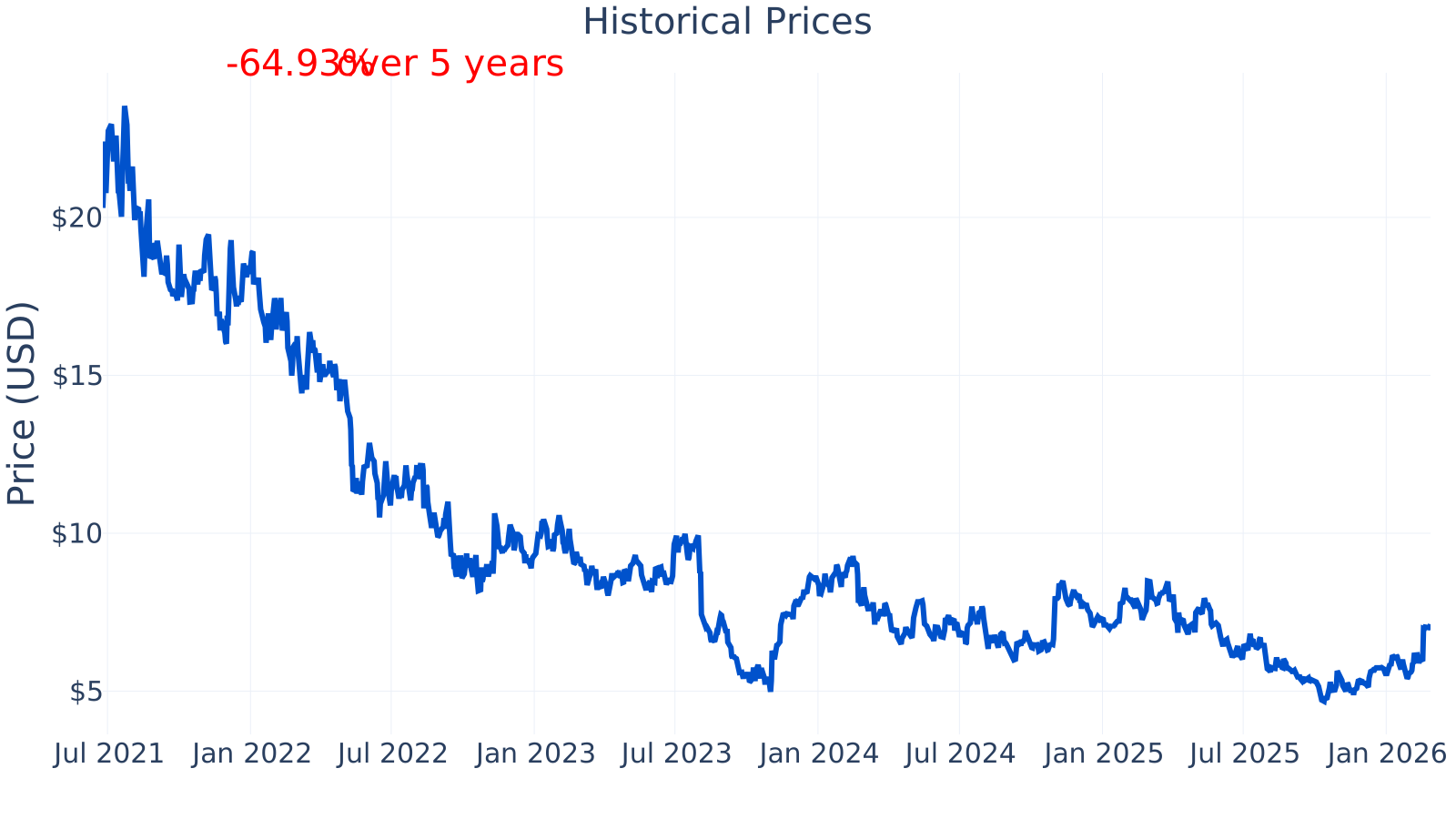
Overview
Mister Car Wash Inc. (MCW) operates a network of car wash locations in the United States. The company focuses on providing exterior and interior cleaning services through a standardized, multi-site operating model. A key part of the business is selling recurring wash plans (membership-style subscriptions), alongside single-visit washes and related services.
In practical terms, the business is driven by (1) how many cars it can serve at each location, (2) how many customers enroll in recurring plans, and (3) how effectively it can operate sites with consistent service quality and cost control.
Main revenue sources are generally described as:
- Unlimited wash / recurring plans (subscription-like memberships)
- Retail (single-visit) washes
- Detailing and other ancillary services (where offered)
Public filings typically emphasize the importance of recurring plans, but exact percentages by revenue stream may vary by period and are not always presented as a simple split in headline disclosures.
Across the years shown, total revenue rises from about $758 million (2021) to about $1.052 billion (2025). Over the same period, operating income moves from slightly negative in 2021 to consistently positive thereafter (roughly $178–$200 million in 2023–2025), while interest expense is a meaningful recurring cost (tens of millions per year).
Key Figures
| Metric | Value | Industry ⓘ |
|---|---|---|
| Date | Mar 02, 2026 | |
| Context | ||
| Sector | Consumer Cyclical | |
| Industry | Auto & Truck Dealerships | |
| Market Cap ⓘ | $2.34B | |
| Beta ⓘ | 1.47 | |
| Fundamental | ||
| P/E Ratio ⓘ | 22.97 | 19.65 |
| Profit Margin ⓘ | 9.80% | 2.54% |
| Revenue Growth ⓘ | 4.00% | 3.90% |
| Debt to Equity ⓘ | 85.90% | 157.49% |
| PEG ⓘ | N/A | |
| Free Cash Flow ⓘ | $78.36M | |
Mister Car Wash’s market capitalization is about $2.34 billion. The stock’s beta (~1.47) suggests it has tended to fluctuate more than the overall market. The P/E ratio (~23.0) is above the industry median (~19.6), while the profit margin (~9.8%) is notably higher than the industry median (~2.5%). Revenue growth year over year is about 4.0%, close to the industry median (~3.9%). Debt-to-equity is about 85.9%, below the industry median (~157.5%). Trailing twelve-month free cash flow is shown at about $78.4 million (and it has been volatile over time, discussed below).
Growth (Medium)
Car washing is often viewed as a recurring, service-based category: vehicles need ongoing cleaning and maintenance regardless of broader consumer trends, although demand and “trade-down” behavior can still shift between premium and basic offerings. Mister Car Wash’s long-term growth logic is typically tied to expanding its store base, increasing the mix of recurring plans, and improving throughput and efficiency at each site.
Year-over-year revenue growth is positive throughout the period shown, but it slows materially from early 2022 levels (above 10%–25% in several quarters) to more moderate rates in recent quarters (roughly mid-single digits, ending near ~4%). This pattern can be consistent with a business moving from a higher-growth phase into a more mature, steadier growth profile—unless new expansion or operational initiatives re-accelerate growth.
Free cash flow has swung from positive (around $74–$80 million in 2021–2022) to negative in 2023–2025 (including about -$142 million in 2024), then back toward improvement by the most recent trailing figure shown elsewhere in the metrics list. In businesses that build or acquire locations, free cash flow can be heavily influenced by the pace of investment (new sites, remodels, equipment) rather than only by near-term profitability. For long-term analysis, a key question is whether new investment reliably translates into durable future cash generation once expansion spending moderates.
Potential catalysts, as described in company communications and filings, commonly include continued unit growth (opening additional locations), optimization of the membership program to increase recurring revenue, and productivity improvements (better staffing models, chemical and utility usage efficiency, and leveraging scale in procurement). The strength of these catalysts ultimately depends on execution and local market demand.
Risks (Medium)
A car wash chain faces a mix of local competition and operational execution risk. Demand can be affected by weather patterns and seasonality (rain, drought conditions, harsh winters), and by regional economic conditions that influence consumer discretionary spending. Since operations are distributed across many sites, consistency in staffing, service quality, and uptime matters; disruptions at scale can affect margins.
The debt-to-equity ratio trends down substantially over the period shown, moving from above 200% in 2021–2024 to around 86% by late 2025. This is also below the industry median shown. Even with this improvement, debt still matters because interest expense is a recurring cost, and changes in interest rates and refinancing terms can affect net results and flexibility for expansion.
Profit margin improves from negative in 2021 to strongly positive from 2022 onward, then settles into a more stable range. By late 2025 it is around 9.8%, which is higher than the industry median displayed. At the same time, margins have moved lower from peaks seen in 2022 (mid-teens). This can happen as costs normalize, as the company invests in growth, or as competitive intensity increases. The durability of margins depends on pricing power, customer retention in recurring plans, and cost discipline (labor, utilities, chemicals, and site-level overhead).
Competitive advantages for a large chain can include brand recognition in its markets, the convenience of many locations, and operating scale (purchasing, marketing, and standardized processes). A recurring plan base can also reduce revenue volatility compared with purely single-visit models. However, car washing often remains locally competitive because independent operators and regional chains can compete on price, location, and service formats.
Main competitor types include:
- Local independent car washes (often competing on nearby convenience and price)
- Regional chains with multi-site footprints in overlapping geographies
- Gas station / convenience store washes (often bundled with fuel traffic)
Relative positioning is typically strongest where Mister Car Wash has dense coverage and brand familiarity. In newer markets, customer acquisition and membership conversion may be harder and can pressure near-term returns on new sites.
Valuation
Valuation is often discussed through multiples such as the price-to-earnings (P/E) ratio. For businesses with steady services and recurring revenue elements, the market may assign higher multiples when earnings quality is viewed as durable and growth is expected to remain consistent.
The P/E ratio shown for MCW has generally ranged from the high teens to the 30s during the period displayed, with the latest reading near ~18.7 on the timeline and about ~23.0 in the latest metrics snapshot. The industry median displayed varies widely over time and is sometimes meaningfully lower, though it rises sharply in some more recent points on the chart. Interpreting this comparison requires caution because “industry” groupings can include companies with very different business models and earnings patterns.
At a high level, a higher-than-median P/E can be consistent with expectations of steadier earnings, stronger margins, or a more scalable model. On the other hand, the recent revenue growth readings shown are in the mid-single digits, and free cash flow has been volatile—two factors that can weigh on how easily a higher multiple is sustained over time.
Conclusion
Mister Car Wash is a scaled operator in a recurring service category, with a business model that emphasizes a large network of locations and recurring wash plans. Over the years shown, revenue rises to above $1.0 billion annually, profitability becomes positive and remains so, and profit margins are higher than the industry median displayed.
The main open questions for long-term-oriented readers are less about whether cars will continue to be washed, and more about execution: whether the company can expand locations and memberships while keeping unit economics strong, and whether cash generation becomes consistently positive after periods of heavier investment. Balance-sheet leverage, while improved versus earlier years in the chart, remains a factor due to ongoing interest costs. The valuation metrics shown place MCW somewhat above the industry median on earnings multiples, which puts more weight on continued operational delivery and sustained profitability.
Sources:
- U.S. Securities and Exchange Commission (SEC) EDGAR — Mister Car Wash Inc filings (Form 10-K, Form 10-Q)
- Mister Car Wash — Investor Relations materials and SEC filing documents (company-hosted)
- Wikipedia — “Mister Car Wash” (basic company background)
This article is for informational purposes only and does not constitute financial advice. Some content is AI-generated. See Disclaimer


