Stock Analysis · MillerKnoll Inc (MLKN)
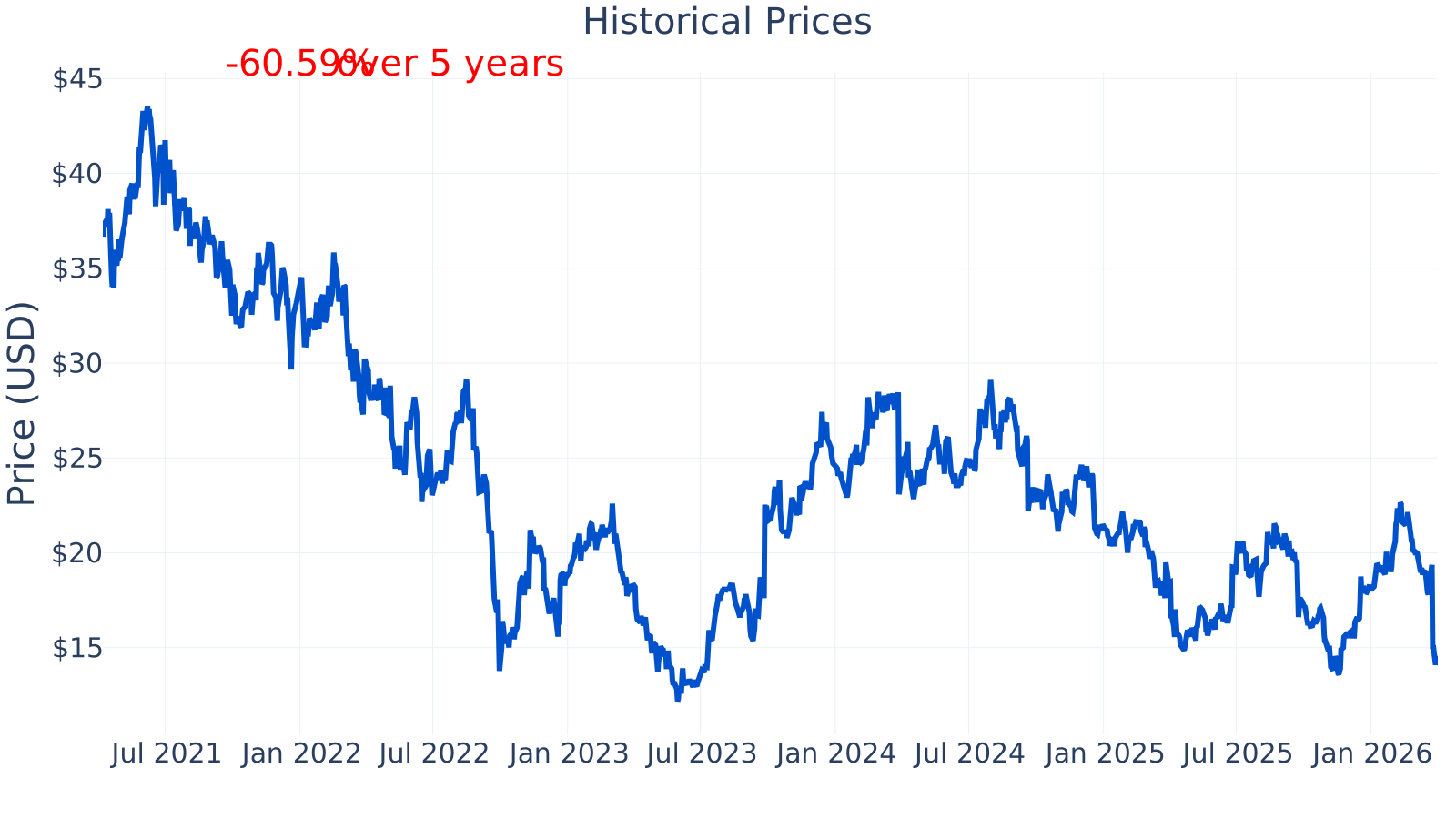
Overview
MillerKnoll Inc. (MLKN) is a furniture and interior solutions company best known for its design-focused brands (including Herman Miller and Knoll). It sells products and services used in workplaces (office systems, seating, and related interiors), as well as products for the home and other spaces. Its business is tied to how organizations design and refresh offices and how consumers spend on higher-end furnishings.
In its public filings, MillerKnoll describes revenue coming from selling furniture and related products and services through multiple channels (for example, direct sales to organizations, dealers, and retail/e-commerce for consumer-oriented lines). The company’s mix can shift over time depending on demand from commercial customers versus homeowners, and by region.
Because exact, up-to-date revenue percentages by product line/channel are not included in the provided figures here, the key takeaway is that MillerKnoll is primarily driven by:
- Workplace / contract furniture and interior projects (typically the largest driver in the category overall, influenced by corporate spending cycles)
- Seating, systems, and ancillary products sold as part of broader workspace solutions
- Retail and e-commerce sales tied to consumer demand for premium home furnishings
Across recent fiscal years shown, total revenue peaked around fiscal 2023 (~$4.09B) and then stepped down in fiscal 2024–2025 (~$3.63B–$3.67B). Operating income remained positive in these years, while net income swung between profit and loss, suggesting that non-operating items (such as interest expense) and other factors can materially affect bottom-line results.
Key Figures
| Metric | Value | Industry ⓘ |
|---|---|---|
| Date | Apr 06, 2026 | |
| Context | ||
| Sector | Consumer Cyclical | |
| Industry | Furnishings, Fixtures & Appliances | |
| Market Cap ⓘ | $988.01M | |
| Beta ⓘ | 1.40 | |
| Fundamental | ||
| P/E Ratio ⓘ | 96.33 | 21.13 |
| Profit Margin ⓘ | 0.28% | 3.93% |
| Revenue Growth ⓘ | 5.80% | 4.30% |
| Debt to Equity ⓘ | 133.45% | 100.56% |
| PEG ⓘ | 0.52 | |
| Free Cash Flow ⓘ | $83.10M | |
MillerKnoll’s market capitalization is about $1.0B, placing it in the small-to-mid size range among public companies. The stock’s beta (~1.40) indicates it has tended to move more than the broader market. The company shows year-over-year revenue growth of ~5.8% (above the industry median ~4.3%), but its profit margin is ~0.28%, well below the industry median (~3.93%), highlighting that recent profitability has been thin. Leverage is notable: debt-to-equity is ~133% versus an industry median near 101%. Trailing twelve-month free cash flow is ~$83M.
Growth (Medium)
MillerKnoll operates in the furnishings industry, which is generally mature and cyclical rather than consistently high-growth. Demand tends to rise and fall with business investment (office buildouts and renovations), consumer confidence, and real estate activity. A key structural question for the sector is how “hybrid work” changes long-term office space needs: this can reduce some traditional demand, but it can also reshape it toward reconfigured collaboration spaces, higher-quality seating, and more frequent re-stacking of offices.
The year-over-year revenue pattern shows a surge in 2021–2022 (very high growth rates), followed by a contraction through much of 2023–2024, and then a return to modest growth more recently (latest reading around +5.8%). For long-term expectations, this history suggests that results can be heavily influenced by the cycle (post-pandemic normalization, commercial project timing, and discretionary spending) rather than a smooth upward trajectory.
Free cash flow has been positive recently but volatile over the period shown: from negative in early 2022 (about -$68.5M) to a high in early 2024 (about $269.9M), then down to $83.1M most recently. For a furniture manufacturer and integrator, this kind of variability can reflect changing working capital needs (inventory and receivables), demand swings, and restructuring or integration-related spending.
Potential catalysts mentioned in company communications and filings for businesses like MillerKnoll typically include normalization of order patterns, improving project pipelines, cost actions, and product refresh cycles. However, the realized impact depends on broader economic conditions and on the company’s ability to protect margins while competing for volume.
Risks (High)
A major risk for MillerKnoll is cyclicality: office furniture demand can drop when companies delay capital spending, and consumer demand can weaken when discretionary budgets tighten. Another key risk is pricing and input cost pressure (materials, freight, and labor), which can compress margins when costs rise faster than prices.
Leverage is a meaningful consideration. The company’s debt-to-equity ratio has generally trended above the industry median in recent years and sits around 133% most recently (versus an industry median near 101%). Higher leverage can increase sensitivity to interest rates and reduce flexibility during downturns, especially when demand softens.
Profitability has also been a pressure point. The net profit margin has swung from positive levels earlier in the period to negative in parts of 2025, and it stands at about 0.28% most recently—below the industry median (about 3.68% at the latest point shown). Thin margins leave less room for execution missteps or unexpected cost increases.
On competitive position, MillerKnoll benefits from well-known brands, design reputation, and relationships with dealers, architects, and corporate buyers. These are real advantages in premium categories where aesthetics, ergonomics, and specification matter. That said, the company operates in a competitive market with other established office furniture manufacturers and a long tail of regional and niche players. In many projects, competition can come down to price, lead times, and the ability to deliver large installations reliably.
Additional risks commonly highlighted in filings for companies in this space include supply chain disruption, demand forecasting errors (leading to excess inventory), execution risk on cost initiatives, and the possibility that workplace utilization trends reduce the size or frequency of office renovations over time.
Valuation
The latest P/E ratio shown is ~96.3, far above the industry median of ~21.1. In general, a high P/E can occur when earnings are temporarily depressed (making the “E” small), when the market expects a sharp rebound in future earnings, or when one-time items distort trailing results. The historical P/E line also shows large swings and periods where the P/E is not meaningful (set to 0 in the chart), which is consistent with uneven earnings over time.
Given the combination of thin recent net margins, meaningful leverage, and cyclical end markets, valuation readings that rely on current earnings can be difficult to interpret without a clear view of normalized profitability. In such cases, investors often also look at longer-term margin stability and cash flow consistency, since those fundamentals help explain whether elevated multiples are driven by temporarily low earnings or by durable improvements in operating performance.
Conclusion
MillerKnoll is a well-known, design-led furnishings company with meaningful exposure to workplace environments and premium home categories. Recent results show modest revenue growth returning, but also very thin net profitability compared with the industry median and a higher-than-median debt load, both of which increase sensitivity to economic slowdowns and execution challenges.
From a long-term perspective, the company’s brand portfolio and presence in spec-driven commercial projects can support resilience, but the overall industry remains cyclical and closely tied to corporate and consumer spending patterns. The current valuation signals (notably the high trailing P/E) appear heavily influenced by the recent earnings profile, making profitability normalization and balance-sheet trajectory especially important context points when interpreting the stock’s pricing.
Sources:
- U.S. SEC EDGAR — MillerKnoll Inc. filings (Form 10-K, Form 10-Q)
- MillerKnoll Investor Relations — SEC filings and investor materials (company-hosted)
- Wikipedia — “MillerKnoll” (basic company background)
This article is for informational purposes only and does not constitute financial advice. Some content is AI-generated. See Disclaimer


