Stock Analysis · Micron Technology Inc (MU)
Overview
Micron Technology Inc is a U.S.-based semiconductor company focused on memory and storage. In simple terms, it makes the chips that help devices and data centers “remember” information and move it quickly. Micron’s products are used in servers (including systems built for artificial intelligence workloads), personal computers, smartphones, automobiles, and many industrial and consumer devices.
Micron’s business is mainly organized around two core product types:
- DRAM (dynamic random-access memory): “Working memory” used to run applications smoothly, especially important in servers and PCs.
- NAND (flash memory): Storage memory used in solid-state drives (SSDs) and many consumer electronics.
Because memory chips are widely used across technology, Micron’s demand tends to be tied to large end-markets such as data centers, PCs, smartphones, and automotive electronics. Revenue mix can also shift meaningfully from year to year depending on the memory cycle (pricing and demand changes) and which end-markets are strongest.
The multi-year income breakdown highlights how results can swing sharply in the memory industry: revenue and profits expanded strongly into 2022, then compressed substantially in 2023 as industry conditions weakened, before improving again by 2025. Over the same period, spending on research and development remained substantial, reflecting the ongoing need to invest to stay competitive in advanced memory technologies.
Key Figures
| Metric | Value | Industry ⓘ |
|---|---|---|
| Date | Feb 06, 2026 | |
| Context | ||
| Sector | Technology | |
| Industry | Semiconductors | |
| Market Cap ⓘ | $430.95B | |
| Beta ⓘ | 1.50 | |
| Fundamental | ||
| P/E Ratio ⓘ | 36.36 | 42.89 |
| Profit Margin ⓘ | 28.15% | 8.14% |
| Revenue Growth ⓘ | 56.70% | 12.35% |
| Debt to Equity ⓘ | 21.24% | 25.62% |
| PEG ⓘ | 0.67 | |
| Free Cash Flow ⓘ | $11.91B | |
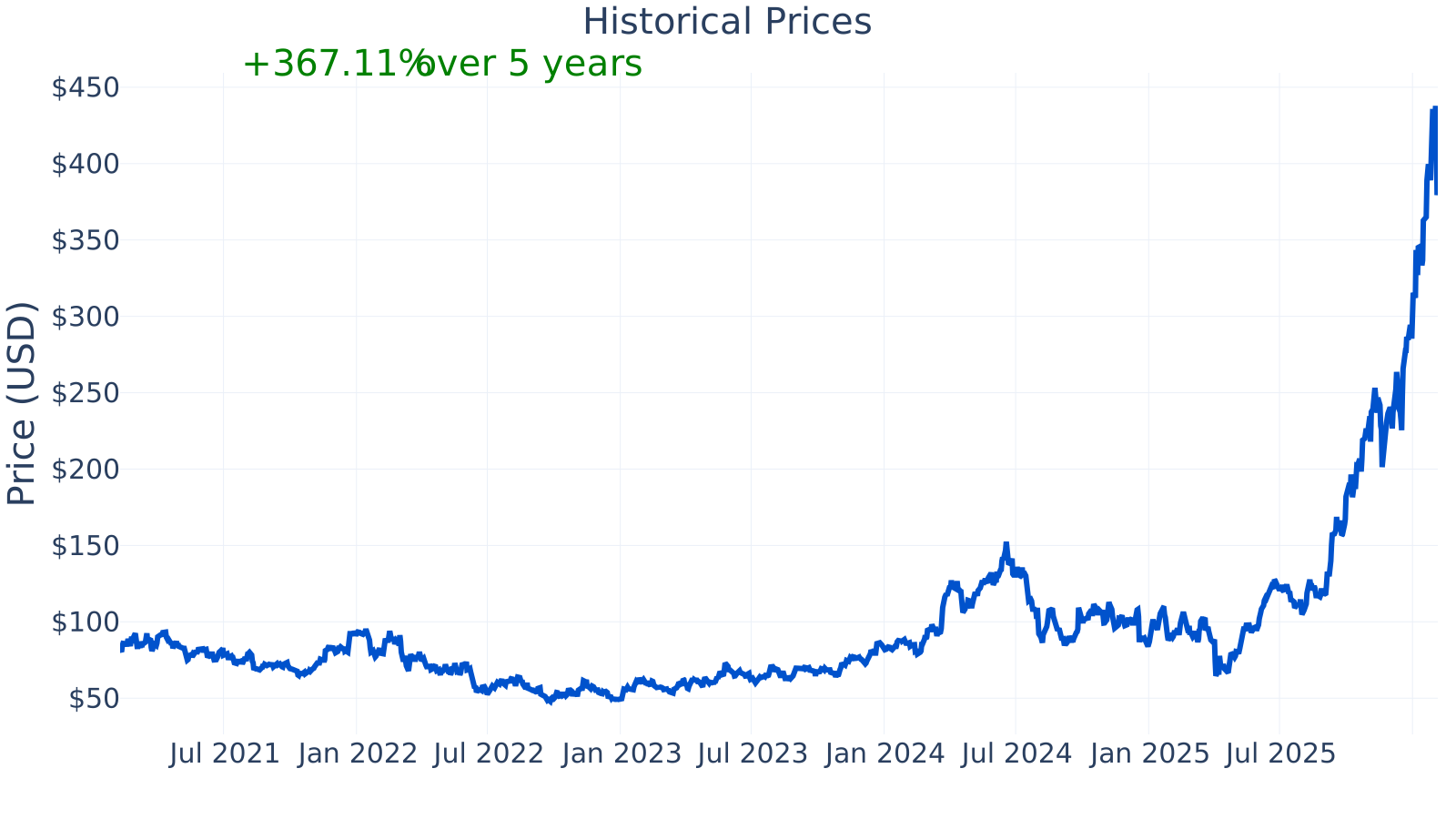
Micron’s market capitalization is about $431B, and its beta (~1.5) indicates the stock has historically moved more than the overall market (higher volatility). The latest P/E ratio is ~36.4, below the semiconductor industry median shown here (~42.9), while profit margin is ~28.1%, well above the industry median (~8.1%). Recent year-over-year revenue growth is ~56.7%, also far above the industry median (~12.4%), and debt-to-equity is ~21%, slightly below the industry median (~25.6%). Trailing twelve-month free cash flow is about $11.9B, reflecting a rebound from weaker cash generation during the down part of the cycle.
Growth (Medium)
Micron operates in an industry with long-term growth drivers: more data creation, more computing, and more connected devices all tend to increase memory needs over time. In addition, modern workloads—especially in large-scale data centers—often require very large pools of high-performance memory, which can increase the amount of memory per server over time.
At the same time, memory is known for pronounced cycles. Industry-wide expansions in manufacturing capacity can lead to periods of oversupply, which pushes prices down and can quickly reduce revenue and profitability. When demand improves and supply tightens, pricing can recover and results can rebound. This cyclical pattern is a central feature of Micron’s growth profile.
The year-over-year revenue growth pattern shows that Micron can move from steep declines to rapid growth within a relatively short period. After deep contraction during 2022–2023, growth turned positive and accelerated, reaching roughly 56.7% most recently—well above the broader semiconductor industry median shown alongside it. This kind of swing is consistent with a memory upcycle rather than a steady, linear growth path.
Free cash flow also reflects the same cyclicality. It was negative in parts of the downturn (for example, around early 2024), then improved significantly to about $11.9B in the trailing twelve months. For long-term analysis, this matters because Micron must fund heavy manufacturing and technology investment; stronger cash generation provides more flexibility through weaker periods.
Strategy-wise, Micron emphasizes advanced process technology, new memory generations, and product mix improvements. In practice, that means attempting to sell more high-value memory (such as higher-performance solutions for data centers and other demanding uses) rather than competing only on commodity pricing. If that mix shift persists, it can support stronger profitability during favorable parts of the cycle.
Risks (High)
This article is for informational purposes only and does not constitute financial advice. Some content is AI-generated. See Disclaimer