Stock Analysis · MicroStrategy Incorporated (MSTR)
Overview
MicroStrategy Incorporated is a software company best known for enterprise analytics and business intelligence tools. In recent years, it has also become widely associated with a second, separate pillar: a corporate strategy of holding a large amount of bitcoin on its balance sheet. In simple terms, the company combines (1) a traditional software business that sells products and services to organizations and (2) a significant treasury position whose value can rise or fall based on bitcoin’s market price.
MicroStrategy’s revenue is primarily tied to its software offering and related services. Based on the company’s reporting categories in its SEC filings, the main revenue streams generally include:
- Product licenses and subscription services (software access, including term subscriptions and cloud-related offerings)
- Product support (maintenance and support contracts)
- Other services (consulting, training, and related professional services)
Percentages can vary by period and are best read directly from the latest annual report (Form 10-K) where the company breaks out revenues by category.
The financial picture can look unusual compared with many software peers because accounting gains and losses tied to bitcoin holdings (and the financing used to acquire them) can materially affect reported profitability, even when the underlying software business changes only modestly.
Across the years shown, total revenue stays in a relatively narrow range (roughly the mid-$400M to ~$500M area), while operating expenses swing substantially—helping explain why operating income and net income can vary widely from year to year.
Key Figures
| Metric | Value | Industry ⓘ |
|---|---|---|
| Date | May 08, 2026 | |
| Context | ||
| Sector | Technology | |
| Industry | Software - Application | |
| Market Cap ⓘ | $63.01B | |
| Beta ⓘ | 3.60 | |
| Fundamental | ||
| P/E Ratio ⓘ | 5.88 | 26.40 |
| Profit Margin ⓘ | N/A | 7.95% |
| Revenue Growth ⓘ | 11.90% | 15.60% |
| Debt to Equity ⓘ | 0.30% | 27.14% |
| PEG ⓘ | 2.85 | |
| Free Cash Flow ⓘ | -$11.81B | |
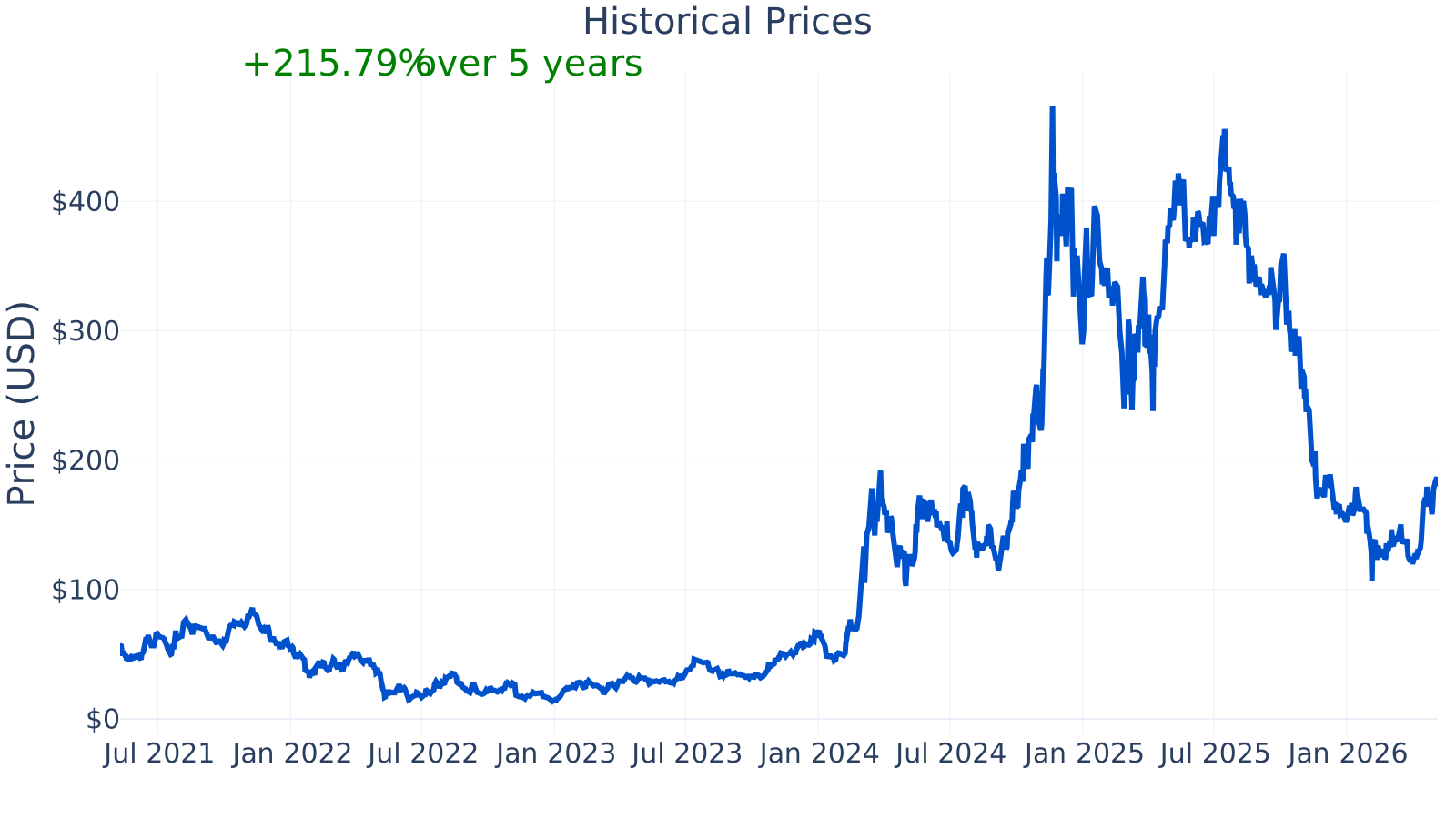
MicroStrategy’s market capitalization is about $63.0B, and its beta of ~3.60 indicates the stock has historically moved much more than the broader market. The company’s P/E ratio is ~5.9 versus an industry median near 26.4, but this metric can be hard to interpret here because earnings may be heavily influenced by bitcoin-related accounting effects and financing costs. Reported profit margin is ~0% versus an industry median near 8%, and free cash flow (TTM) is about -$11.8B, which suggests substantial cash outflows over the trailing twelve months (often linked to financing and bitcoin acquisition activity rather than typical software operating needs). Revenue growth year-over-year is about 11.9%, somewhat below the industry median near 15.6%.
Growth (Medium)
MicroStrategy participates in the enterprise software market, where long-term demand is supported by ongoing needs for data analysis, reporting, governance, and productivity improvements. That said, the company’s reported revenue in recent years has been relatively stable rather than consistently compounding at high rates, which is a different profile from many fast-growing software businesses.
A major driver of perceived “growth” for the overall equity story has often been the company’s bitcoin-focused treasury strategy. When bitcoin prices rise, the market value of MicroStrategy’s holdings can increase and can influence how market participants value the company. This dynamic can act as a catalyst, but it is fundamentally different from operational growth in customers, recurring subscription revenue, or software market share.
The year-over-year revenue growth line shows periods of contraction and modest expansion, with more recent quarters turning positive. Even so, the overall pattern looks more like a mature or slow-growing software business than a consistently high-growth one.
Free cash flow is deeply negative across the periods shown, with especially large outflows in the most recent years. For a typical software company, this would often raise questions about operating efficiency or heavy investment. For MicroStrategy, readers usually need to separate “software operations” from “capital allocation activity,” because significant cash movements can reflect financing and bitcoin purchases rather than day-to-day software spending.
Risks (Very High)
The most distinctive risk is that MicroStrategy’s results and stock behavior can be dominated by bitcoin price volatility. This can create large swings in reported earnings, equity value, and investor sentiment that may not correlate with the performance of the underlying software business.
Another key risk is financial structure and funding strategy. The company has historically used various forms of financing to support its treasury approach, and that can introduce refinancing risk, interest expense burden, and sensitivity to capital market conditions. Even when accounting ratios look low at a point in time, investors typically look beyond a single snapshot and consider how quickly leverage and obligations could change if strategy or market conditions shift.
Debt-to-equity trends dramatically downward over time in the chart, ending near 0.3% versus an industry median around 35%. While that final point appears conservative, the earlier volatility in the series suggests the balance sheet relationship between debt and equity has not been stable historically, which can happen when equity values (and retained earnings) move sharply.
Profitability is another area of uncertainty. The company’s net income and margins can be heavily influenced by items that are not purely tied to software sales (including accounting impacts related to bitcoin and the costs of financing).
Profit margin swings widely, including very large negative periods and large positive periods. Compared with the industry median (which is consistently positive in the mid-single digits), MicroStrategy’s margin profile looks much less stable and therefore harder to extrapolate.
On competitive positioning, MicroStrategy operates in a crowded analytics and business intelligence landscape with well-established platforms and extensive ecosystems. Competitors commonly cited in this space include large suite providers and cloud-centric analytics vendors. In practice, many enterprises standardize analytics within broader cloud or productivity stacks, which can be a challenge for smaller, more specialized vendors. MicroStrategy’s differentiation has historically centered on its analytics capabilities and enterprise deployments, but it is not generally viewed as the dominant market leader in modern BI the way the largest platform vendors are.
Valuation
The P/E ratio shown (with a current value around 5.9, below the software industry median) can look “low” on the surface. However, for MicroStrategy this figure may be less informative than usual because earnings can be distorted by bitcoin-related accounting impacts and financing costs, which may not reflect the underlying economics of the software segment in a steady way.
As a result, valuation discussions often shift from traditional software multiples (based on recurring revenue and operating margins) toward a blended view: the software business plus the market value and risk profile of bitcoin exposure, plus the costs and constraints of the company’s funding approach. In that context, whether the stock price appears expensive or inexpensive depends heavily on how much weight one assigns to the bitcoin treasury strategy versus the long-term cash-generating potential of the core software operations, and how one views the sustainability of the company’s capital structure through market cycles.
Conclusion
MicroStrategy combines a relatively steady enterprise software business with a high-volatility bitcoin treasury strategy that can dominate financial results and stock behavior. The company operates in a large, durable software category, but its reported revenue growth appears modest and its profitability and cash flow patterns have been highly unstable in recent years.
From a long-term perspective, the central question is less about typical software execution alone and more about the ongoing impact of bitcoin price movements, funding choices, and the resulting volatility in earnings, cash flows, and balance sheet metrics. Readers evaluating the company’s long-run fundamentals often separate the software segment’s performance from the treasury strategy and consider whether the combined risk profile matches their own tolerance for large swings and complex drivers.
Sources:
- U.S. Securities and Exchange Commission (SEC EDGAR) — MicroStrategy Incorporated filings (Form 10-K, 10-Q, 8-K)
- MicroStrategy Incorporated — Investor Relations materials and SEC filing archives (including annual reports and shareholder communications)
- Wikipedia — “MicroStrategy” (basic company background and history)
This article is for informational purposes only and does not constitute financial advice. Some content is AI-generated. See Disclaimer


