Stock Analysis · Soho House & Co Inc (SHCO)
Overview
Soho House & Co Inc is a hospitality and membership company built around private members’ clubs (“Houses”), bedrooms (short-stay accommodation inside some Houses), and a broader lifestyle ecosystem that includes food and beverage, events, and consumer-facing brands. The concept is designed to combine a “club” experience (membership access and community) with hotel-like stays and on-site spending.
In its SEC filings, the company describes revenue as coming primarily from membership-related income and on-site spending tied to its physical locations (for example, rooms and food & beverage). It also generates revenue from other activities (such as licensing/other brand activities), which are typically smaller relative to the core club and hospitality operations. Exact percentage splits can vary by period and are best read directly from the company’s segment and revenue disclosures in its annual report.
Main revenue streams (typical structure as described in filings):
- Membership (initiation and annual dues, depending on membership type)
- In-house spend at locations (food & beverage, events, and other on-site purchases)
- Rooms (accommodation at Houses with bedrooms and at related properties)
- Other / brand-related revenue (generally smaller and more variable)
The business model is relatively asset-heavy compared with “pure” digital subscription businesses because Houses and bedrooms require long-term leases or owned real estate, build-outs, staffing, and ongoing maintenance. That tends to make results sensitive to occupancy, member utilization, and operating costs.
Across 2021–2024, total revenue increased materially (from about $561M in 2021 to about $1.204B in 2024). Over the same period, operating income remained negative, and interest expense stayed sizable (roughly $71M–$84M per year), which helps explain why net income remained negative even as revenue grew.
Key Figures
| Metric | Value | Industry ⓘ |
|---|---|---|
| Date | Mar 16, 2026 | |
| Context | ||
| Sector | Consumer Cyclical | |
| Industry | Lodging | |
| Market Cap ⓘ | $1.76B | |
| Beta ⓘ | 0.69 | |
| Fundamental | ||
| P/E Ratio ⓘ | N/A | 29.20 |
| Profit Margin ⓘ | -6.00% | 15.95% |
| Revenue Growth ⓘ | 11.20% | 7.00% |
| Debt to Equity ⓘ | -713.34% | 44.41% |
| PEG ⓘ | N/A | |
| Free Cash Flow ⓘ | $25.53M | |
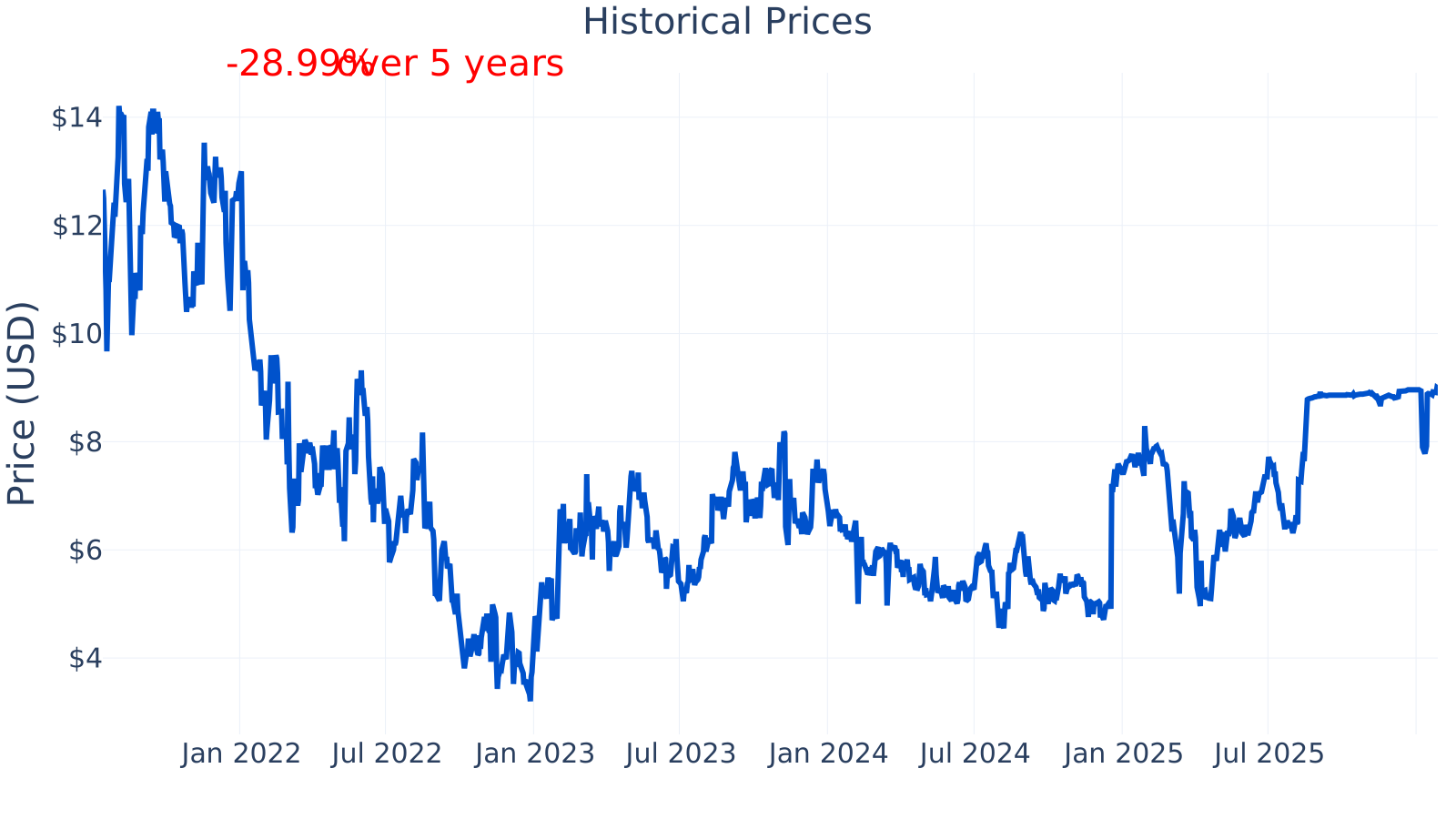
Soho House & Co’s market capitalization is about $1.76B. The stock’s beta is about 0.69, which indicates it has historically moved less than the broader market on average (though beta can change over time and does not capture business-specific risk).
On profitability, the latest profit margin shown is about -6%, while the industry median shown is about 15.95%, indicating the company is still operating below typical lodging-sector profitability. On growth, revenue growth year-over-year is about 11.2%, above the industry median shown of about 7%.
Debt-to-equity is shown as -713% versus an industry median of about 44%. A negative debt-to-equity ratio commonly happens when a company’s accounting shareholders’ equity is negative, which can make this ratio hard to interpret in the usual way and often signals a more leveraged balance-sheet profile or accumulated losses over time.
Growth (Medium)
Soho House operates in the broader lodging and experiential hospitality space, where demand is influenced by travel trends, consumer discretionary spending, and the appeal of differentiated experiences. Within that, private membership clubs represent a niche that can benefit from network effects (more locations can increase perceived membership value) and from a recurring-revenue component (membership dues).
Strategically, the company’s growth logic tends to rest on expanding its footprint (new Houses/locations), increasing utilization of existing locations (rooms and food & beverage), and maintaining a brand that supports pricing power for dues and on-site spend. In practice, this strategy can work well when execution is strong and consumer demand is healthy, but it also requires disciplined site selection and tight cost control given the fixed-cost nature of hospitality.
Year-over-year revenue growth has cooled from very high levels in 2022 (above 40% in the periods shown) to mid-to-high single digits and low double digits more recently, reaching about 11.2% in the most recent point shown. This pattern is consistent with a business moving from a rebound/expansion phase toward a more normalized growth rate.
Free cash flow (trailing twelve months) improved from negative levels (about -$123.3M in mid-2022) toward breakeven and then turned positive (about $33.1M by March 2025; the latest metric table shows about $25.5M). For a company that must invest in buildings, fit-outs, and upkeep, sustained positive free cash flow can be an important milestone—though it may fluctuate depending on expansion pace and maintenance spending.
Risks (High)
The main risks are closely tied to the economics of hospitality and the company’s balance sheet. Operating a network of premium clubs and accommodations involves meaningful fixed costs (leases, labor, utilities, and maintenance). If utilization softens—because of weaker travel demand, local competition, reputational issues, or broader economic slowdown—profits can swing quickly.
Another important risk area is leverage and financing flexibility. Interest expense has been significant in recent years, and that can limit how much of the gross profit ultimately reaches net income. When rates are higher or refinancing conditions tighten, funding new locations or refinancing existing obligations can become more difficult or more expensive.
The debt-to-equity series is volatile and turns negative in the periods shown, which commonly reflects negative shareholders’ equity. Even without getting into accounting mechanics, this is a signal that balance-sheet structure may be less conservative than many established lodging peers, and it can increase sensitivity to earnings volatility and financing conditions.
Profitability remains a key execution risk. The company has narrowed losses versus earlier periods, but it is still not consistently profitable on a net basis.
Profit margins improved significantly from very negative levels in 2022 (around -33%) to closer to breakeven more recently (around -6% at the latest point shown). However, the industry median shown remains solidly positive (around 12%–19% over much of the period), highlighting that Soho House still has a gap to close versus typical lodging-sector profitability.
On competitive positioning, Soho House benefits from brand recognition, a curated membership model, and a network of locations that can reinforce the value proposition for frequent travelers. That said, it is not competing only with traditional hotels. The competitive set can include:
- Global hotel groups (premium and lifestyle brands with loyalty programs and broad footprints)
- Other private members’ clubs (local and international club operators)
- Boutique/lifestyle hospitality operators (independent hotels and experiential concepts)
Relative to large hotel groups, Soho House is smaller and more concentrated, which can be a disadvantage in purchasing power and geographic diversification. Its differentiation is the membership/community angle and its curated experience, but that advantage depends heavily on brand stewardship and consistent member satisfaction.
Valuation
A traditional price-to-earnings (P/E) comparison is not very informative here because the company’s P/E is not meaningful when earnings are negative (the chart shows zeros for the company across the displayed dates, while the industry median P/E is shown in a range roughly around the low-20s to low-30s). In these cases, valuation discussions often lean more on revenue-based multiples, cash flow trends, and the path to sustainable profitability rather than current earnings multiples.
From a fundamentals perspective, the key valuation question is whether the company can translate its revenue base (about $1.204B in 2024 total revenue shown in the operating flow) into durable operating profit while managing financing costs and ongoing investment needs. The recent improvement in free cash flow is directionally supportive, but the company’s net losses and balance-sheet signals (such as negative equity implied by the debt-to-equity behavior) are important context when interpreting any valuation measure.
Conclusion
Soho House & Co combines recurring membership revenue with hospitality-driven on-site spending, supported by a recognizable lifestyle brand and a network effect that can strengthen as locations expand. Over the last several years, revenue has grown substantially, and free cash flow has improved from deeply negative levels to positive in the periods shown.
At the same time, net profitability has not been consistently achieved, interest costs have been meaningful, and balance-sheet indicators suggest elevated financial risk compared with typical lodging peers. For long-term analysis, the central items to track are whether operating income can turn sustainably positive, whether free cash flow can remain positive while the company expands, and whether financing needs can be met on acceptable terms without undermining the operating model.
Sources:
- SEC EDGAR — Soho House & Co Inc filings (Form 10-K, Form 10-Q, Form 8-K)
- Soho House & Co Inc — Investor Relations materials and press releases (company website)
- Wikipedia — “Soho House” (basic company background)
This article is for informational purposes only and does not constitute financial advice. Some content is AI-generated. See Disclaimer


