Stock Analysis · Melco Resorts & Entertainment Ltd (MLCO)
Overview
Melco Resorts & Entertainment Ltd (MLCO) is an owner and operator of integrated resorts (large destination properties that combine hotels, casinos, restaurants, entertainment, and retail). The company’s core business is hosting visitors—primarily in Asia—who spend money on gaming as well as on rooms, food, shows, and other on-site experiences.
Melco’s revenue is typically generated from these main streams (often reported by property and by type of activity in company filings):
- Casino / gaming revenue (the largest driver for most integrated resort operators)
- Non-gaming revenue such as hotel rooms, food & beverage, entertainment, and retail
Because the mix can shift by travel demand, customer type (mass-market vs. premium), and property performance, the most reliable breakdown and percentages are found in the company’s annual report sections that describe segment and property results.
Across the period shown, total revenue increases meaningfully from about $2.0B (2021) to about $5.16B (2025). Over the same span, operating income moves from negative to positive (about -$603M (2021) to about +$600M (2025)), which suggests that the business has regained scale and improved cost absorption as activity levels recovered. Interest expense remains a large recurring cost (roughly $473M in 2025), highlighting how important financing structure is for overall profitability.
Key Figures
| Metric | Value | Industry ⓘ |
|---|---|---|
| Date | Mar 02, 2026 | |
| Context | ||
| Sector | Consumer Cyclical | |
| Industry | Resorts & Casinos | |
| Market Cap ⓘ | $2.32B | |
| Beta ⓘ | 0.58 | |
| Fundamental | ||
| P/E Ratio ⓘ | 12.91 | 19.47 |
| Profit Margin ⓘ | 3.58% | 4.08% |
| Revenue Growth ⓘ | 8.60% | 4.10% |
| Debt to Equity ⓘ | -563.53% | 370.89% |
| PEG ⓘ | 0.45 | |
| Free Cash Flow ⓘ | $538.35M | |
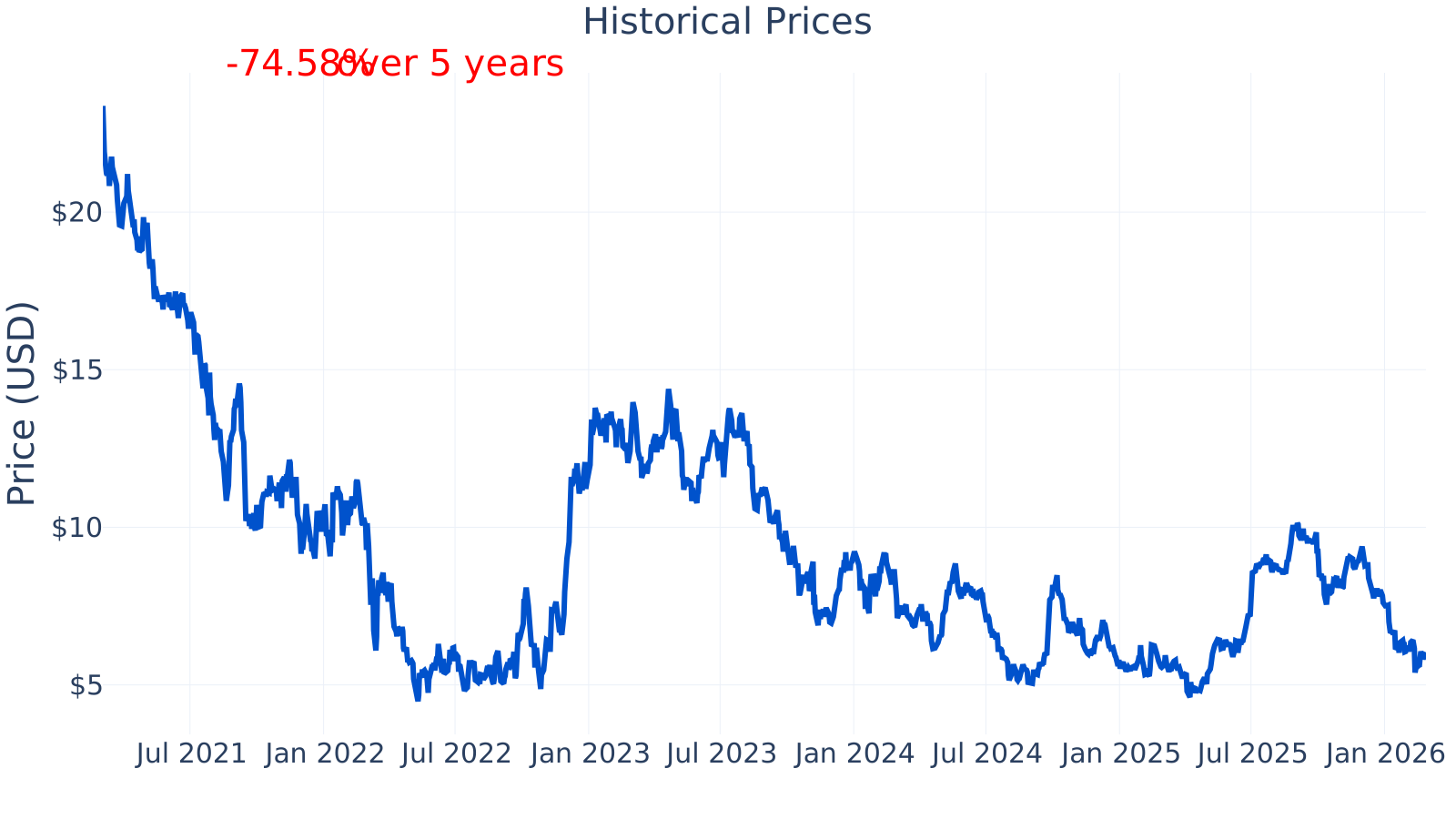
Melco’s market capitalization is about $2.32B, placing it in the smaller range among publicly traded global resort and casino operators. The stock’s beta (~0.58) indicates it has historically moved less than the broader market on average, though company-specific and region-specific events can still drive large swings.
On profitability, the latest profit margin is ~3.6%, slightly below the industry median shown (~4.1%). On growth, the latest year-over-year revenue growth is ~8.6%, above the industry median shown (~4.1%), indicating faster recent top-line expansion than the typical peer in the comparison set.
The latest P/E ratio is ~12.9 versus an industry median of ~19.5. The PEG ratio (~0.45) is included as a growth-adjusted indicator, but it should be treated carefully because it depends on growth assumptions that can change quickly in cyclical industries like travel and gaming.
Debt-to-equity is negative (about -563%), which usually happens when accounting equity is low or negative rather than implying “negative debt.” In such cases, the debt-to-equity ratio can become difficult to interpret, and other leverage measures in filings (for example, net debt and maturity schedules) often provide clearer context. The company’s free cash flow (TTM) is about $538M, which matters because cash generation is what ultimately supports debt service, reinvestment, and financial flexibility.
Growth (Medium)
The resorts and casinos industry is closely tied to travel volumes, consumer discretionary spending, and regulatory conditions. For companies with significant exposure to large tourism hubs, growth can be driven by higher visitation, increasing spend per visitor, and continued development of non-gaming attractions that broaden the customer base beyond pure gaming demand.
The year-over-year revenue growth pattern shows large swings earlier in the timeline and then moderates more recently into mid-to-high single digits (for example, about 8.6% at the latest point). This kind of progression is consistent with a recovery phase transitioning into a more normal growth phase, where growth depends less on “bounce-back” effects and more on execution and market conditions.
Free cash flow is positive in the periods shown and reaches about $538M (TTM) in the latest metric snapshot. For an integrated resort operator, sustained positive free cash flow can be a meaningful support for long-term resilience because it helps fund property maintenance, upgrades, and debt obligations without relying entirely on new borrowing.
Potential catalysts in this business model are generally operational rather than technological—such as ramping performance at existing properties, increasing hotel occupancy and room rates, improving the mix of higher-margin offerings, and maintaining stable regulatory relationships in the jurisdictions where the company operates.
Risks (High)
Melco’s risk profile is strongly influenced by geography, regulation, and financing. Integrated resorts are capital-intensive and operate under gaming licenses and detailed rules that can affect permitted activities, taxes/levies, operating requirements, and renewal terms. Shifts in policy, compliance expectations, or broader travel conditions can have an outsized impact on results.
The debt-to-equity line shows unusually large and then negative values over time, which most often reflects periods where shareholder equity became very small or negative. When equity is compressed, leverage ratios can become volatile and less intuitive, while the underlying obligation to service debt remains. In practice, this increases the importance of liquidity, refinancing access, and stable operating cash flow—especially in an industry where results can be cyclical.
Profitability has improved substantially versus earlier periods that were deeply negative, reaching a positive margin around 3.6% most recently. Even so, margins remain modest versus the industry median shown, which indicates the business may have less room for operational setbacks (for example, weaker demand, promotional pressure, higher costs, or unfavorable mix changes) before profits are meaningfully impacted.
Competition is another key consideration. Melco competes with other integrated resort operators for visitation, premium customers, hotel bookings, entertainment traffic, and convention demand. Major competitors commonly include large, well-capitalized operators with flagship properties in the same tourism-driven gaming hubs. Relative positioning typically depends on property location, brand strength, loyalty programs, the quality of non-gaming amenities, and the ability to consistently deliver high service levels. While scale and prime locations can be advantages in this sector, competitive intensity can pressure margins through marketing and reinvestment requirements.
Valuation
Melco’s latest P/E ratio (~12.9) is below the industry median shown (~19.5). In purely descriptive terms, that indicates the market is valuing Melco at a lower multiple of current earnings than the median peer in the comparison group.
However, P/E ratios in this industry can be harder to interpret without context because earnings can swing with travel demand, promotional intensity, and financing costs. Melco’s historical P/E values shown in the later part of the timeline vary widely (roughly from the 30s up to the 70s at points), reflecting how quickly the “E” (earnings) can change. Given the company’s meaningful interest expense (hundreds of millions per year in the income statement items shown) and the leverage-related complexity implied by negative equity, valuation is often discussed alongside cash flow durability and balance-sheet flexibility, not only headline earnings multiples.
Conclusion
Melco Resorts & Entertainment is a travel- and gaming-exposed operator that has shown a strong multi-year recovery in revenue and a return to positive profitability in the most recent year shown. Recent revenue growth is above the industry median in the comparison provided, and free cash flow is positive, which can support ongoing operations and financial obligations.
At the same time, the company faces high structural risks typical of the sector—regulatory dependence, cyclical demand, and capital intensity—combined with added balance-sheet complexity suggested by negative equity and substantial interest expense. In valuation terms, the current earnings multiple shown is below the industry median, but the usefulness of that single comparison depends heavily on how stable earnings and cash flow remain through the cycle.
Sources:
- U.S. SEC EDGAR — Melco Resorts & Entertainment Ltd filings (Annual Report on Form 20-F, and other submitted reports)
- Melco Resorts & Entertainment Ltd — Investor Relations materials (company-hosted reports and releases)
- Wikipedia — “Melco Resorts & Entertainment” (basic company background)
This article is for informational purposes only and does not constitute financial advice. Some content is AI-generated. See Disclaimer


