Stock Analysis · McDonalds Corporation (MCD)
Overview
McDonald’s Corporation (MCD) is a global quick-service restaurant company best known for its McDonald’s brand. It operates with a heavily franchised model: many restaurants are run by franchisees, while McDonald’s also operates some company-run locations. In simple terms, McDonald’s earns money both from selling food directly (in company-operated restaurants) and from collecting ongoing payments from franchisees who use the brand, menu system, and operating playbook.
The business is typically described through three operating segments: U.S., International Operated Markets (developed markets where McDonald’s operates directly), and International Developmental Licensed Markets & Corporate (markets that are more often franchised or licensed). This structure highlights a core feature of the company: it is not only a restaurant operator, but also a brand-and-franchise platform with significant real estate and rental income dynamics in many markets.
Main revenue sources (high-level, based on how the company reports its business model):
- Franchised restaurants: primarily rent and royalties paid by franchisees (often the largest driver given the franchised structure).
- Company-operated restaurants: sales from food and beverages sold to customers.
- Other revenues: smaller items depending on reporting period and geography (for example, certain fees and other operating items).
Over recent years, company-wide revenue has been relatively stable to modestly growing, while profitability tends to be supported by the franchised mix (royalty/rent streams typically carry different economics than running every restaurant directly).
Across the years shown, total revenue trends upward overall (from about $23.2B in 2021 to about $26.9B in 2025). Operating income remains large relative to revenue, and net income stays in a similar range over time (roughly $6.2B–$8.6B in the period shown). Interest expense rises (from about $1.19B in 2021 to about $1.58B in 2025), which is consistent with a business that uses meaningful debt and is sensitive to financing costs.
Key Figures
| Metric | Value | Industry ⓘ |
|---|---|---|
| Date | Feb 16, 2026 | |
| Context | ||
| Sector | Consumer Cyclical | |
| Industry | Restaurants | |
| Market Cap ⓘ | $233.76B | |
| Beta ⓘ | 0.53 | |
| Fundamental | ||
| P/E Ratio ⓘ | 27.39 | 27.62 |
| Profit Margin ⓘ | 31.85% | 7.98% |
| Revenue Growth ⓘ | 9.70% | 7.40% |
| Debt to Equity ⓘ | -2580.58% | 59.83% |
| PEG ⓘ | 2.90 | |
| Free Cash Flow ⓘ | $7.37B | |
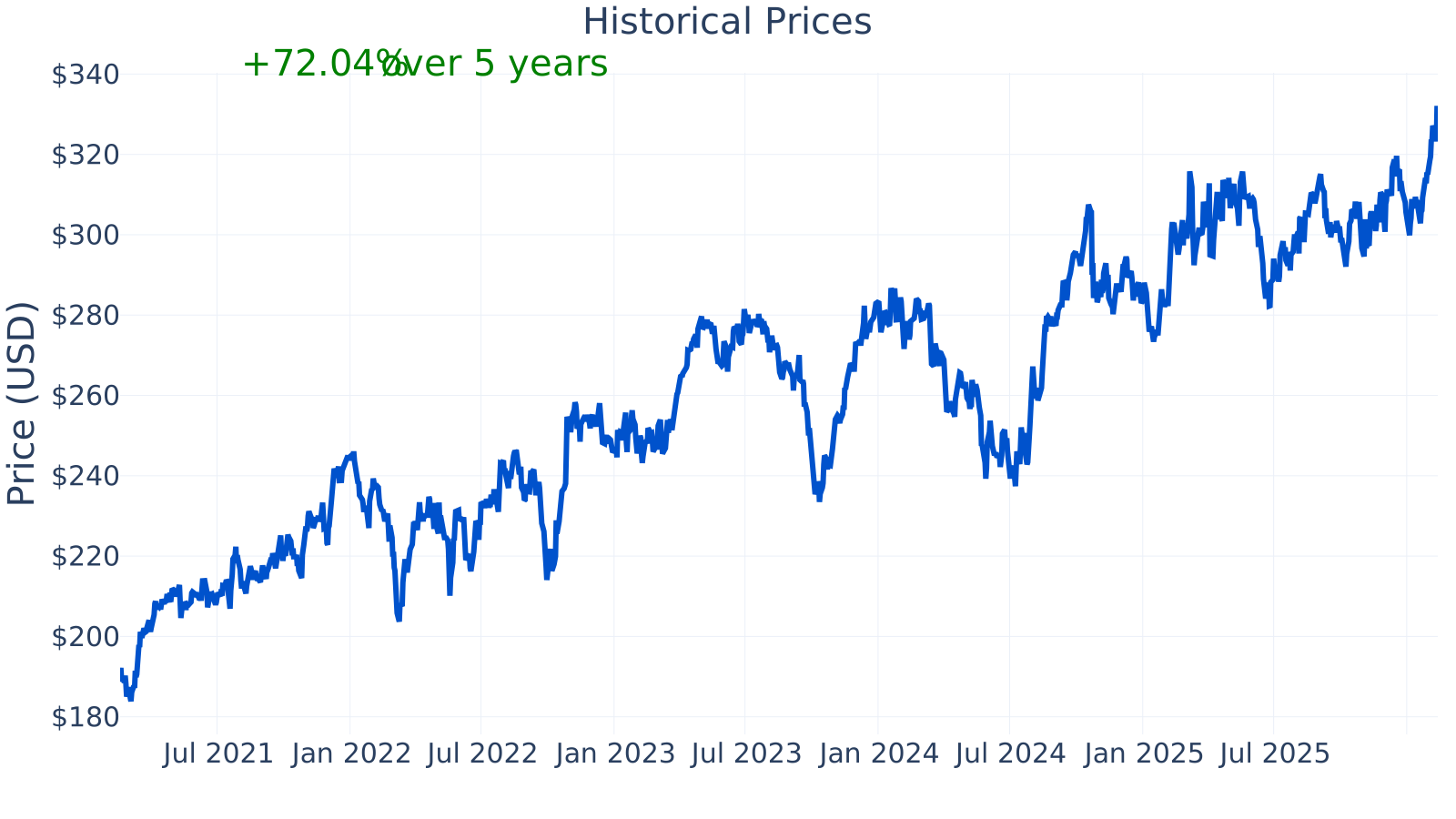
McDonald’s has a market capitalization of about $233.8B and a beta of ~0.53, which indicates the stock has historically moved less than the broader market on average (though it can still decline). The P/E ratio is ~27.4, close to the restaurant industry median (~27.6) in the peer set provided. Profitability stands out: McDonald’s profit margin is ~31.9% versus an industry median of ~8.0%, reflecting the economics of its scale and franchised mix. The latest year-over-year revenue growth is ~9.7% (industry median ~7.4%). Trailing twelve-month free cash flow is about $7.37B. The reported debt-to-equity is negative, which usually happens when accounting equity is negative; that makes this ratio less intuitive to interpret in the usual way and is better assessed alongside cash flow generation and the broader balance-sheet discussion in filings.
Growth (Medium)
McDonald’s operates in the global restaurant and quick-service category, which is mature in many developed markets but still benefits from long-running drivers such as population growth, urbanization, and convenience-focused eating. In a mature category, growth often comes less from “new-to-the-world” demand and more from execution: value positioning, menu innovation, operational speed, digital ordering, delivery partnerships, loyalty programs, and selective unit growth (especially in markets with room to expand).
As a franchised-heavy system, McDonald’s strategy can support growth through a combination of brand-driven customer traffic and franchisee-led reinvestment, while the corporation focuses on marketing, technology platforms, and system standards. Potential catalysts that can matter over time include improved digital engagement (ordering and loyalty), modernization of restaurants, and international expansion via franchise or licensing structures, which can reduce the capital required for growth compared with owning all locations directly.
Revenue growth over the period shown is uneven, which is typical for a global consumer business exposed to currency moves, pricing changes, and shifting demand. There is a surge in 2021 (including a very high mid-2021 comparison), a soft patch with negative year-over-year readings in parts of 2022 and again around parts of 2024–2025, and then an improvement into the most recent point shown (~9.7% year over year). This pattern suggests that while the business can grow, it does not grow in a straight line and remains sensitive to consumer conditions and comparisons from prior periods.
Free cash flow is consistently large in absolute dollars, ranging from about $5.3B to $7.2B in the periods shown, with the latest around $7.37B. For a franchised-oriented model, steady free cash flow can be an important indicator of financial flexibility, because it can be used for reinvestment, debt servicing, and shareholder returns (subject to board decisions and market conditions).
Risks (Medium)
McDonald’s faces the common risks of global consumer and restaurant businesses. Demand can weaken when consumers become more price-sensitive, and the company can face cost pressures (food inputs, packaging, energy, and labor) that affect franchisee economics and company-operated margins. Because the brand is highly visible, it is also exposed to reputational risks related to food quality, safety incidents, marketing missteps, labor practices, and broader social or geopolitical controversies in different regions.
Competition is persistent and multi-layered: it includes large global quick-service brands, regional chains, and fast-casual concepts. Key competitors commonly include Restaurant Brands International (Burger King and others), Yum! Brands (KFC, Taco Bell, Pizza Hut), and Wendy’s, along with many local players in each market. McDonald’s is widely considered one of the category leaders by global scale and brand reach, which can help with marketing efficiency, supplier relationships, and consumer awareness. Competitive advantage is often expressed through brand strength, store density, operating processes, and systemwide consistency; however, competitors can still take share through sharper value offerings, differentiated menus, or superior customer experience in specific dayparts and regions.
The debt-to-equity chart shows McDonald’s at negative values (for example, around -2,581% at the latest point shown), while the industry median remains positive (around 110% at the latest point). A negative value typically indicates negative total equity on the balance sheet, which makes the conventional “debt-to-equity” comparison less straightforward than usual. Practically, this increases the importance of monitoring cash flow, interest costs, refinancing needs, and the company’s discussion of capital structure in its filings.
Profit margin is consistently far above the industry median across the period shown, staying around the low-30% range recently (latest about 31.9% versus an industry median near 7.9%). This gap suggests McDonald’s business model converts a larger share of revenue into bottom-line profit than many restaurant peers. Even so, margins can compress if consumer demand weakens, if franchisee economics come under pressure, or if costs rise faster than pricing and productivity improvements.
Valuation
One simple way to describe valuation is the price-to-earnings (P/E) ratio, which compares the stock price to the company’s earnings. For mature consumer businesses, P/E levels are often interpreted alongside growth consistency, resilience in downturns, and the durability of competitive advantages.
McDonald’s recent P/E ratio is about 27.4, which is very close to the provided restaurant industry median (about 27.6). Historically in the period shown, McDonald’s P/E moved roughly from the low-20s to low-30s, sometimes above and sometimes below the industry median. In descriptive terms, that places the stock valuation broadly in line with peers on this measure, rather than clearly discounted or clearly far more expensive than the peer median.
Another valuation reference in the key figures is the PEG ratio (~2.9), which relates P/E to growth expectations; higher values can indicate that the price is high relative to growth assumptions (though PEG depends heavily on how growth is estimated and is less reliable for businesses with uneven growth). The company’s substantial free cash flow generation provides an additional lens investors often use when thinking about valuation, but that requires a deeper breakdown (capital spending needs, franchise economics, and financing structure) than a single ratio can provide.
Conclusion
McDonald’s is a globally scaled restaurant and franchising business with a well-known brand and a model that has historically produced high profit margins relative to many restaurant peers. Revenue growth over time appears positive but uneven, which is typical for a mature global consumer company. Free cash flow is consistently large, supporting financial flexibility.
The main trade-offs visible from the information here are that profitability is strong and valuation (by P/E) is close to the peer median, while balance-sheet structure looks unusual through the lens of debt-to-equity because equity is negative in the periods shown. Competitive pressure, consumer sensitivity to pricing, operating cost inflation, and reputational risk remain ongoing considerations for the business over long time horizons.
Sources:
- U.S. SEC EDGAR — McDonald’s Corporation filings (Form 10-K, Form 10-Q)
- McDonald’s Investor Relations — Annual Report / Form 10-K (business description, segment information)
- Wikipedia — “McDonald’s” (basic company background)
This article is for informational purposes only and does not constitute financial advice. Some content is AI-generated. See Disclaimer


