Stock Analysis · MaxLinear Inc (MXL)
Overview
MaxLinear, Inc. (MXL) is a semiconductor company that designs and sells mixed-signal integrated circuits (chips). In simple terms, its products help move, process, and manage high-speed data signals in devices and networks. The company’s chips are commonly used in broadband and cable access equipment, optical and Ethernet networking gear, and connected/home networking devices. Like many “fabless” chip companies, MaxLinear typically focuses on design and relies on external manufacturers to produce the chips.
Revenue is primarily generated from selling semiconductors and related solutions to equipment makers (original equipment manufacturers). The business is exposed to end markets that can be cyclical—demand can rise strongly in upgrade cycles and fall when customers work through excess inventory.
Public filings describe revenue by product families/end markets, but the exact percentage mix can shift materially over time with customer ordering patterns. A simplified view of where revenue typically comes from includes:
- Broadband access (for example, cable and fiber access equipment components)
- Connectivity / home networking (chips used in wired/wireless connectivity solutions depending on the product cycle)
- Infrastructure / data center networking (such as Ethernet and optical interconnect-related products)
From a high-level financial perspective, the company has gone through a period where revenue contracted sharply after earlier growth, and profitability has been pressured—an important backdrop for any long-term evaluation.
Across the years shown, total revenue rose from about $892M (2021) to $1.12B (2022), then dropped to $693M (2023) and $361M (2024), before improving to $468M (2025). Over the same period, research and development spending remained substantial (roughly $209M–$296M per year in the years shown), which helps support future products but can weigh on profits when revenue is lower.
Key Figures
| Metric | Value | Industry ⓘ |
|---|---|---|
| Date | Apr 27, 2026 | |
| Context | ||
| Sector | Technology | |
| Industry | Semiconductors | |
| Market Cap ⓘ | $5.40B | |
| Beta ⓘ | 1.70 | |
| Fundamental | ||
| P/E Ratio ⓘ | N/A | 63.60 |
| Profit Margin ⓘ | -25.96% | 7.71% |
| Revenue Growth ⓘ | 43.00% | 19.70% |
| Debt to Equity ⓘ | 31.21% | 20.71% |
| PEG ⓘ | 0.39 | |
| Free Cash Flow ⓘ | $10.15M | |
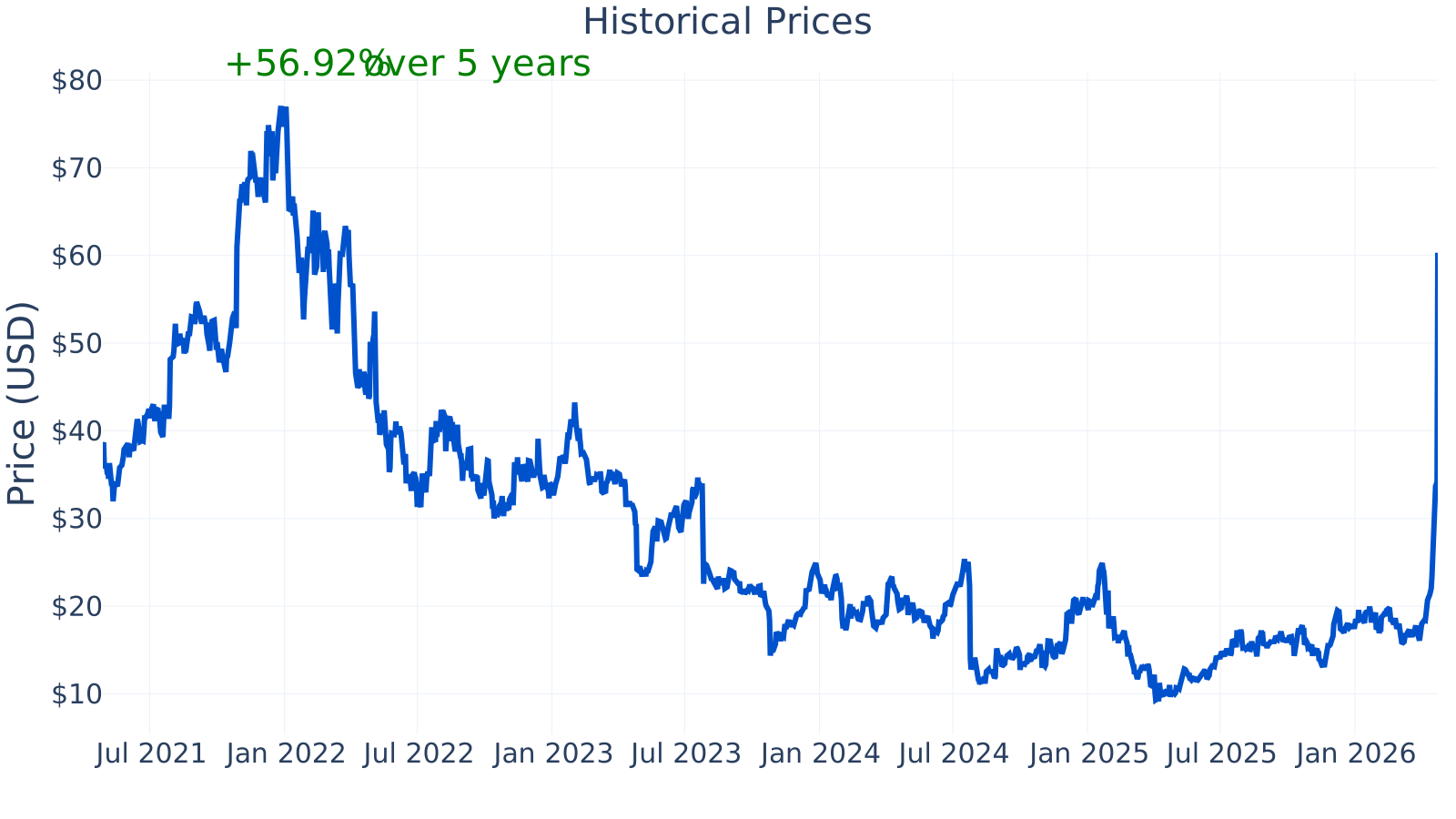
MaxLinear’s market capitalization is about $5.4B, and the stock’s beta (~1.70) indicates it has tended to move more than the broader market (higher volatility). The latest profit margin is about -26% versus an industry median near +7.7%, highlighting a profitability gap versus many peers at this time. On the growth side, latest year-over-year revenue growth is about +43% versus an industry median near +19.7%, suggesting a rebound from a weaker base. Leverage is moderate with debt-to-equity around 31% (industry median roughly 21%). Free cash flow over the trailing twelve months is slightly positive at about $10M, after being negative in prior periods.
Growth (Medium)
MaxLinear operates in semiconductors, a sector supported long-term by structural demand for connectivity and bandwidth—more data moving through homes, enterprises, and cloud infrastructure generally requires more silicon content. However, semiconductor demand is also well-known for cyclical swings driven by inventory corrections, customer capital spending cycles, and product transitions.
A core question for future growth is whether MaxLinear can translate its product portfolio into sustained demand across multiple end markets at the same time (rather than relying on a single cycle). Another key factor is operating leverage: when revenue rises, fixed costs like engineering and overhead can become a smaller percentage of sales, potentially improving margins—while the reverse happens when revenue falls.
The revenue growth pattern shows a sharp downturn during 2023–2024 (deeply negative year-over-year comparisons), followed by a return to positive growth into 2025 and early 2026, reaching roughly +43% most recently. This type of rebound can be consistent with an industry recovery and/or customers resuming orders after an inventory digestion period.
Cash generation has also been volatile: free cash flow was strongly positive in 2022–2023 (above $200M in the periods shown), turned negative in 2024–2025, and most recently returned to slightly positive (about $10M). For long-term business durability, a key point to monitor is whether cash flow can remain consistently positive through a full cycle, not only at peaks.
Risks (High)
The main risk is cyclicality and customer concentration dynamics that are common in semiconductors: a small number of large customers and platforms can drive significant portions of demand, and order patterns can change quickly based on inventory levels and end-market conditions. This can lead to sharp revenue swings, which is visible in the multi-year revenue and margin variability.
A second major risk is profitability. Even if revenue returns, the company needs to manage pricing pressure, product mix, and operating expenses (including ongoing R&D investment) to regain stable profitability. Sustained losses can limit flexibility over time (for example, less room for investment or higher reliance on external financing).
Debt-to-equity is currently about 31%, down significantly from much higher levels earlier in the timeline (for example, ~87% in mid-2021), but still above the industry median in the most recent point shown (~15%). This suggests leverage has improved versus the past, yet remains somewhat higher than the typical peer median at the moment.
Profitability has weakened materially over time. The company posted positive margins around 2022 (low double-digit percentages in the periods shown) before turning negative in late 2023 and reaching very low levels during 2024, with a partial improvement most recently to about -26%. Meanwhile, the industry median stayed positive (roughly mid-single to high-single digits in the periods shown). This gap implies that company-specific execution and/or mix issues matter in addition to industry conditions.
Competition is another important risk. MaxLinear operates in markets where multiple semiconductor vendors compete on performance, power efficiency, integration, software/firmware support, time-to-market, and price. Depending on the exact product area, competitors can include large diversified semiconductor companies and specialized connectivity/networking chip providers. In general terms, MaxLinear is not the largest semiconductor company in its field, so competitive advantages tend to depend on having strong product features in specific niches, maintaining customer design wins, and delivering reliable roadmaps. Losing a major design win or facing aggressive pricing from larger competitors can affect both revenue and margins.
Valuation
A common valuation metric is the price-to-earnings (P/E) ratio, but it becomes less informative when earnings are negative. In the periods shown, MaxLinear’s P/E is displayed as 0 for many dates (typically reflecting negative or not-meaningful earnings), while the semiconductor industry median P/E remains positive and varies widely over time. In earlier periods when MaxLinear had meaningful positive earnings, its P/E moved from very high levels (for example above 100 in early 2022) down toward more typical ranges (roughly 20–30 in parts of 2022–2023), before becoming not meaningful again as profitability deteriorated.
Given the current negative profit margin, valuation discussions typically shift toward balance-sheet strength, cash flow normalization potential, and whether revenue recovery can translate into sustainable operating profitability. In other words, the key valuation debate is less about today’s earnings multiple and more about how quickly—and how durably—profits and free cash flow can recover through the cycle.
Conclusion
MaxLinear is a connectivity-focused semiconductor designer with exposure to long-term themes around bandwidth growth, broadband access, and networking infrastructure. The company’s recent history shows pronounced cyclicality: revenue expanded into 2022, contracted sharply in 2023–2024, and then rebounded into 2025–early 2026, while profitability swung from positive to meaningfully negative.
The central long-term issue is whether the current revenue recovery can be converted into consistent profitability and steadier cash generation, while maintaining competitive positioning in demanding and price-sensitive chip markets. The key facts to watch over time include: stability of revenue across quarters, improvement in profit margin relative to peers, sustained positive free cash flow, and leverage trends relative to the industry.
Sources:
- SEC EDGAR — MaxLinear, Inc. Form 10-K (Annual Report)
- SEC EDGAR — MaxLinear, Inc. Form 10-Q (Quarterly Report)
- MaxLinear Investor Relations — Earnings Releases and SEC Filings (company-hosted)
- Wikipedia — “MaxLinear” (company overview and history)
This article is for informational purposes only and does not constitute financial advice. Some content is AI-generated. See Disclaimer


