Stock Analysis · Marvell Technology Group Ltd (MRVL)
Overview
Marvell Technology Group Ltd is a semiconductor company that designs chips used to move, store, process, and secure data. In simple terms, Marvell sells the “specialized brains and highways” that help large amounts of information travel efficiently inside data centers, across telecom networks, and within many connected devices. The company is considered a “fabless” chip designer, meaning it typically designs products and relies on external manufacturing partners to build them.
Marvell’s products are commonly associated with:
- Cloud and data centers (high-speed networking, data movement, and custom silicon used in large computing systems)
- Telecom infrastructure (chips used in carrier networks, including fiber and 5G-related infrastructure)
- Storage and connectivity (components supporting data storage systems and device connectivity)
Marvell reports revenue by end markets in its official filings, and those mixes can shift over time as customers build or pause major infrastructure projects. For precise, up-to-date percentages by end market, the most reliable reference is the company’s latest Form 10-K and quarterly updates on SEC EDGAR.
Across the periods shown, total revenue increased from about $4.46B (FY2022) to $5.77B (FY2025). Over the same span, operating expenses stayed very large (including substantial research and development), which helps explain why operating income and net income were negative in some years despite meaningful gross profit.
Key Figures
| Metric | Value | Industry ⓘ |
|---|---|---|
| Date | Mar 02, 2026 | |
| Context | ||
| Sector | Technology | |
| Industry | Semiconductors | |
| Market Cap ⓘ | $69.28B | |
| Beta ⓘ | 1.98 | |
| Fundamental | ||
| P/E Ratio ⓘ | 28.76 | 44.92 |
| Profit Margin ⓘ | 31.75% | 10.84% |
| Revenue Growth ⓘ | 36.80% | 16.00% |
| Debt to Equity ⓘ | 35.80% | 21.24% |
| PEG ⓘ | 1.52 | |
| Free Cash Flow ⓘ | $1.58B | |
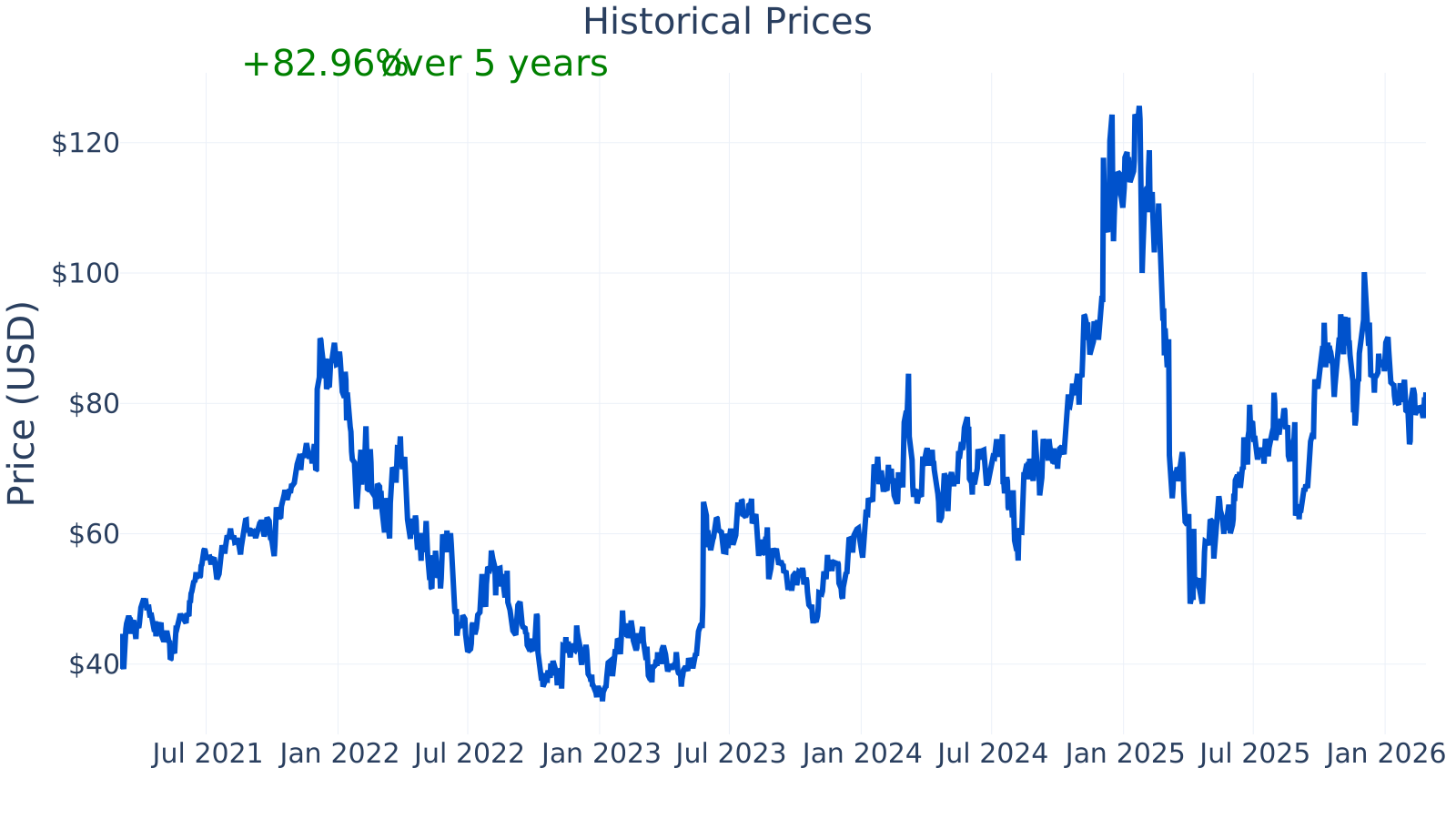
Marvell’s market capitalization is about $69.3B, placing it among the larger publicly listed chip designers. The stock has tended to be volatile (beta about 1.98), meaning it has often moved more than the broader market.
On profitability, the latest profit margin shown is about 31.8%, which is notably above the industry median shown (about 10.8%). Growth metrics also stand out: the latest year-over-year revenue growth shown is about 36.8% versus an industry median of about 16%. Free cash flow over the trailing twelve months is about $1.58B, indicating the business has recently generated meaningful cash after operating and capital spending.
Growth (Medium)
Marvell is exposed to long-running growth drivers in semiconductors: more data creation, higher network speeds, and increasing compute needs in cloud infrastructure. Demand in these markets can be uneven from quarter to quarter, but the underlying direction is tied to structural trends such as data center expansion, bandwidth growth, and specialized computing needs.
A key part of Marvell’s approach is focusing on higher-value chips used in data infrastructure (rather than commodity components). In practice, this often means products where customers care about performance, power efficiency, and tight integration into large systems—areas that can support longer product cycles and deeper customer relationships.
The growth pattern shown is cyclical: very high growth in earlier periods, a slowdown and some negative year-over-year comparisons during weaker phases, and then a return to strong positive growth more recently (about 36.8% in the latest point shown). This type of swing is common in semiconductors, especially when customers adjust inventories or delay large infrastructure purchases.
Free cash flow improved from roughly $0.63B (FY2022) to about $1.39B (FY2025), and the latest trailing twelve months is around $1.58B. For long-term business strength, sustained free cash flow matters because it can support research spending, debt reduction, and resilience through downcycles.
Risks (High)
Semiconductors are cyclical. Even when the long-term demand trend is favorable, customers can cut orders quickly due to inventory corrections, macro slowdowns, or shifts in spending priorities. For a company like Marvell, results can be influenced by the timing of large customer projects (especially in cloud and telecom infrastructure).
Marvell’s latest debt-to-equity is about 35.8%, compared with an industry median shown near 21.2%. The chart also shows a gradual increase from the high-20%/low-30% range to the mid-30% range over time. Debt is not inherently negative, but it can reduce flexibility if industry conditions weaken or if interest costs rise, especially when profits are under pressure.
The profit margin series shows a notable swing: negative margins for an extended period and then a sharp move to a positive margin (about 31.8% at the latest point shown), well above the industry median shown (about 6.6%). Large changes like this can occur due to business mix shifts, cost structure changes, and accounting items that affect net income. For long-term assessment, many readers also track operating margin and cash generation alongside net margin, because net income can be influenced by non-cash charges and one-time items.
Competition is intense. Marvell operates in markets where rivals can be large and well-funded, and customers can have significant negotiating power. Competitors vary by product area, but commonly include major chip suppliers and networking-focused semiconductor firms such as Broadcom, NVIDIA (data center interconnect and platform-adjacent areas), AMD and Intel (in certain infrastructure and compute-adjacent segments), and others across networking, storage, and connectivity. Marvell is not “the” single leader across all these categories; its positioning depends on the specific workload (networking, storage, custom silicon) and the customer’s architecture choices.
Another risk is execution: winning and keeping large infrastructure customers requires staying ahead on performance and power efficiency while meeting strict delivery and quality targets. Because Marvell relies on external manufacturing partners, supply constraints, advanced packaging availability, or manufacturing transitions can also affect product timing and costs.
Valuation
At the latest point shown, Marvell’s P/E ratio is about 28.8, below the industry median shown at about 44.9. The P/E chart includes many periods where Marvell’s P/E is not displayed (set to zero), which commonly happens when earnings are negative or not meaningful for a P/E calculation. In other words, the P/E can become less informative when profits are volatile.
To interpret today’s valuation contextually, it helps to combine multiple indicators:
- Growth: latest year-over-year revenue growth shown (~36.8%) is above the industry median shown.
- Profitability: the latest profit margin shown is strong, but the historical variability suggests earnings can shift materially across cycles.
- Financial structure: debt-to-equity is higher than the industry median shown, which can matter during downturns.
The table also shows a PEG ratio of about 1.52, a metric that relates valuation to growth expectations. PEG ratios depend heavily on the earnings growth assumptions behind them, so they are best read as a rough reference rather than a definitive measure.
Conclusion
Marvell is a sizable semiconductor designer focused on data infrastructure markets where long-term demand is supported by ongoing growth in cloud computing, network bandwidth, and data movement. The financial picture shown combines strong recent revenue growth and meaningful free cash flow with historically volatile profitability and a debt level that is higher than the industry median shown.
For a long-term, fundamentals-focused view, the main points to track over time are whether revenue growth remains durable across cycles, whether free cash flow stays consistently positive through weaker periods, and whether profitability and leverage remain controlled as the company continues to invest heavily in research and development.
Sources:
- U.S. SEC EDGAR — Marvell Technology Group Ltd filings (Form 10-K, 10-Q)
- Marvell Investor Relations — Annual Report materials and shareholder resources
- Marvell Investor Relations — Earnings releases and company-hosted earnings call materials
- Wikipedia — “Marvell Technology” (basic company background)
This article is for informational purposes only and does not constitute financial advice. Some content is AI-generated. See Disclaimer


