Stock Analysis · Marriott International Inc (MAR)
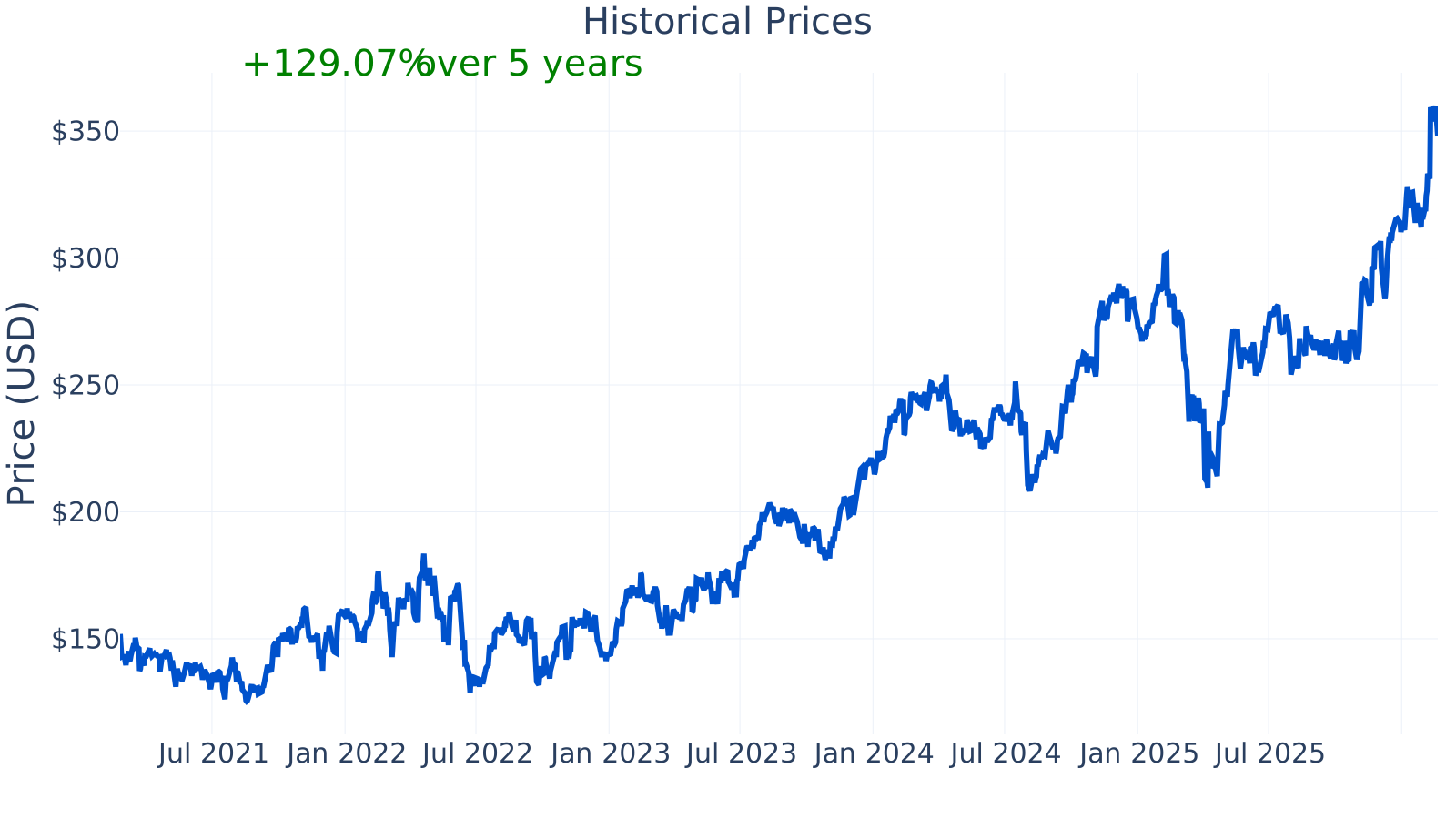
Overview
Marriott International is a global hospitality company best known for operating and franchising hotels under many brands (for example, Marriott, Sheraton, Westin, Ritz-Carlton, Courtyard, and others). In simple terms, Marriott’s business is to run hotel brands and systems at scale: it helps hotel owners attract guests through brand recognition, a large loyalty program, and reservation/technology platforms, while also managing some hotels directly.
Marriott reports results mainly through two segments: U.S. & Canada and International. Across both, the company’s revenue typically comes from a mix of fees and hotel operations. The largest revenue streams are generally:
- Rooms and related hotel revenue from properties Marriott operates or leases (this includes the room night itself plus some on-property services depending on the hotel)
- Management fees (earned for operating hotels owned by others)
- Franchise fees (earned when independently owned hotels use Marriott brands and systems)
- Incentive management fees (performance-based fees tied to hotel profitability)
- Co-brand credit card and loyalty-related revenue (tied to the Marriott Bonvoy ecosystem)
Because Marriott’s mix of managed, franchised, and owned/leased hotels can shift over time, the exact percentage split by revenue line can vary year to year. Many long-term discussions focus on the fee-driven parts of the model (management and franchise fees), because they tend to be less capital-intensive than owning real estate.
Scale and recent profitability: Looking at recent full-year totals, revenue increased from about $13.9B (2021) to $26.2B (2025), while net income moved from about $1.1B (2021) to about $2.6B (2025). Over the same period, interest expense rose (roughly $420M in 2021 to about $809M in 2025), which matters when thinking about financial flexibility.
The income picture shows a large cost base tied to hotel operations, alongside meaningful operating income. From 2021 to 2025, total revenue rose substantially, while interest expense also trended higher, which can reduce how much of operating profit ultimately reaches net income.
Key Figures
| Metric | Value | Industry ⓘ |
|---|---|---|
| Date | Feb 23, 2026 | |
| Context | ||
| Sector | Consumer Cyclical | |
| Industry | Lodging | |
| Market Cap ⓘ | $92.20B | |
| Beta ⓘ | 1.10 | |
| Fundamental | ||
| P/E Ratio ⓘ | 36.62 | 30.60 |
| Profit Margin ⓘ | 9.88% | 14.61% |
| Revenue Growth ⓘ | 4.20% | 7.00% |
| Debt to Equity ⓘ | -453.01% | 44.41% |
| PEG ⓘ | 1.37 | |
| Free Cash Flow ⓘ | $2.90B | |
Marriott’s equity market value is about $92.2B, and the stock’s beta (~1.10) suggests it has historically moved slightly more than the overall market. The P/E ratio (~36.6) is above the lodging industry median (~30.6). Recent profit margin (~9.9%) is below the industry median (~14.6%), and year-over-year revenue growth (~4.2%) is also below the industry median (~7.0%). Trailing twelve-month free cash flow is about $2.9B. The debt-to-equity figure is negative, which commonly happens when total shareholders’ equity is negative; in that case, this ratio becomes less intuitive and should be interpreted alongside the balance sheet details in filings.
Growth (medium)
Hotel demand is closely linked to travel and business activity, so the lodging industry tends to grow over time with global travel, but it can be cyclical. Marriott is positioned in that long-term travel trend because it has a large global footprint across price points (from select-service to luxury) and a broad set of brands that can match different trip purposes.
A key part of Marriott’s strategy is its asset-light approach (more franchising and management contracts, less ownership of hotel real estate). This can support growth because expanding the “system” (the total number of branded rooms) does not necessarily require Marriott to fund hotel construction. Another structural growth lever is the loyalty ecosystem (Marriott Bonvoy), which can support repeat stays and helps Marriott negotiate distribution and partnerships.
Revenue growth was exceptionally high during the post-pandemic rebound period and then normalized. More recently, growth appears to have settled into mid-single digits (for example, around 4–6% in the latest points shown), which is more consistent with a mature global operator than a fast-growing early-stage company.
Free cash flow increased strongly from 2021 into 2024 (from roughly $1.0B to about $2.6B), then eased in the most recent period shown (about $1.8B). For long-term shareholders, the direction of free cash flow matters because it is the pool of cash used for reinvestment in the business, debt-related needs, and shareholder returns.
Risks (medium)
Marriott’s results are sensitive to the travel cycle. A weaker economy, reduced corporate travel, geopolitical disruptions, or public health events can reduce occupancy and room rates across the industry. Even with an asset-light model, lower hotel profitability can pressure incentive fees and reduce overall earnings.
Competition is intense. Marriott competes with other global hotel brand families (notably Hilton, Hyatt, IHG Hotels & Resorts, and Wyndham) as well as alternative accommodations. Competitive advantages in this industry often come from brand portfolio breadth, loyalty program scale, distribution (direct bookings and corporate relationships), and the ability to sign attractive franchise/management agreements with hotel owners. Marriott is widely recognized as one of the global leaders by scale, which can help it compete for owners and guests, but it does not eliminate pricing pressure or the need to keep brands and technology relevant.
Financial structure is another key risk area. Marriott has historically returned significant capital to shareholders (for example, via repurchases), and that can contribute to negative shareholders’ equity on the balance sheet, which makes some leverage ratios harder to interpret at a glance.
The debt-to-equity series includes periods where the ratio turns negative, typically indicating negative equity. In that situation, focusing on the company’s total debt levels, maturity schedule, and interest costs (visible in filings) is often more informative than relying on the ratio alone.
Profitability can also shift as demand normalizes and costs change (labor, property-level expenses at managed/owned hotels, marketing, and technology spending).
Profit margin improved materially from the pandemic-impacted period into 2022–2023 (roughly moving into the low-teens), and more recently sits around ~10%, slightly below the lodging industry median shown. This indicates Marriott remains solidly profitable, but it is not currently leading the peer set on this specific margin metric.
Valuation
Valuation for hotel companies is often discussed using earnings-based multiples because results can fluctuate with the cycle. Marriott’s current P/E (~36.6) is above the lodging industry median (~30.6) based on the latest figures shown. A higher P/E can reflect expectations of steadier earnings, stronger brand economics, or greater confidence in long-term fee growth—but it also means the market is placing a higher price on current earnings than for the median peer.
Historically, Marriott’s P/E has moved across a wide range. After settling into the 20s during 2022–2024 in the series shown, it rose into the low 30s more recently, staying above the industry median at several points. That pattern is consistent with a “quality premium” narrative at times, but it also increases the importance of execution and resilience if industry conditions soften.
One practical way to frame the current valuation without forecasting is to compare it to the company’s recent growth and profitability profile: recent revenue growth (~4%) and profit margin (~10%) are positive but not especially high versus peers, while the multiple is above peer median. That combination can leave less room for disappointment if growth slows further or costs rise.
Conclusion
Marriott is a large, global lodging company with well-known brands and a business model that emphasizes management and franchise fees alongside some direct hotel operations. Over recent years it has produced substantial revenue and earnings, and it has generated meaningful free cash flow, even though that cash flow has not increased every year.
The long-term case for the company typically rests on industry-scale advantages (brands, loyalty, and distribution) and the ability to expand its system with limited balance-sheet investment compared with hotel ownership. The main trade-offs visible in today’s snapshot are (1) exposure to economic and travel cycles, (2) competitive pressure from other global hotel groups and alternative accommodations, and (3) a valuation that appears above the industry median while some recent growth and margin metrics are not above peer medians.
Sources:
- U.S. SEC EDGAR — Marriott International, Inc. — Annual Report (Form 10-K)
- U.S. SEC EDGAR — Marriott International, Inc. — Quarterly Report (Form 10-Q)
- Marriott International — Investor Relations — SEC Filings
- Marriott International — Investor Relations — Press Releases
- Wikipedia — “Marriott International”
This article is for informational purposes only and does not constitute financial advice. Some content is AI-generated. See Disclaimer


