Stock Analysis · Marriot Vacations Worldwide (VAC)
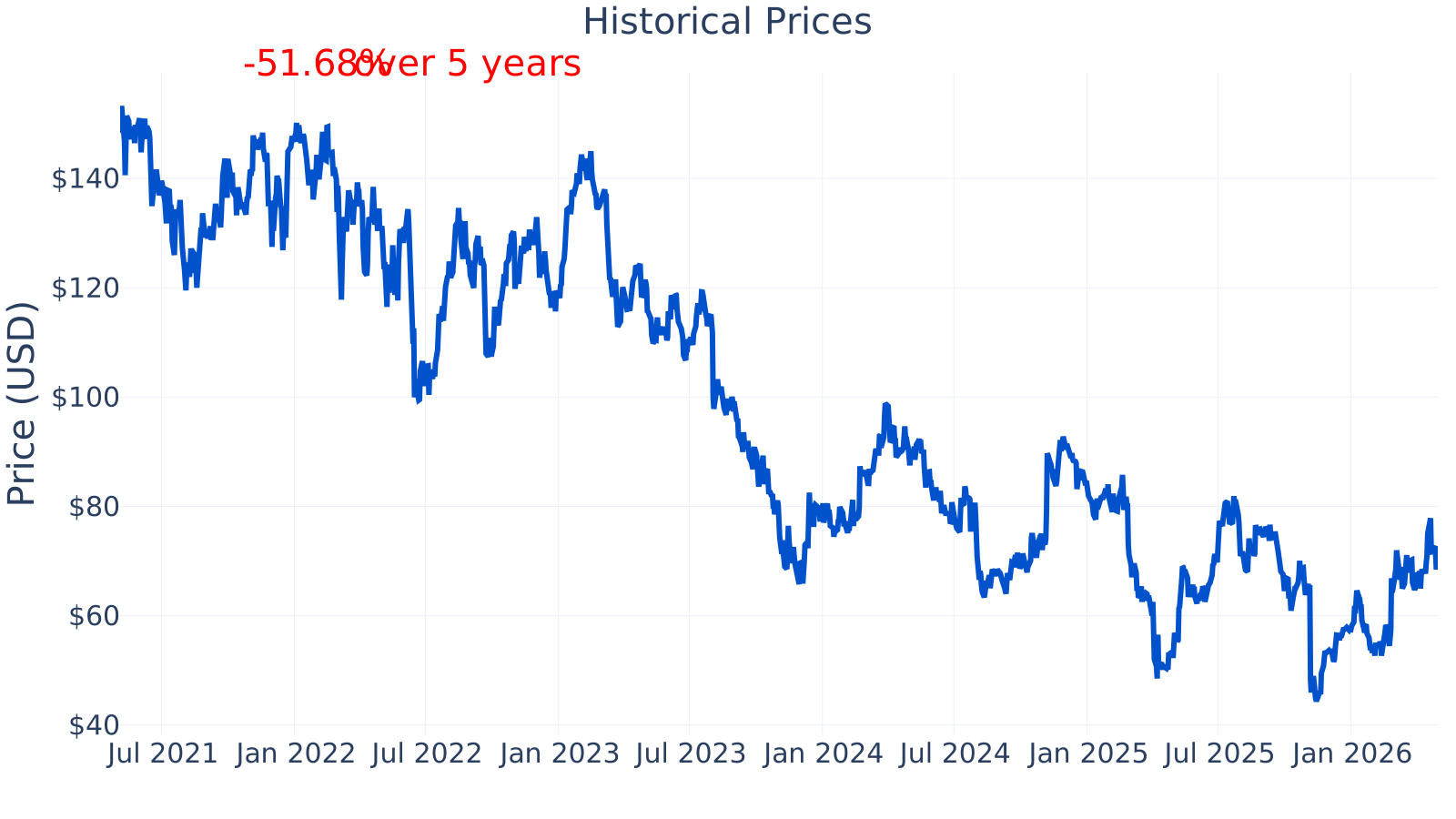
Overview
Marriott Vacations Worldwide (VAC) is a vacation ownership company. In simple terms, it sells timeshare interests (the right to use a resort accommodation for a certain period), provides financing for some of those purchases, and then manages resorts and membership programs for owners over time. The business model mixes “one-time” sales activity (selling vacation ownership products) with recurring revenue streams (management fees, member-related fees, and loan interest).
In its filings, the company describes multiple lines of business, but the core economic drivers tend to be:
- Vacation ownership sales (selling ownership interests and related products)
- Financing income (interest income on loans provided to customers who finance purchases)
- Resort / property and program management (fees for managing resorts, owner associations, and membership programs)
- Other ancillary revenue (for example, services connected to the owner base and travel usage)
Because revenue mix can shift by period (for example, with consumer demand, marketing spend, financing volumes, and securitization activity), the most reliable way to confirm the exact segment percentages is to review the segment and revenue footnotes in the latest Form 10-K and 10-Q.
From 2021 to 2024, total revenue increased (about $3.89B to $4.97B), while operating income remained positive. In 2025, revenue was still similar (about $5.03B) but profitability dropped sharply: gross profit fell and operating income turned negative, ending with a net loss. This highlights that revenue stability does not always translate into stable earnings for this type of business, where costs, credit performance, and one-time items can materially affect results.
Key Figures
| Metric | Value | Industry ⓘ |
|---|---|---|
| Date | May 04, 2026 | |
| Context | ||
| Sector | Consumer Cyclical | |
| Industry | Resorts & Casinos | |
| Market Cap ⓘ | $2.50B | |
| Beta ⓘ | 1.20 | |
| Fundamental | ||
| P/E Ratio ⓘ | 14.23 | 19.89 |
| Profit Margin ⓘ | -9.24% | 4.08% |
| Revenue Growth ⓘ | -2.70% | 3.45% |
| Debt to Equity ⓘ | 288.66% | 370.23% |
| PEG ⓘ | 1.48 | |
| Free Cash Flow ⓘ | -$29.00M | |
The latest snapshot shows a market capitalization of about $2.50B and a beta of ~1.20, which indicates the shares have tended to move more than the broader market. The P/E ratio is ~14.2, below the industry median shown here (~19.9), but that comparison should be treated carefully because the company’s profit margin is negative (-9.24%) versus an industry median of +4.09%, meaning current earnings are under pressure. Year-over-year revenue growth is also slightly negative (-2.7%) compared with the industry median shown (+3.45%). Leverage is meaningful: debt-to-equity is ~289% (below the industry median in this grouping, but still high in absolute terms). Free cash flow over the trailing twelve months is negative (~-$29M), which can reduce financial flexibility if sustained.
Growth (medium)
Vacation ownership sits within the broader travel and leisure space, which tends to benefit from long-term travel demand but is also cyclical. Demand can rise when consumers feel confident and discretionary spending is strong, and it can slow when household budgets tighten. This makes the industry structurally tied to economic conditions and borrowing costs.
Strategically, the company’s long-run growth approach typically relies on expanding its member base, keeping existing owners engaged (repeat usage, upgrades, and exchanges), and using its brand and resort network to support tours and new sales. An important structural feature of the model is that it can generate recurring fees (management and membership-related) and financing income, which can provide steadier cash flows than sales alone—when credit performance and funding markets remain supportive.
The year-over-year revenue growth pattern is volatile over time, including periods of strong growth and periods of contraction. More recently, growth appears to have moderated and turned slightly negative by the latest point shown, which can be consistent with a more challenging consumer environment or mix changes.
Free cash flow has declined over the time period shown, moving from positive levels (hundreds of millions) toward slightly negative most recently. For a business that uses financing as part of its model, free cash flow can be influenced by the timing of receivables, loan originations, securitizations, and working capital needs, so changes here can reflect both operating performance and balance-sheet mechanics.
Risks (high)
A key risk for vacation ownership companies is economic sensitivity. Sales volume can drop when consumer confidence weakens, unemployment rises, or discretionary spending is pressured. In addition, because many purchases are financed, interest rates and credit conditions matter: higher borrowing costs can reduce affordability for customers and increase the company’s cost of funding.
The business also carries meaningful financial leverage and relies on continued access to funding markets to support customer financing receivables. Elevated debt levels can amplify outcomes—helpful when conditions are strong, but more challenging when profitability weakens.
The debt-to-equity ratio has generally increased over time and ends around 289%. While it is below the industry median shown at the latest date (about 373%), it remains high in absolute terms, which can limit flexibility during downturns or periods of weaker cash generation.
Profitability is another central risk. Even with steady revenue, costs, marketing efficiency, credit performance, and one-time impacts can swing earnings materially.
Profit margin was positive for several periods but declined over time and turns negative at the latest point (about -6.7% for that period shown), while the industry median remains positive. This gap suggests the company’s recent cost structure and/or non-recurring items were unfavorable relative to peers in the same broad industry grouping.
On competitive positioning, Marriott Vacations Worldwide is a well-known operator in vacation ownership, but it is not the only scaled player. Competition generally comes from other vacation ownership and vacation club providers and from alternative lodging options that can substitute for timeshares (traditional hotels, short-term rentals, and travel subscription-style products). Competitive advantages in this space often come from brand strength, resort locations, owner satisfaction and retention, and the ability to efficiently generate tours and close sales. The company’s connection to the Marriott-branded ecosystem can support marketing reach and perceived quality, but competitive pressure remains significant across leisure lodging choices.
Valuation
Based on the latest metrics shown, VAC trades at a P/E of ~14.2, below the industry median displayed (~19.9). Historically, the P/E shown has moved widely, which is common when earnings are volatile. A lower P/E can sometimes indicate lower expectations or higher perceived risk, but it can also be distorted when earnings swing (including one-time items), so it is most informative when paired with profitability and cash flow trends.
In context, the current valuation picture looks mixed: the multiple shown is not high relative to the peer median in this grouping, but recent negative profit margin and negative trailing free cash flow increase uncertainty around how representative current earnings are. For this company, a valuation discussion typically requires a close look at normalized profitability (over a full cycle), credit performance on financed receivables, and the sustainability of funding costs—items that can meaningfully change results without large changes in headline revenue.
Conclusion
Marriott Vacations Worldwide operates a recognizable vacation ownership platform that blends sales-driven revenue with recurring fee and financing-related income. Over the 2021–2024 period shown, revenue expanded and the company remained profitable, but the latest year displayed includes a sharp deterioration in profitability despite similar revenue levels, underscoring that earnings can be more volatile than revenue.
From a long-term perspective, the company is tied to durable travel demand, but its results can be heavily influenced by economic cycles, interest rates, credit performance, and leverage. The recent combination of negative profit margin, declining free cash flow, and rising debt-to-equity increases the importance of monitoring whether profitability and cash generation stabilize across future reporting periods.
Sources:
- SEC EDGAR — Marriott Vacations Worldwide Corp. Forms 10-K, 10-Q, and 8-K
- Marriott Vacations Worldwide Investor Relations — SEC Filings and earnings materials (company-hosted)
- Wikipedia — “Marriott Vacations Worldwide” (basic company background)
This article is for informational purposes only and does not constitute financial advice. Some content is AI-generated. See Disclaimer


