Stock Analysis · Maplebear Inc (CART)
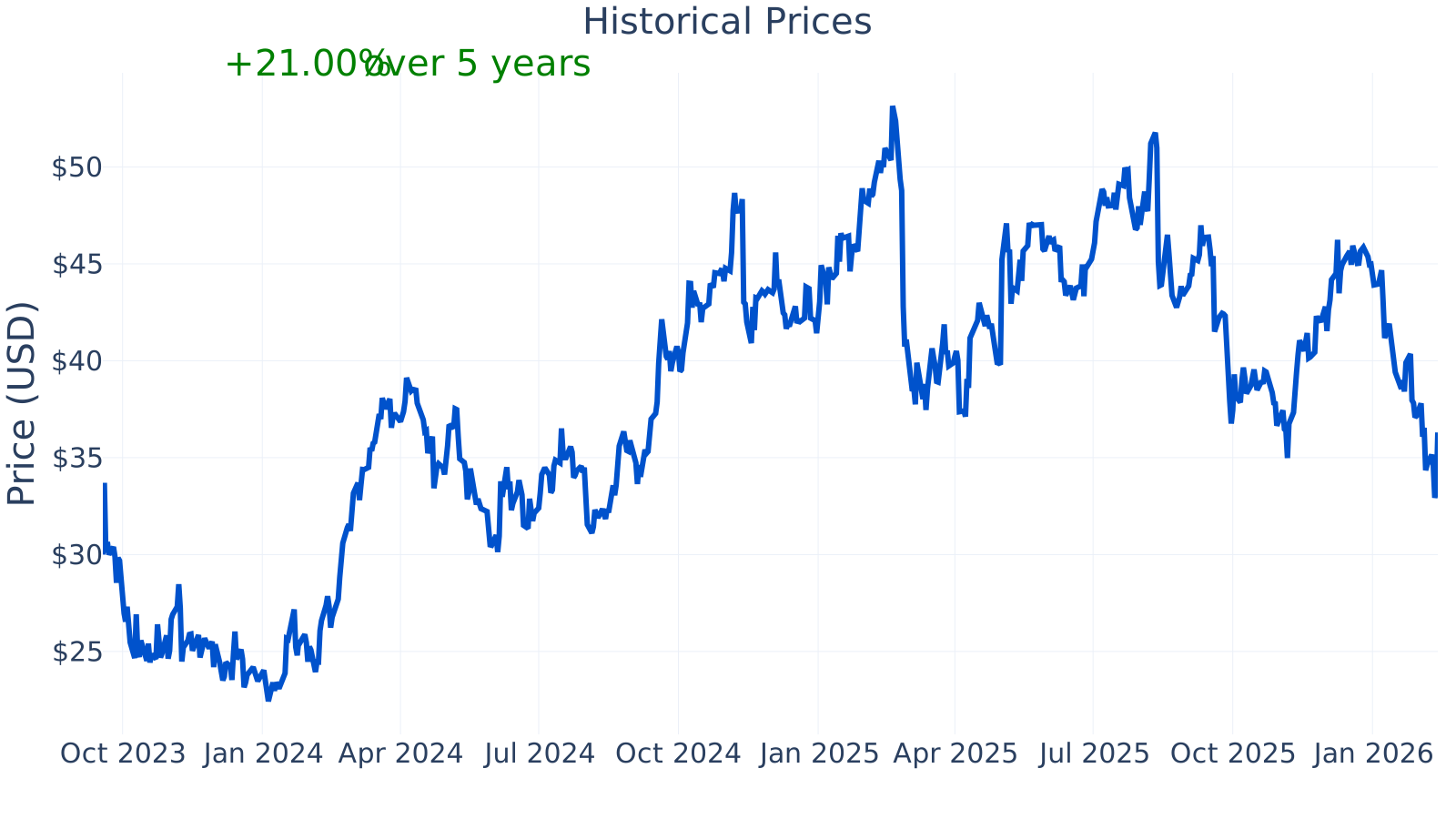
Overview
Maplebear Inc. (doing business as Instacart) operates a technology platform that connects three main groups: consumers who want groceries and other household items delivered, retailers that want digital storefronts and order fulfillment, and brands that want to advertise to shoppers at the point of purchase. In practice, Instacart helps retailers offer online shopping (website/app experiences and related tools) and coordinates delivery through shoppers who pick, pack, and deliver orders.
Its revenue is generally tied to two big engines: (1) transaction activity on the marketplace (orders and related fees) and (2) advertising and other services sold to brands and retailers. In company reporting, these are commonly described as:
- Transaction revenue (fees tied to orders and services on the platform)
- Advertising and other revenue (ads and related tools sold to consumer packaged goods brands and partners)
The business model is designed to scale because advertising can grow as shopping activity grows, and software/services can be sold across many retail partners without needing Instacart to own inventory.
Across the years shown, total revenue rises meaningfully (about $1.8B in 2021 to about $3.4B in 2024). Profitability also looks uneven: operating income and net income swing from losses (notably in 2023) to a positive result in 2024, while operating expenses vary substantially year to year. This kind of volatility often reflects one-time items and/or periods of heavier investment and should be interpreted with the company’s filings for context.
Key Figures
| Metric | Value | Industry ⓘ |
|---|---|---|
| Date | Feb 16, 2026 | |
| Context | ||
| Sector | Consumer Cyclical | |
| Industry | Internet Retail | |
| Market Cap ⓘ | $9.56B | |
| Beta ⓘ | 1.00 | |
| Fundamental | ||
| P/E Ratio ⓘ | 19.95 | 31.74 |
| Profit Margin ⓘ | 11.94% | 6.32% |
| Revenue Growth ⓘ | 12.30% | 12.40% |
| Debt to Equity ⓘ | 1.01% | 35.76% |
| PEG ⓘ | 3.54 | |
| Free Cash Flow ⓘ | $880.00M | |
Maplebear’s market capitalization is about $9.6B and its beta is about 1.0, suggesting price moves broadly in line with the overall market. The company’s P/E ratio is ~19.9, below the industry median shown (~31.7), while its profit margin is ~11.9%, higher than the industry median shown (~6.3%). Revenue growth year over year is about 12.3%, close to the industry median shown (~12.4%). Financial leverage appears low: debt-to-equity is ~1% versus an industry median shown around 35.8%. Trailing twelve-month free cash flow is about $880M.
Growth (Medium)
Instacart operates in online grocery and broader “digital storefront + fulfillment” for retailers—areas that can expand over time as more shopping shifts online and as retailers seek better software, data, and tools to personalize offers. The company also participates in retail media (ads shown to shoppers in digital storefronts), which can grow as brands continue shifting budgets toward measurable, purchase-linked advertising.
A key strategic logic is that grocery orders create frequent shopping sessions, which can support a growing advertising business. If Instacart increases the number of retailers on its platform, improves the online shopping experience, and expands ad tools for brands, it can potentially deepen monetization without relying only on higher delivery volumes.
The year-over-year revenue growth trend shown stays in the low double-digits over the periods displayed (roughly ~9% to ~15%), suggesting steady expansion rather than hypergrowth. For long-term expectations, this often places more emphasis on execution, competitive positioning, and sustained margins than on rapid top-line acceleration.
Free cash flow over the trailing twelve months increases from about $559M to about $813M across the dates shown (and the latest table shows about $880M). Consistent free cash flow can matter because it gives a business flexibility to invest in product improvements, partnerships, and operational efficiency, while also maintaining a buffer in weaker periods.
Risks (High)
The main risks center on competition and the economics of grocery delivery. Grocery is typically a low-margin category, and delivery is operationally complex. If consumer demand softens, if delivery and shopper incentives rise, or if retailers push back on fees, overall profitability can be pressured.
Competition is another major factor. Instacart faces alternatives from large retailers with their own fulfillment capabilities and from major e-commerce and delivery platforms. Competitors can include:
- Large grocery and mass retailers with in-house pickup/delivery and strong loyalty ecosystems
- General e-commerce and logistics players that can bundle delivery with other services
- On-demand delivery platforms expanding grocery and convenience offerings
Instacart’s competitive strengths are typically associated with its retailer relationships, its technology stack for e-commerce enablement, and the scale of shopping activity that supports advertising. Still, leadership can vary by geography, retailer partner mix, and the pace at which retailers choose to build in-house capabilities.
Financial leverage appears low and stable in the periods shown: debt-to-equity hovers around ~0.7% to ~1.2%, well below the industry medians displayed in the same chart. Lower leverage can reduce financial risk, but it does not remove operational and competitive risks.
Profit margin in the periods shown is volatile: it is deeply negative in early 2024, then turns positive and stays around the low-to-mid teens (roughly ~12% to ~14%) later. This pattern suggests profitability can be influenced by non-recurring items and/or shifts in expense levels. For long-term analysis, it is often important to understand what portion of margins comes from durable operations (repeatable unit economics) versus accounting items or one-offs discussed in filings.
Valuation
The P/E ratio shown for the company is generally below the industry median across the displayed dates (with the company in the low-to-mid 20s in much of the period shown, versus higher industry medians). In simple terms, that means the market price per dollar of earnings is lower than the median peer group in this view—though comparisons can be imperfect because “Internet Retail” peers may have very different business mixes, margins, and growth profiles.
Another way to frame valuation context is to connect it to growth and durability. With revenue growth around the low double-digits and profit margins that recently appear higher than the industry median in the latest metrics table, the central question becomes whether those margins and cash generation are repeatable through cycles and competitive responses. The PEG ratio shown (~3.54) can be interpreted as a sign that the valuation may be less compelling if growth expectations are modest; however, PEG is sensitive to how growth is measured and may not capture changes in profitability, advertising mix, or long-term business model evolution.
Conclusion
Maplebear/Instacart is a platform business positioned at the intersection of grocery commerce, retailer technology, and advertising. The company shows steady revenue expansion in the periods displayed and meaningful free cash flow generation, alongside very low financial leverage. At the same time, the business operates in a competitive and operationally demanding environment, and profitability metrics have shown large swings, which increases the importance of understanding what is recurring versus one-time.
From a long-term, fundamentals-focused viewpoint, the key points to track over time are (1) sustained growth in marketplace activity and retailer partnerships, (2) the ability to expand and defend advertising and services revenue, and (3) stable, repeatable profitability and cash flow through different demand environments. Valuation, as reflected in the P/E comparisons shown, appears lower than the industry median in this view, but the interpretation depends heavily on confidence in durable earnings power and competitive positioning.
Sources:
- SEC EDGAR — Maplebear Inc. filings (Form 10-K, 10-Q, 8-K)
- Maplebear Inc. / Instacart Investor Relations — SEC filings and shareholder materials
- Wikipedia — “Instacart” (basic company background)
This article is for informational purposes only and does not constitute financial advice. Some content is AI-generated. See Disclaimer


