Stock Analysis · Manhattan Associates Inc (MANH)
Overview
Manhattan Associates, Inc. (MANH) is a software company focused on helping businesses run and optimize their supply chain and commerce operations. In practical terms, its products are used by retailers, manufacturers, wholesalers, and logistics providers to manage warehouses, transportation, inventory, and order fulfillment across physical stores and online channels. The company positions its platform to support “omnichannel” operations, where customers can buy, return, or receive goods through multiple paths (ship-to-home, buy-online-pickup-in-store, ship-from-store, and similar models).
Manhattan Associates generally generates revenue from software and related services. Based on how the company describes its business in its SEC filings, the main revenue streams typically include software licenses/subscriptions (including cloud offerings) and maintenance/support, plus professional services such as implementation and consulting. Exact percentages can vary by year and are reported in detail in the company’s annual report.
Main sources of revenue (typical structure as described in filings)
- Software revenue (licenses and/or subscriptions, including cloud)
- Maintenance and support (support and updates tied to software use)
- Services (implementation, consulting, and related professional services)
The business model tends to benefit from recurring elements (support and subscription-style revenue), while services can help drive adoption and expansion of the software footprint inside customers.
Across the periods shown, total revenue rises materially (from about $664M in 2021 to about $1.081B in 2025). Spending on research and development also increases (about $98M to about $145M), indicating continued investment in product capabilities alongside revenue expansion. Net income also grows over the same span (about $110M to about $220M), showing that profitability has been maintained while the business scaled.
Key Figures
| Metric | Value | Industry ⓘ |
|---|---|---|
| Date | Feb 07, 2026 | |
| Context | ||
| Sector | Technology | |
| Industry | Software - Application | |
| Market Cap ⓘ | $8.74B | |
| Beta ⓘ | 1.03 | |
| Fundamental | ||
| P/E Ratio ⓘ | 40.30 | 27.79 |
| Profit Margin ⓘ | 20.34% | 6.02% |
| Revenue Growth ⓘ | 16.60% | 15.80% |
| Debt to Equity ⓘ | 35.70% | 25.15% |
| PEG ⓘ | 1.68 | |
| Free Cash Flow ⓘ | $374.01M | |
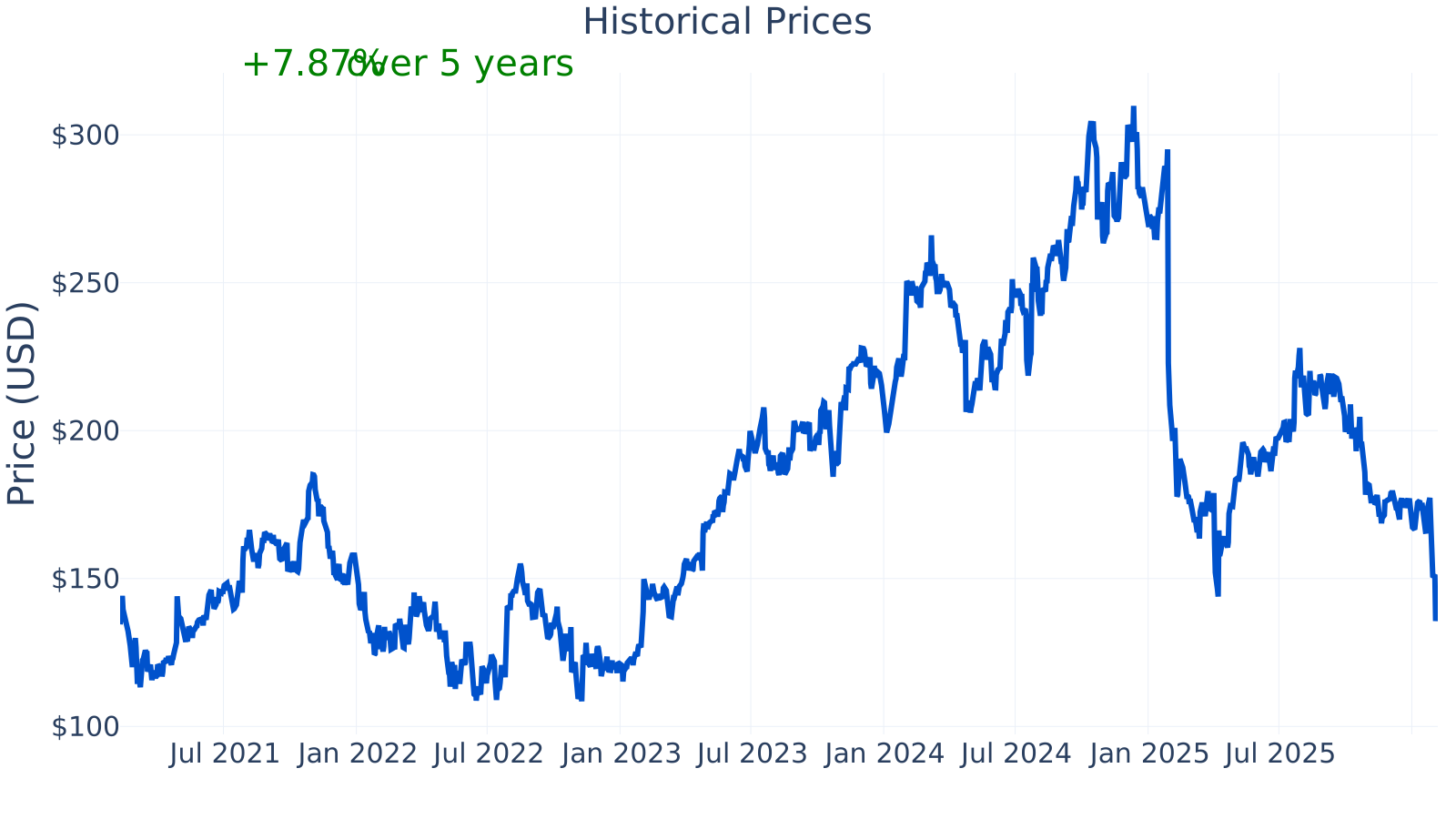
Manhattan Associates’ market capitalization is about $8.7B, and the stock’s beta (~1.03) suggests price movement broadly in line with the overall market. Profitability stands out versus the industry median: the company’s profit margin is ~20.34% compared with an industry median near 6.03%. Year-over-year revenue growth is about 16.6%, roughly in line with the industry median (~15.8%). Leverage is moderate with debt-to-equity ~35.7% (industry median ~25.2%). The trailing free cash flow shown is about $374M. The P/E ratio is ~40.3 versus an industry median near 27.8, and the PEG ratio is ~1.68, which is often used as a rough way to relate valuation to growth expectations.
Growth (Medium)
Manhattan Associates operates in supply chain and enterprise software—an area supported by long-term trends such as rising e-commerce complexity, faster delivery expectations, labor constraints in warehouses, and the need for better inventory visibility across networks. These trends tend to push companies to modernize warehouse management, transportation planning, and order orchestration systems, especially when they are trying to unify store and online operations.
The company’s strategy centers on mission-critical software that is deeply integrated into customer operations. Once deployed, these systems can be expensive and time-consuming to replace, which can support longer customer relationships. Growth can also come from expanding within existing accounts (adding more modules, locations, or users) and from continued adoption of cloud-based deployments, where customers pay over time rather than largely upfront.
The year-over-year revenue growth rate shown is strong in 2021–2023 (often around the mid-to-high teens and above 20% in several quarters), then it slows notably through 2024–2025 (down to low single digits in multiple quarters, with a modest rebound to about 5.7% by the end of 2025). This pattern can be consistent with a normalization after a strong period, but it also means future outcomes may depend more on execution, customer spending cycles, and competitive dynamics.
Free cash flow trends upward over the period shown (from about $167M in 2021 to about $308M by early 2025), indicating improving cash generation as the business scales. This can matter for long-term durability because cash flow can support reinvestment in product development and sales capacity, and it can provide flexibility through weaker demand environments.
Risks (Medium)
This article is for informational purposes only and does not constitute financial advice. Some content is AI-generated. See Disclaimer