Stock Analysis · Sphere Entertainment Co (SPHR)
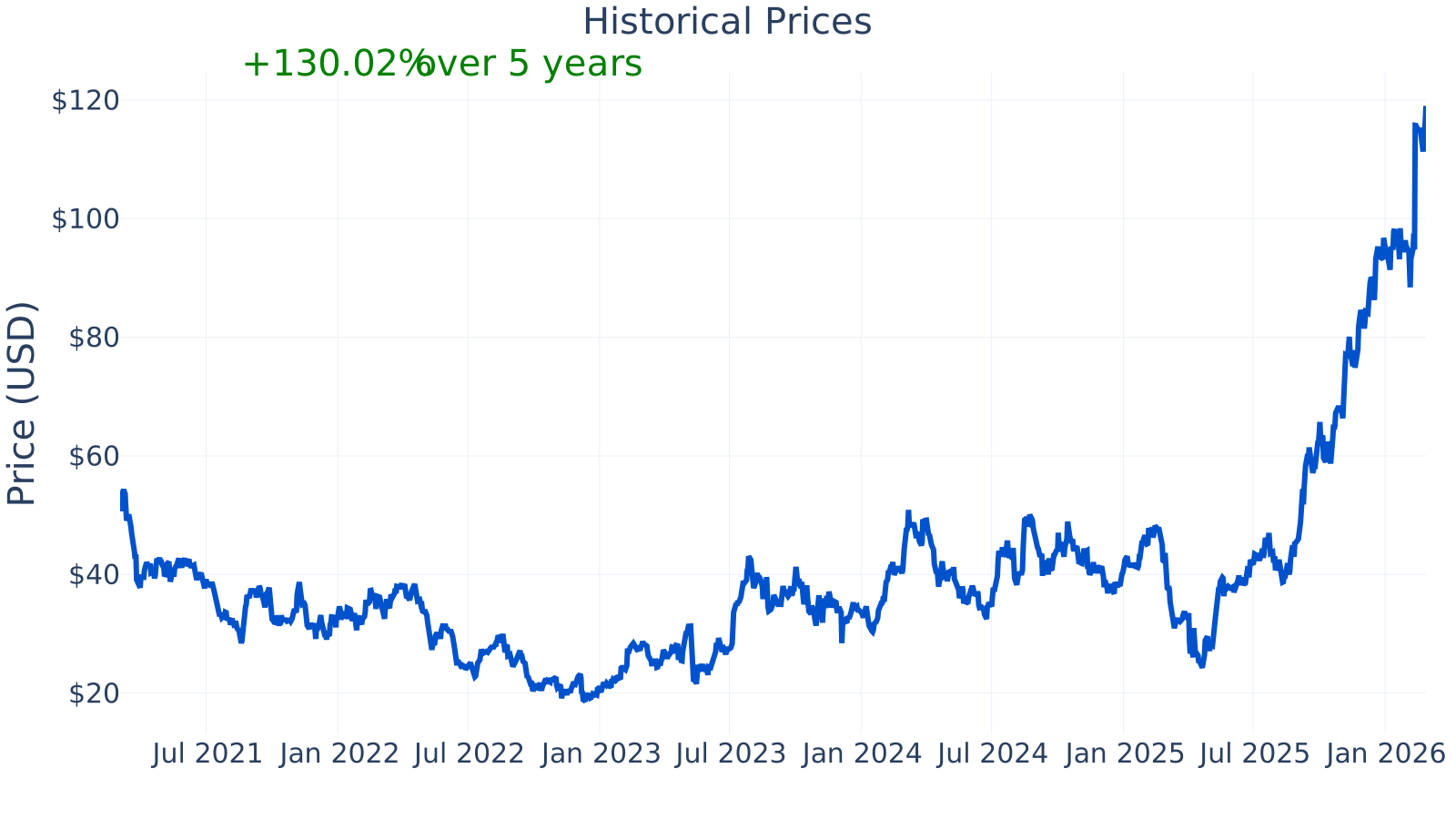
Overview
Sphere Entertainment Co. (SPHR) is an entertainment company built around live experiences and venue-based content. Its best-known asset is Sphere in Las Vegas, a purpose-built venue designed for large-scale concerts and immersive shows that combine custom video, audio, and production technologies. The company also owns and operates Madison Square Garden in New York City, a major arena that hosts sports and live events.
In plain terms, Sphere Entertainment primarily earns money by selling tickets and premium seating for events, generating venue-related income (such as suites and hospitality), and selling advertising or sponsorship placements tied to its venues and productions. Because the business is centered on physical venues, results can vary meaningfully from quarter to quarter depending on the event calendar, the mix of shows, and one-time items tied to productions or accounting.
Main revenue sources typically include the following (ordered from largest to smallest in most venue-based entertainment models; exact mix varies by period and is detailed in company filings):
- Event-related revenue (ticket sales, premium seating, suites, VIP packages)
- Venue-related revenue (food and beverage, merchandise, facility fees, hospitality)
- Advertising and sponsorship (brand partnerships and venue media placements)
- Content and production-related revenue (when the company produces/hosts proprietary shows and related commercial arrangements)
Over time, the strategic question for long-term shareholders is whether Sphere can consistently fill event calendars at attractive economics and whether the company can replicate or expand its venue concept and content model beyond a single flagship location.
The most visible pattern in the operating flow is that revenue can be large, but profitability depends heavily on cost structure. In some periods, operating expenses and interest costs have been meaningful, which can pressure bottom-line results even when sales are strong.
Key Figures
| Metric | Value | Industry ⓘ |
|---|---|---|
| Date | Mar 02, 2026 | |
| Context | ||
| Sector | Communication Services | |
| Industry | Entertainment | |
| Market Cap ⓘ | $4.23B | |
| Beta ⓘ | 1.65 | |
| Fundamental | ||
| P/E Ratio ⓘ | 160.82 | 60.32 |
| Profit Margin ⓘ | 2.74% | 4.13% |
| Revenue Growth ⓘ | 27.90% | 9.80% |
| Debt to Equity ⓘ | 43.05% | 72.22% |
| PEG ⓘ | N/A | |
| Free Cash Flow ⓘ | $191.00M | |
Sphere Entertainment’s market capitalization is about $4.23B. The stock’s beta of 1.65 suggests it has tended to move more than the broader market, which often aligns with companies that have higher uncertainty in earnings or business execution.
On profitability, the latest profit margin is about 2.74% versus an industry median around 4.13%, indicating thinner net profitability than many peers at this point in time. On growth, the latest year-over-year revenue growth is about 27.9% versus an industry median around 9.8%, which stands out as faster top-line expansion than the typical company in its entertainment peer set.
Balance-sheet leverage (debt relative to equity) is about 43.1%, below an industry median around 72.2%. Free cash flow over the trailing twelve months is shown as about $191.0M, though longer-term consistency matters more than a single period for a venue-and-production business.
Growth (Medium)
Live entertainment is a large, established industry, and venue-based experiences continue to compete well for consumer leisure spending. Sphere Entertainment’s approach focuses on differentiation: offering a venue format that artists and audiences may see as meaningfully distinct from standard arenas. If the format proves durable, it can support pricing power through premium seating, sponsorship demand, and repeat attendance for proprietary productions.
However, the growth profile is not purely “industry growth”—it is also highly company-specific. A key driver is execution: booking a steady pipeline of compelling shows, operating the venue efficiently, and scaling the model through new content formats or potential additional venues over time (if the company chooses and is able to do so).
Revenue growth has been volatile across quarters, including some very large swings. The most recent reading shows a return to positive growth (about 27.9% year over year), which is notably above the peer median shown. For a business like this, swings can reflect timing of major events, changes in show schedules, and the mix between one-time and recurring revenue streams.
Free cash flow has also shown meaningful variation over time. Earlier periods were deeply negative, improving toward near break-even and then turning positive in the latest trailing twelve months (about $191.0M). For long-term evaluation, an important question is whether positive free cash flow is repeatable after accounting for ongoing venue upkeep, technology upgrades, and the cost of developing new shows.
Potential catalysts (in a factual, non-predictive sense) generally include: (1) a stronger and more predictable event slate, (2) improved operating efficiency and cost control, (3) growth in high-margin sponsorship/advertising tied to the venues, and (4) any strategic steps to expand the Sphere concept or monetize the underlying venue technology through partnerships.
Risks (High)
Sphere Entertainment faces several risks that are typical for venue-centric companies but can be amplified by the uniqueness and scale of the Sphere concept. A major operational risk is event concentration: results can depend heavily on a limited number of major shows and production runs. If demand softens, if the booking pipeline weakens, or if production costs rise, profitability can change quickly.
Debt relative to equity is currently about 43.1%, below the peer median shown. Even with moderate leverage by comparison, the company’s business model can be capital-intensive, and interest expense can matter when earnings are uneven. The historical pattern shows leverage has moved around substantially over time, reinforcing that balance-sheet positioning is an item to monitor rather than assume stable.
Profitability has been highly volatile from quarter to quarter. The latest net profit margin is slightly positive (about 2.74%) but below the industry median displayed (about 4.76%). Prior periods include deeply negative margins as well as unusually high positive readings, which can occur when one-time items, accounting impacts, or large discrete events affect results. For long-term assessment, the key is whether the company can deliver steadier operating income through repeatable venue economics rather than sporadic peaks.
Competitive dynamics are complex because Sphere is not a typical “one-to-one” competitor with standard arenas—it is closer to a premium, differentiated venue category. That said, it still competes for the same limited inputs: top-tier artist tours, audience attention, and brand sponsorship budgets. Important competitive pressures include:
- Major venue operators and promoters (large networks can have scale advantages in booking, marketing, and sponsorship sales)
- Other destination venues in Las Vegas and major cities (competing for visitor time and discretionary spending)
- Alternative entertainment formats (sports, concerts in traditional arenas/stadiums, streaming, and experiential attractions)
Sphere Entertainment’s competitive advantage is primarily differentiation—a venue designed to enable shows that are difficult to replicate elsewhere. Whether that advantage remains strong depends on continued content quality, operational execution, and the willingness of artists and partners to prioritize the format.
Valuation
The current P/E ratio is about 160.8, which is well above the industry median of about 60.3 shown in the table. A high P/E can occur when the market expects materially higher future earnings, when current earnings are temporarily depressed (making the “E” small), or when profitability is inconsistent and the metric becomes less informative.
For Sphere Entertainment specifically, the valuation picture should be read alongside two realities visible elsewhere in the metrics: (1) profit margins have been volatile, and (2) free cash flow has improved recently but has not been consistently positive across the full period shown. In that context, a high P/E can be interpreted less as a clean signal of “expensive vs. cheap” and more as a reflection that the company’s current earnings level may not represent a stable, mature run-rate.
Conclusion
Sphere Entertainment is a venue-based entertainment business with a differentiated flagship asset and a strategy centered on premium live experiences, sponsorship, and venue monetization. The recent metrics show stronger year-over-year revenue growth than the peer median and improved free cash flow compared with earlier periods, but they also show thin profitability and a history of large swings in margins.
From a long-term perspective, the central issues are durability and repeatability: whether the company can consistently program high-demand events, expand higher-margin revenue streams like sponsorship and premium seating, and manage operating costs and capital needs over time. The valuation metrics shown (including a high P/E versus the peer median) indicate that the stock’s pricing is sensitive to expectations about future earnings normalization and growth, making the outcome more dependent on execution than for a steadier, more predictable entertainment business.
Sources:
- SEC EDGAR — Sphere Entertainment Co filings (Form 10-K, Form 10-Q, Form 8-K)
- Sphere Entertainment Co — Investor Relations materials and press releases
- Wikipedia — “Sphere Entertainment Co” (basic company background)
This article is for informational purposes only and does not constitute financial advice. Some content is AI-generated. See Disclaimer


