Stock Analysis · Madison Square Garden Sports Corp (MSGS)
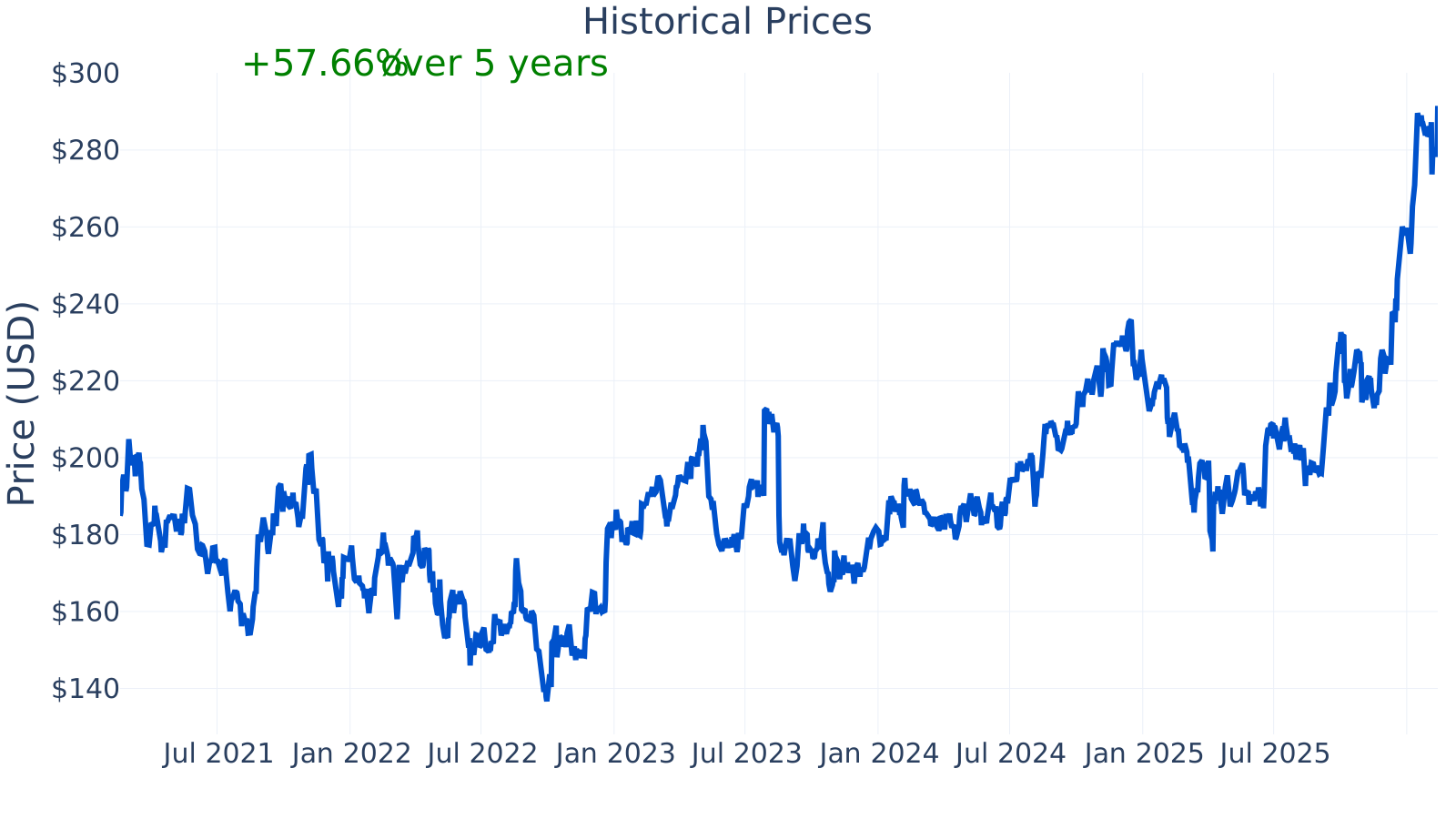
Overview
Madison Square Garden Sports Corp (MSGS) is a U.S. sports company that owns and operates major professional sports franchises. Its core assets are the New York Knicks (NBA) and the New York Rangers (NHL). The business centers on staging games and related events, selling tickets and premium experiences, negotiating media rights, and monetizing team brands through sponsorships and merchandise.
In its SEC filings, MSGS describes revenue mainly across these categories (names can vary slightly by reporting period):
- Media rights (regional sports network and other media arrangements tied to game broadcasts)
- Ticket sales (including suites and premium seating)
- Sponsorship and advertising
- Merchandise (team-related sales and licensing)
- Other revenues (including league distributions and other event-related items)
Across recent years, the company’s economics have been heavily influenced by (1) the strength of demand for live sports in New York, (2) the value of media rights, and (3) the cost structure of operating teams—especially player compensation and team-related expenses.
The business mix shown above highlights that total revenue has generally been higher in more recent periods than in earlier years shown, while costs and overhead (including team and operating expenses) remain large and can swing profitability meaningfully from year to year.
Key Figures
| Metric | Value | Industry ⓘ |
|---|---|---|
| Date | Feb 16, 2026 | |
| Context | ||
| Sector | Communication Services | |
| Industry | Entertainment | |
| Market Cap ⓘ | $7.02B | |
| Beta ⓘ | 0.56 | |
| Fundamental | ||
| P/E Ratio ⓘ | N/A | 51.67 |
| Profit Margin ⓘ | -1.55% | 4.43% |
| Revenue Growth ⓘ | 12.80% | 5.50% |
| Debt to Equity ⓘ | -719.27% | 76.35% |
| PEG ⓘ | N/A | |
| Free Cash Flow ⓘ | $2.77M | |
MSGS has a market capitalization of about $7.0B and a beta of ~0.56, which historically has implied less day-to-day volatility than the broad market. The company’s latest profit margin is about -1.6% versus an industry median near 4.4%, indicating profitability has recently been below many peers. At the same time, its year-over-year revenue growth is about 12.8%, above the industry median near 5.5%. Free cash flow over the trailing twelve months is about $2.8M, which is positive but small relative to the size of the business and can vary substantially with working capital timing and seasonal factors in sports.
Growth (Medium)
Professional sports team ownership typically participates in long-term demand for live entertainment and premium sports content. Over time, leagues have benefited from ongoing interest in live games (which are harder to replace with on-demand content) and from continued evolution in how sports media is packaged and distributed. For MSGS, the strategic logic is straightforward: the Knicks and Rangers are long-lived brands with valuable home markets, and the company can monetize them through tickets, premium seating, sponsorships, and media-related arrangements.
The revenue growth pattern has been uneven quarter-to-quarter, but the most recent year-over-year growth shown is ~12.8%, above the industry median. For a sports operator, fluctuations can come from scheduling, playoff runs, pricing changes, and contractual timing for sponsorship and media items.
Free cash flow has moved from materially negative in 2021 (shown at about -$183M) to positive in later periods (for example, about $228M in 2023 and $150M in 2025 as shown). The latest trailing figure shown is positive but modest. This history suggests cash generation can be strong in some periods, but it is not consistently high every year.
Potential catalysts (in the plain-language sense of “things that can change results”) typically include: changes in media economics and distribution, renewed or renegotiated commercial partnerships, sustained demand for premium seating, and on-court performance (especially playoff-related home games), all of which are discussed as key business factors in company filings.
Risks (High)
MSGS faces meaningful operating risk because a large portion of its costs are tied to running professional teams. Player and team personnel compensation, revenue-sharing and league-related costs, and game-day operating expenses can pressure results, particularly if revenue growth slows. Performance risk also matters: team success can influence attendance, premium pricing power, and playoff-related revenue opportunities.
The debt-to-equity ratio shown is negative in the periods displayed (most recently shown around -719%). A negative debt-to-equity ratio often happens when accounting equity is negative (for example, due to accumulated deficits and/or capital structure history), which can make this ratio less intuitive than for typical operating companies. Even when the ratio is hard to interpret, the underlying point remains: the balance sheet structure and financing terms are important to review directly in the 10-K/10-Q because leverage, liquidity needs, and covenant constraints can affect flexibility.
Profitability has also been volatile. The most recent profit margin shown is about -1.6%, below the industry median (about 5.0% in the latest point shown for the peer median). MSGS has had periods of solid positive margins in earlier quarters, followed by weaker recent results. This variability is consistent with a business where expenses and revenue timing can shift meaningfully across seasons and years.
In terms of competitive positioning, MSGS’s advantages are primarily asset-based: ownership of two major league franchises in a very large media market, with long-standing fan bases and brand recognition. However, it is not competing “product-to-product” in the way a typical consumer company might; rather, it competes for consumer entertainment spending, sponsorship budgets, and media economics, while league structures shape many economic rules (such as revenue sharing, salary rules, and licensing).
Main comparable competitors are other publicly traded sports and live entertainment entities that own teams and monetize media, sponsorships, and tickets. Examples commonly referenced by investors include companies tied to professional franchises and sports rights holders (though business models differ), such as:
- Liberty Media tracking stocks with sports exposure (structure differs from MSGS)
- Other public team ownership groups (where available) and broader sports/entertainment operators
Relative placement is less about being a “market share leader” and more about the value and scarcity of the underlying franchises, local market economics, arena-related dynamics (even where MSGS does not own the venue), and the terms of media and sponsorship arrangements.
Valuation
Price-to-earnings (P/E) is a common yardstick, but it can be less informative for MSGS when earnings swing meaningfully. In the periods where a P/E is shown, MSGS often appears higher than the industry median (for example, many displayed points are well above peer medians in the ~20–40 range). A higher P/E can occur when the market assigns more value to franchise scarcity and long-lived brand assets, but it can also reflect that current earnings are temporarily low versus revenue potential.
Because recent profitability is thin to negative (as shown by the latest margin), valuation discussions frequently require looking beyond a single-year earnings snapshot—such as reviewing multi-year operating performance, cash flow consistency, and balance sheet details in the company’s filings. In other words, whether the current price is “expensive” is tightly linked to assumptions about (1) normalized earnings power across sports cycles, (2) the durability of media and sponsorship economics, and (3) cost control versus revenue growth.
Conclusion
MSGS is primarily a concentrated ownership play on two iconic New York professional sports franchises, monetized through media-related arrangements, tickets (including premium seating), sponsorships, and merchandise. The long-run growth logic generally rests on continued demand for live sports and the scarcity value of major-league teams, while results can still vary widely based on team performance, cost structure, and media economics.
The recent profile shown combines above-median revenue growth with weaker recent profitability and a balance sheet ratio (debt-to-equity) that is difficult to interpret without closely reviewing the underlying equity and liabilities in SEC reports. For long-horizon analysis, the key factual focus areas are (1) the sustainability of revenue streams, (2) the drivers of margin volatility, and (3) financing and liquidity details disclosed in the 10-K and 10-Q.
Sources:
- U.S. Securities and Exchange Commission (SEC EDGAR) — Madison Square Garden Sports Corp filings (10-K, 10-Q, 8-K)
- Madison Square Garden Sports Corp Investor Relations — SEC filings and investor materials
- Wikipedia — “Madison Square Garden Sports” (basic company background)
This article is for informational purposes only and does not constitute financial advice. Some content is AI-generated. See Disclaimer


