Stock Analysis · Madison Square Garden Entertainment Corp (MSGE)
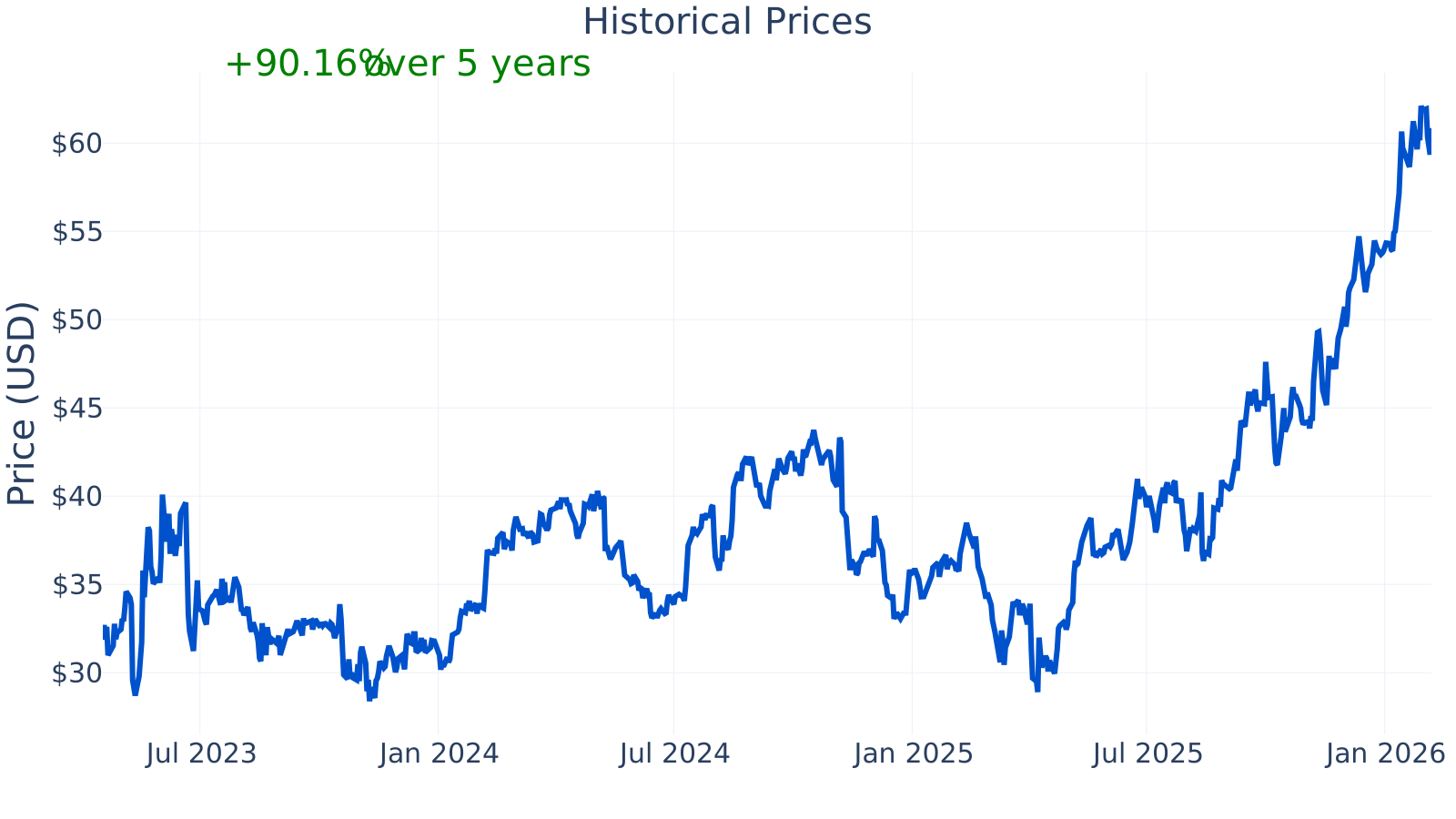
Overview
Madison Square Garden Entertainment Corp (MSGE) is a live entertainment company. It operates and books major venues, promotes and presents concerts and events, and earns revenue from hosting third-party events as well as from company-promoted shows. In practice, MSGE’s results are shaped by how many events it can schedule, how strong demand is for tickets, and how much it can earn per event from premium seating, food and beverage, suites, sponsorships, and venue-related services.
In its SEC reporting, MSGE discusses revenue in terms of its entertainment and venue operations (rather than a single product line). Common revenue streams for this type of venue-and-events business include ticketing-related income, sponsorship/advertising, premium hospitality, and other venue-based services (such as rentals, concessions, and merchandise tied to events).
When looking at the overall business mix, it can be helpful to think of MSGE’s revenue as coming from a few big “buckets” (ordered from typically largest to smaller), even if exact percentages vary by period and event calendar:
- Event-related revenue (ticketing-related income, fees tied to events, and other show-driven revenue)
- Premium hospitality (suites, premium seating products, VIP experiences)
- Food, beverage, and merchandise (venue sales connected to attendance)
- Sponsorship and advertising (brand partnerships and venue signage/activations)
- Venue rentals and other services (third-party events and venue-related services)
From a big-picture financial standpoint, MSGE has operated at around a ~$0.9–$1.0B annual revenue level in recent fiscal years, while profitability can move meaningfully year to year as the event mix changes and fixed costs are absorbed across more (or fewer) events.
Over the last several fiscal years shown, total revenue rose sharply from FY2021 levels (a period heavily affected by pandemic disruptions) to a more normalized range by FY2022–FY2025. Over that span, gross profit also expanded materially versus FY2021, while interest expense remained a recurring cost. Net income improved versus earlier years but has not moved in a straight line, highlighting how event-driven businesses can see profitability swing as scheduling, pricing, and costs change.
Key Figures
| Metric | Value | Industry ⓘ |
|---|---|---|
| Date | Feb 07, 2026 | |
| Context | ||
| Sector | Consumer Cyclical | |
| Industry | Leisure | |
| Market Cap ⓘ | $2.88B | |
| Beta ⓘ | 0.39 | |
| Fundamental | ||
| P/E Ratio ⓘ | 55.83 | 27.06 |
| Profit Margin ⓘ | 5.12% | 7.90% |
| Revenue Growth ⓘ | 12.90% | 6.00% |
| Debt to Equity ⓘ | 4900.27% | 33.08% |
| PEG ⓘ | N/A | |
| Free Cash Flow ⓘ | $206.96M | |
MSGE’s market capitalization is about $2.88B, placing it in the small-to-mid cap range. The stock’s beta of ~0.39 suggests the shares have historically moved less than the broader market on average (though company-specific news and event cycles can still drive volatility). The latest P/E ratio is ~55.8, which is above the industry median (~27.1). Profitability is currently under pressure: the latest profit margin is ~5.1% versus an industry median (~7.9%). On growth, the latest year-over-year revenue growth is ~12.9%, above the industry median (~6.0%). One standout metric is capital structure: debt-to-equity is ~4,900% versus an industry median of ~33%, a sign that equity (book value) is low relative to debt and that leverage and accounting equity levels can meaningfully affect ratio-based comparisons. Trailing twelve-month free cash flow is about $207M, indicating the business has recently generated cash after operating costs and capital spending.
Growth (Medium)
Live entertainment is supported by long-term consumer demand for in-person experiences, but it is also cyclical: spending on concerts and events can soften during economic downturns, and results can vary based on touring schedules and the overall event calendar. Within that context, MSGE’s path to growth is closely tied to increasing the volume and quality of events it hosts and promotes, improving per-cap spending (premium seating, hospitality, food and beverage), and maintaining strong venue utilization.
The year-over-year revenue growth pattern has been uneven, with quarters swinging between contraction and expansion. Recent readings include a return to positive growth (for example, roughly +14.1% and +12.9% in the most recent points shown), but there were also periods of decline (including around -17.2%). This variability is consistent with an events business where timing and the mix of shows can shift results from quarter to quarter.
Free cash flow has also fluctuated but remained positive in the periods shown, moving from about $120.5M (mid-2023) to about $91.8M (early 2024) and then back to about $119.8M (early 2025), with the latest trailing twelve-month level listed at about $207M in the key figures table. For long-term business building, sustained positive free cash flow can matter because it can help fund venue investment, reduce financial obligations, or provide flexibility during weaker event cycles (how it is used depends on management decisions and constraints).
Potential catalysts (in a strictly factual, business-sense framing) generally include: strong touring and event demand, improved venue utilization, enhanced premium offerings, and continued ability to secure high-profile events and partnerships. Because MSGE’s business is venue-centric, execution and scheduling are central: the company’s strategy tends to work best when it can consistently run a high number of high-demand events through its venues and related platforms.
Risks (High)
MSGE faces several structural risks typical of live entertainment. Revenue depends on event schedules and consumer discretionary spending, which can weaken during recessions. Costs also include meaningful fixed components (venue operations, staffing, maintenance), which can pressure margins if event volume dips. In addition, event businesses can face concentration risk if performance is heavily influenced by a smaller number of major events, tours, or seasonal patterns.
Leverage metrics show notable volatility over time and an unusually high latest debt-to-equity reading (about 4,900%, versus an industry median near 33%). This ratio can be distorted when accounting equity is low, but it still points to a balance sheet structure that may be more sensitive to interest costs, refinancing conditions, and shifts in profitability than peers with more conservative leverage. The historical series also includes negative values and very large positives, reinforcing that this is not a stable, “set-and-forget” ratio for MSGE and should be interpreted with care and with the full financial statements.
Margins have also been unstable. The series shows periods of strong profitability (for example, margin peaks above 15% and 18% at certain points) followed by a sharp deterioration into negative territory (around -4.6% and -2.7% in the latest points shown). Compared with the industry median line, MSGE has at times outperformed peers, but the more recent trend indicates increased pressure. For an investor trying to understand business quality, this kind of swing typically raises questions about cost control, event mix, and how resilient earnings are across cycles.
Competition is also a key consideration. MSGE competes for concerts and events with other major venue operators and live entertainment promoters. Competitive advantages for MSGE generally come from the strength and reputation of its venues, location advantages for certain events, and the ability to offer premium experiences that can lift per-attendee revenue. At the same time, large-scale promoters, ticketing ecosystems, and alternative venues can influence booking economics and bargaining power. MSGE’s position is strong in the specific venues it controls, but the broader live-events landscape is competitive and influenced by artist touring decisions, venue availability, and promoter relationships.
Valuation
On an earnings-multiple basis, MSGE currently screens as more expensive than the industry median: the latest P/E is ~55.8 versus an industry median ~27.1. The historical P/E series also shows that MSGE’s multiple has moved widely over time, including periods around the low teens and a sharp spike (around 50.9) in mid-2025. In general terms, a higher P/E often implies the market is placing more value on each dollar of current earnings, which can be harder to justify if earnings are volatile.
In MSGE’s case, interpreting valuation requires extra caution because profitability and margins have swung significantly, and leverage-related ratios can be affected by changes in accounting equity. When earnings are temporarily depressed (or unusually strong), P/E ratios can look misleadingly high (or low). For that reason, valuation is often discussed alongside cash generation, balance sheet structure, and whether revenue and margins are becoming more stable over time.
Conclusion
MSGE is a live entertainment and venue-focused company whose results are driven by event volume, demand for premium experiences, and the economics of booking and hosting major shows. Financially, revenue has recovered substantially from early-2020s disruption levels and recent year-over-year revenue growth has been positive, but the path has been uneven. Cash generation has been positive in the periods shown, which can support operational flexibility.
The main areas that stand out for a long-term, fundamentals-focused review are (1) the variability in profit margins, including recent negative readings, and (2) an unusually high and volatile debt-to-equity profile relative to industry medians, which can increase sensitivity to downturns and financing conditions. On valuation, the current P/E multiple is above the industry median, which places more weight on the company’s ability to deliver steadier profitability over time.
Sources:
- SEC EDGAR — Madison Square Garden Entertainment Corp filings (Form 10-K, Form 10-Q, Form 8-K)
- Madison Square Garden Entertainment Corp — Investor Relations materials (company-hosted press releases and financial reports)
- Wikipedia — “Madison Square Garden Entertainment” (basic company background)
This article is for informational purposes only and does not constitute financial advice. Some content is AI-generated. See Disclaimer


