Stock Analysis · Macys Inc (M)
Overview
Macy’s, Inc. is a U.S. retail company best known for its department stores and related digital storefronts. It sells a broad mix of consumer products, with a heavy focus on apparel and accessories, beauty, home goods, and seasonal items. The company operates under multiple nameplates, including Macy’s and Bloomingdale’s, and it also runs Bluemercury (a specialty beauty chain). In practice, Macy’s combines physical stores (often in major shopping areas and malls) with e-commerce, loyalty programs, and store-branded credit card partnerships that help drive repeat purchasing.
Across its filings, the company describes revenue as coming primarily from retail sales (in stores and online), with additional contribution from credit card-related income and other smaller items. In plain terms, the core business remains selling merchandise to consumers, while financial partnerships (especially store-branded credit cards) can materially influence profitability in certain years.
Main revenue drivers (from largest to smaller, based on how Macy’s describes its business in filings) typically include:
- Merchandise sales (in-store and online across Macy’s, Bloomingdale’s, and Bluemercury)
- Credit card and related income (through a third-party credit card partnership)
- Other revenue (smaller items such as certain service income and ancillary activities)
Percentages by source can vary by year and presentation, and the company’s filings are the authoritative place to confirm the exact breakdown for a given fiscal year.
Over the last several fiscal years shown, total revenue trends down (from about $25.4B in fiscal 2022 to about $23.0B in fiscal 2025). At the same time, operating income and net income fluctuate significantly, which highlights how sensitive results can be to pricing, promotions, inventory management, and operating costs in department-store retail.
Key Figures
| Metric | Value | Industry ⓘ |
|---|---|---|
| Date | Feb 08, 2026 | |
| Context | ||
| Sector | Consumer Cyclical | |
| Industry | Department Stores | |
| Market Cap ⓘ | $6.04B | |
| Beta ⓘ | 1.52 | |
| Fundamental | ||
| P/E Ratio ⓘ | 13.35 | |
| Profit Margin ⓘ | 2.10% | |
| Revenue Growth ⓘ | 0.20% | |
| Debt to Equity ⓘ | 121.14% | |
| PEG ⓘ | 2.42 | |
| Free Cash Flow ⓘ | $1.09B | |
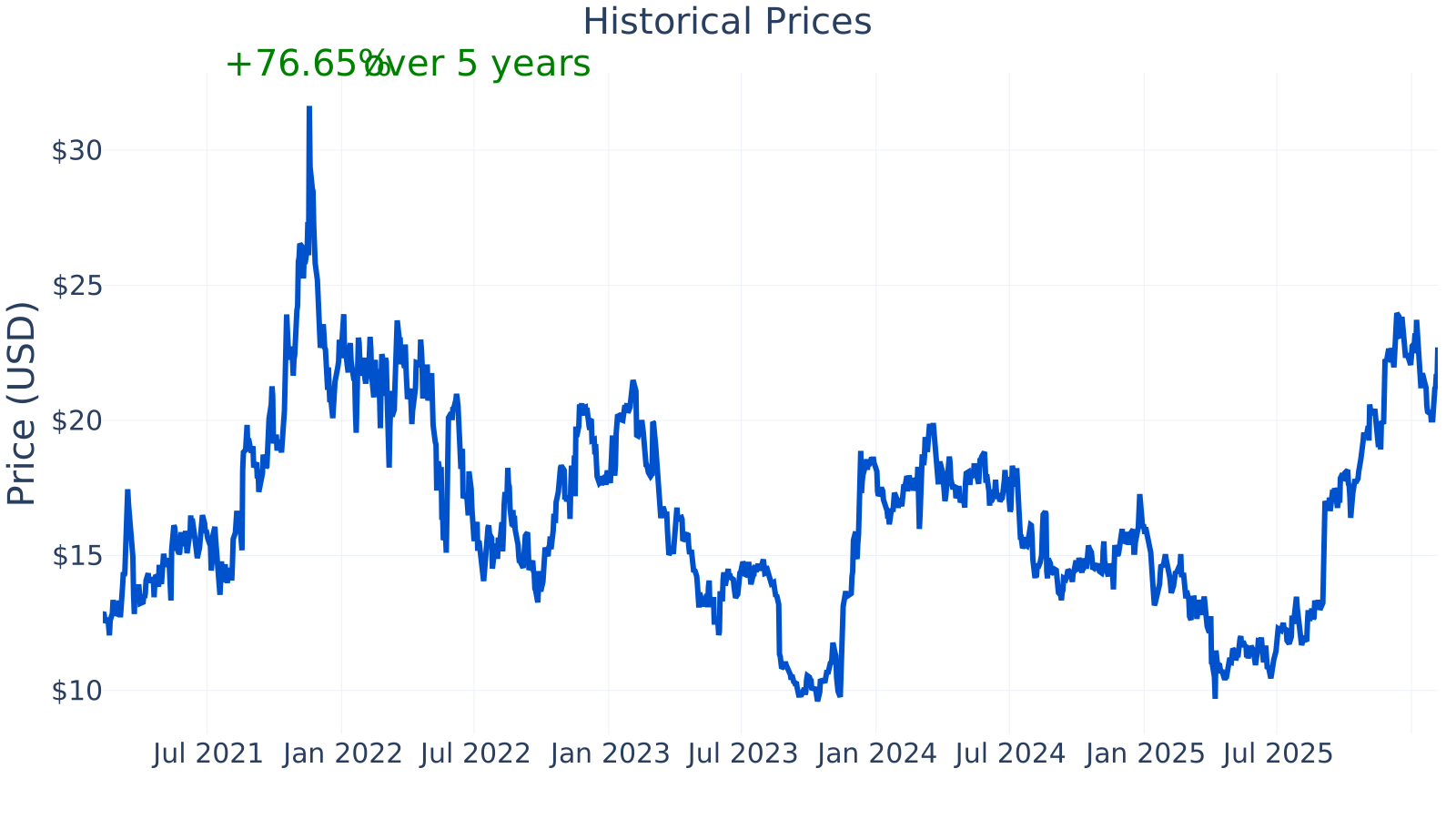
Macy’s market capitalization is about $6.0B, placing it in the mid-cap range. The stock’s beta of ~1.53 suggests it has tended to move more than the overall market, which can matter for long-term holders who prefer steadier price behavior. The company’s latest P/E ratio is ~13.35, while the profit margin is ~2.1%, reflecting a business where small changes in sales or costs can have an outsized impact on earnings. Revenue growth is close to flat most recently (~0.2% year-over-year). Reported debt-to-equity is ~121%, indicating meaningful leverage. Trailing twelve-month free cash flow is about $1.087B, a key support for reinvestment, debt reduction, and shareholder returns when sustained.
Growth (Low)
The department store industry in the U.S. is generally considered mature, with long-running pressure from e-commerce, off-price retailers, and changing consumer shopping habits. That doesn’t prevent periods of stabilization or improvement, but it does mean that long-term expansion often depends more on taking share, improving merchandising and customer experience, and running the cost structure efficiently than on broad industry growth.
Macy’s strategy (as described in company materials and filings) has typically centered on a mix of improving product assortment, strengthening digital capabilities, using data and loyalty programs to personalize marketing, and optimizing the store footprint. In a mature retail category, these actions are often aimed at protecting relevance and margins rather than driving rapid top-line growth.
The year-over-year revenue pattern shows a strong rebound in 2021–early 2022 (against weaker prior periods), followed by a stretch of declines through much of 2022–2025, with the most recent point roughly back to flat (~0.2%). This shape is consistent with a retailer that experienced a post-pandemic demand surge and then faced normalization and heavier competitive pressure.
Free cash flow has been volatile: about $2.115B (fiscal 2022), then down to roughly $0.32B (fiscal 2023) and $0.312B (fiscal 2024), before improving to about $0.51B (fiscal 2025) and $1.087B on a trailing basis. For a long-term view, the key question is whether the more recent improvement reflects durable operating gains (inventory discipline, better full-price sell-through, lower costs) or a more temporary swing tied to working capital and the retail cycle.
Risks (High)
This article is for informational purposes only and does not constitute financial advice. Some content is AI-generated. See Disclaimer