Stock Analysis · MKS Instruments Inc (MKSI)
Overview
MKS Instruments, Inc. (MKSI) designs and manufactures instruments and subsystems that help customers build and run advanced manufacturing processes. In simple terms, it sells highly specialized “tools” that measure, control, power, and improve complex production steps—especially in semiconductor manufacturing (chipmaking), but also in other precision industrial markets.
The company’s products are typically used where customers need extremely high accuracy and consistency, such as controlling power delivered to a process, measuring and managing gas/pressure/flow, or inspecting and improving product quality. Because these tools are integrated into customer production lines, demand often rises and falls with customers’ capital spending cycles (particularly in semiconductors).
In its SEC filings, MKS describes revenue by business segments. A simplified way to think about the company’s main revenue streams is:
- Vacuum & Analysis: instruments used to measure and control critical process conditions (commonly used in semiconductor and other vacuum-based manufacturing).
- Light & Motion: lasers, photonics, and motion-related solutions used in precision manufacturing and other industrial applications.
Percentages by segment can shift over time with market cycles and acquisitions, so the most reliable breakdown is the company’s latest annual report segment note.
Looking at the multi-year income flow, revenue increased from about $2.95B (2021) to roughly $3.59B (2024). Over the same period, profitability was not steady: 2023 stands out as a year with a large loss (net income around -$1.84B) followed by a return to positive net income in 2024 (about $190M). This kind of swing is important context for long-term readers: the business can be profitable, but results may be volatile depending on cycle conditions and one-time items.
Key Figures
| Metric | Value | Industry ⓘ |
|---|---|---|
| Date | Feb 07, 2026 | |
| Context | ||
| Sector | Technology | |
| Industry | Scientific & Technical Instruments | |
| Market Cap ⓘ | $16.32B | |
| Beta ⓘ | 1.94 | |
| Fundamental | ||
| P/E Ratio ⓘ | 58.83 | 45.31 |
| Profit Margin ⓘ | 7.28% | 12.33% |
| Revenue Growth ⓘ | 10.30% | 7.45% |
| Debt to Equity ⓘ | 176.35% | 49.68% |
| PEG ⓘ | 0.61 | |
| Free Cash Flow ⓘ | $530.00M | |
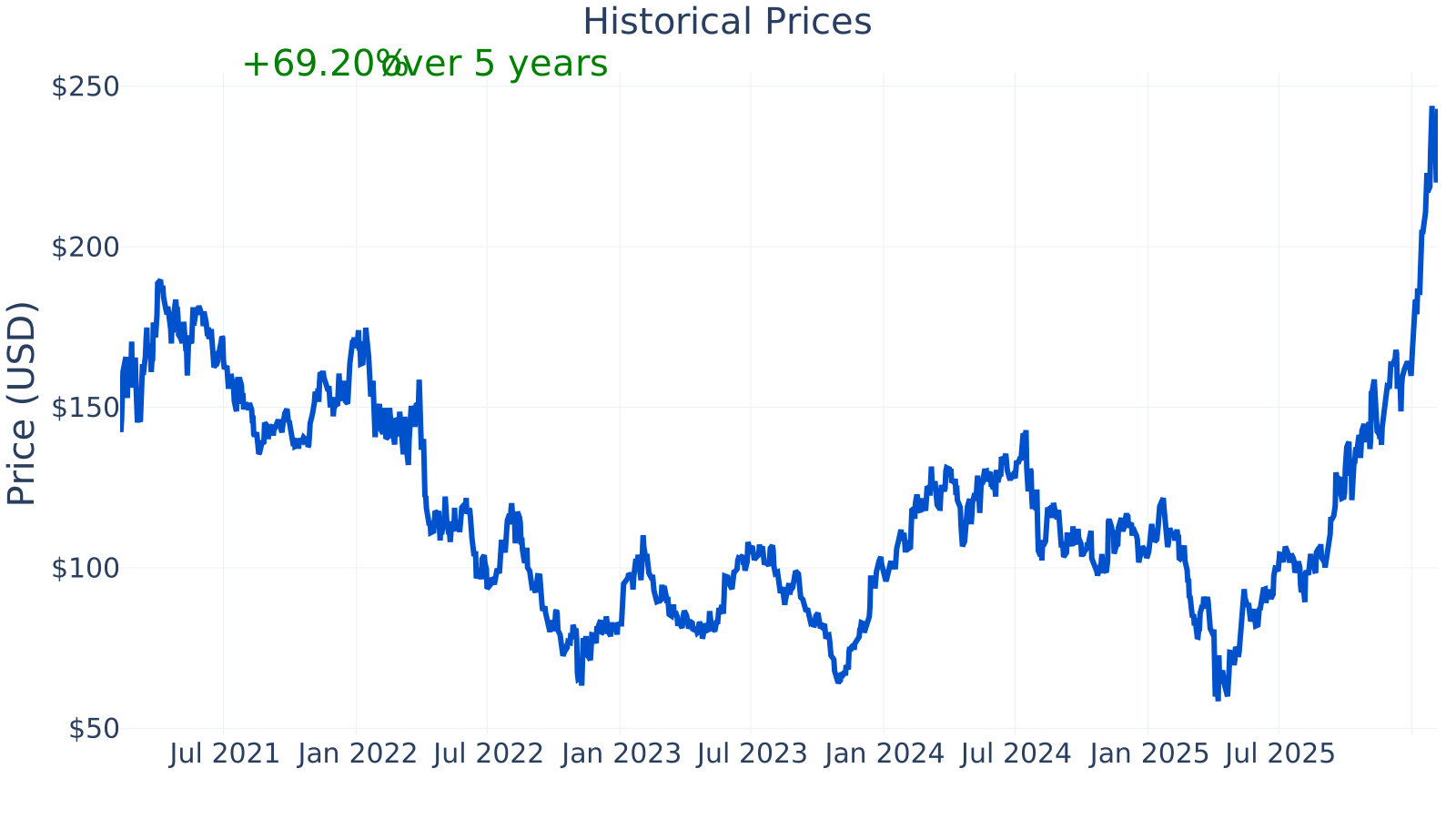
MKS is a mid-to-large sized public company with a market capitalization around $16.3B. The stock’s beta of ~1.94 indicates it has historically moved more than the overall market (higher volatility).
On valuation and profitability, the latest snapshot shows a P/E ratio of ~58.8 versus an industry median near 45.3, while profit margin is ~7.3% versus an industry median around 12.3%. At the same time, year-over-year revenue growth is ~10.3% (industry median ~7.5%). Leverage is a key item: debt-to-equity is ~176% compared with an industry median around 50%. Free cash flow over the trailing twelve months is about $530M, and the displayed PEG ratio (~0.61) suggests the market’s pricing versus expected earnings growth may look different than what the headline P/E implies, depending on the growth assumptions used.
Growth (Medium)
MKS is tied to long-run trends in advanced manufacturing, especially semiconductors. Chip manufacturing has become more complex over time, which increases the need for precision measurement, power delivery, process control, and inspection—areas where MKS sells core products. Over long horizons, that rising complexity can support demand, but the spending pattern is typically cyclical: customers invest heavily in some years and slow down in others.
From a strategy perspective, MKS’ portfolio approach (serving multiple process steps and selling specialized subsystems rather than commodity parts) is designed to make its products “sticky” in customer workflows. When the installed base grows, it can support recurring demand for replacements, service, and upgrades, although the company’s results can still be heavily influenced by the timing of large equipment purchases across the industry.
Recent revenue growth has been uneven. The chart shows periods of strong expansion (including several quarters above 20% year-over-year earlier in the series), followed by contraction in parts of 2023–2024, and then a return to positive growth. The latest point is around +10% year-over-year, which is above the industry median shown in the metrics snapshot.
Free cash flow has also fluctuated: it was about $474M (TTM) in 2022, fell to roughly $261M by 2024, then recovered to around $451M in early 2025 and is shown at about $530M in the latest metrics snapshot. For long-term readers, this matters because free cash flow is what ultimately supports debt repayment, reinvestment, and shareholder returns (when applicable). A sustained recovery tends to be more meaningful than a single strong period.
Potential catalysts (in a neutral, factual sense) generally relate to: improving semiconductor equipment spending, customer mix shifting toward higher-value products, and operational execution (cost control and margin improvement). The company’s filings and earnings materials are the best place to track what management highlights as demand drivers and end-market exposures.
Risks (High)
This article is for informational purposes only and does not constitute financial advice. Some content is AI-generated. See Disclaimer