Stock Analysis · M/I Homes Inc (MHO)
Overview
M/I Homes, Inc. (NYSE: MHO) is a U.S. homebuilder. In simple terms, it buys and develops land (or controls land through options), builds houses, and sells them to homebuyers. The company also operates a mortgage business that helps some buyers finance their home purchase. Its activities are concentrated in multiple metropolitan areas across the United States, which helps reduce reliance on any single local housing market.
From a business model point of view, the company’s results are mainly driven by how many homes it can sell (closings), the average selling price, and the profit it earns per home after land, labor, and materials. Demand for new homes is influenced by mortgage rates, household formation, employment, and the availability (or shortage) of existing homes for sale.
Revenue is primarily generated from:
- Home sales (the large majority of revenue): selling newly built homes to buyers.
- Financial services (smaller share): mainly mortgage origination and related services tied to the homebuilding operations.
Over recent years, total revenue and gross profit have generally moved together (as expected for a builder). A notable point is that interest expense increased meaningfully from 2021–2022 to 2023–2025, which matters because higher interest costs can reduce net income even when operations remain solid.
Key Figures
| Metric | Value | Industry ⓘ |
|---|---|---|
| Date | May 04, 2026 | |
| Context | ||
| Sector | Consumer Cyclical | |
| Industry | Residential Construction | |
| Market Cap ⓘ | $3.35B | |
| Beta ⓘ | 1.77 | |
| Fundamental | ||
| P/E Ratio ⓘ | 9.77 | 12.42 |
| Profit Margin ⓘ | 8.24% | 8.30% |
| Revenue Growth ⓘ | -5.70% | -10.70% |
| Debt to Equity ⓘ | 31.69% | 32.82% |
| PEG ⓘ | 0.95 | |
| Free Cash Flow ⓘ | $199.43M | |
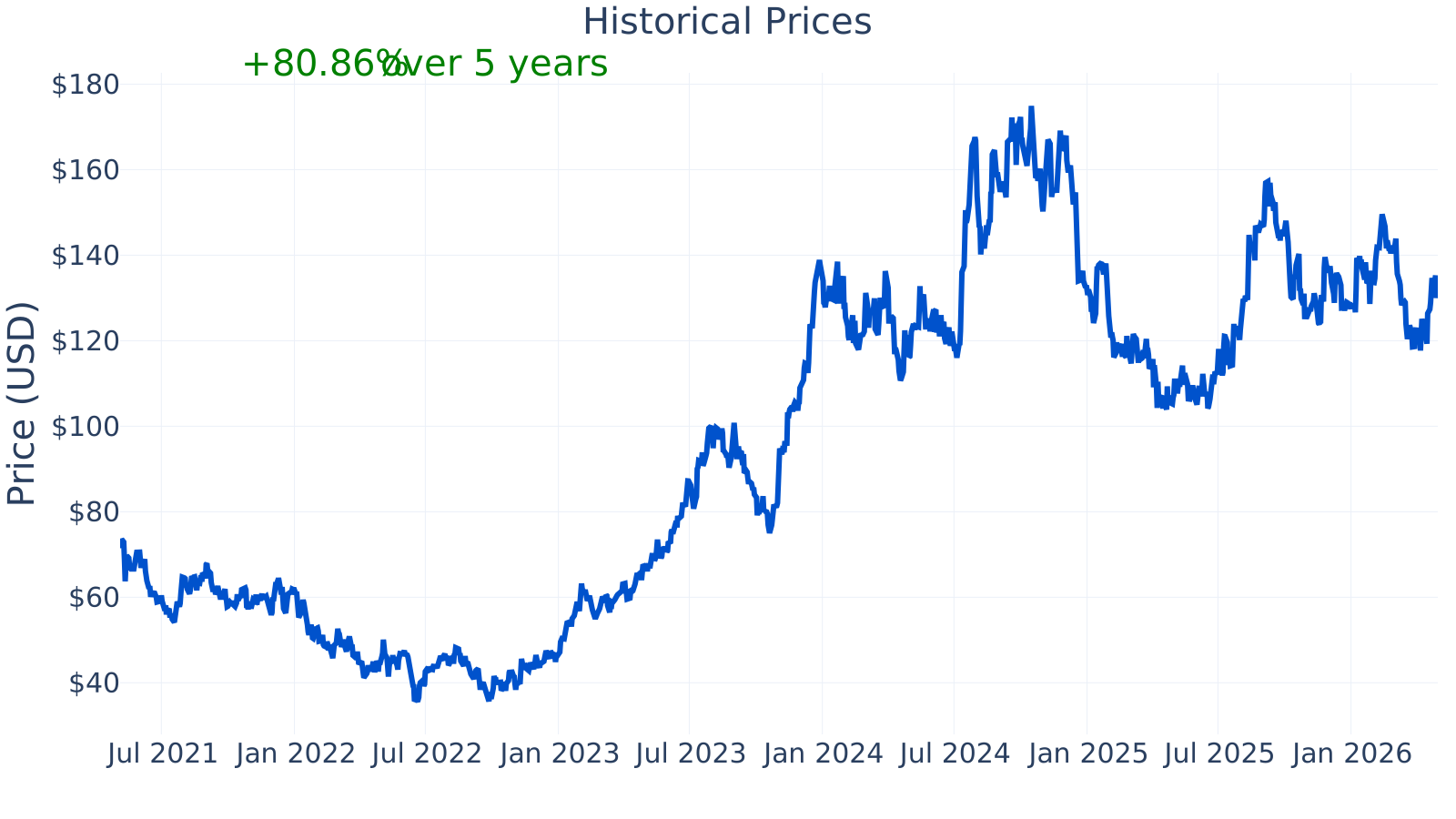
M/I Homes is a mid-sized public homebuilder with a market capitalization of about $3.35 billion. The stock’s beta of ~1.77 suggests it has tended to move more than the overall market (higher ups and downs than a broad index).
On valuation and profitability, the company shows a P/E ratio of ~9.8, below the industry median of about 12.4, while its profit margin is ~8.24%, very close to the industry median (~8.31%). Recent year-over-year revenue growth is about -5.7%, but that compares favorably to the industry median of roughly -10.7%, indicating M/I Homes has recently held up better than many peers in a softer period for the sector.
Leverage (debt relative to equity) is around 31.7%, slightly below the industry median (~32.8%). The company also shows positive trailing twelve-month free cash flow of about $199 million, which can be important in a cyclical business where cash needs can swing with land spending and construction activity.
Growth (Medium)
Residential construction is a cyclical industry: demand can rise and fall sharply with interest rates and consumer confidence. Over the long run, however, new home construction is supported by population growth, household formation, and the need to replace aging housing stock. That said, the path is rarely smooth—homebuilders often face “fast up / fast down” demand shifts depending on mortgage rates and affordability.
For M/I Homes specifically, growth tends to come from a mix of expanding community count (lots and neighborhoods available to sell), maintaining a product offering that matches local demand and affordability, and managing build costs. Because the company operates across multiple markets, it can shift emphasis toward regions where demand is stronger or where supply is tighter.
The year-over-year revenue pattern shows that growth has not been steady: there were periods of strong expansion followed by periods of contraction. The most recent reading is modestly negative, which is consistent with a cooling phase in housing activity, but the decline is less severe than the typical company in the peer set.
Free cash flow is positive over the trailing twelve months (about $199 million) after being much higher in some earlier periods and negative in 2022. For homebuilders, free cash flow can swing due to land purchases and inventory build; still, sustained positive cash generation can provide flexibility during slower markets (for example, to fund operations, manage debt, or invest in land positions for future communities).
Potential catalysts in this industry are usually macro-driven rather than company-specific: changes in mortgage rates, shifts in housing supply (especially the supply of existing homes), and regional job growth. Company execution still matters, but broader affordability conditions often dominate near-term results.
Risks (High)
The largest risk is the industry’s sensitivity to the broader economy and interest rates. When mortgage rates rise or credit tightens, monthly payments increase and affordability declines, which can reduce orders and increase cancellation risk. A weaker economy can also hurt demand, while inflation in labor and materials can pressure profitability if selling prices do not keep up.
Another major risk is inventory and land management. Homebuilders must commit capital to land and construction before they receive cash from the final sale. If demand slows unexpectedly, the company can be left with higher carrying costs, potential pricing pressure, or the need to reduce construction pace. In addition, local regulatory and permitting constraints can affect timing and costs.
M/I Homes’ debt-to-equity ratio has declined substantially from earlier years (moving from levels above ~50% to around 32% recently). This trend suggests a more conservative balance sheet profile than in the past, and the latest level is slightly below the industry median. Even so, housing downturns can stress balance sheets across the sector because cash needs can rise while sales slow.
Profit margin has decreased from the higher levels seen around 2022–2024 to roughly 8.24% most recently. That places it near the industry median and shows how margins can normalize as market conditions change (for example, through incentives, price adjustments, or cost pressures). Because homebuilding margins can be sensitive to both input costs and selling prices, a sustained margin decline is a key risk indicator to watch.
In terms of competitive advantages, homebuilding is typically a competitive business without strong “winner-take-all” dynamics. Advantages often come from execution: disciplined land acquisition, cycle management, construction efficiency, and local market knowledge. M/I Homes competes with large national builders and strong regional builders. Major publicly traded competitors in U.S. homebuilding include companies such as D.R. Horton, Lennar, PulteGroup, NVR, Toll Brothers, and Taylor Morrison. Compared with the largest national players, M/I Homes is smaller by scale, which can be a disadvantage in purchasing power and overhead leverage, but it may benefit from being more selective and focused within its chosen markets.
Valuation
The company’s current P/E ratio is about 9.8, which is below the residential construction industry median of about 12.4. Historically (as shown in the chart), M/I Homes’ P/E multiple has often been below the industry median. This can reflect the market’s tendency to value homebuilders cautiously because earnings are cyclical and can change quickly when demand shifts.
Whether the current valuation is “high” or “low” depends heavily on expectations for future housing demand, interest rates, and margins. A lower P/E can indicate lower market expectations for future earnings stability or growth, especially in cyclical industries. In that context, it is usually more informative to look at valuation together with profitability trends (recent margin compression), balance sheet posture (debt-to-equity around 32%), and the company’s ability to generate cash through the cycle (positive trailing free cash flow).
Conclusion
M/I Homes is a U.S. homebuilder whose results are mainly driven by home sales volume, pricing, and build costs, with a smaller contribution from mortgage-related services. The company has recently shown profitability near the industry middle and revenue performance that has been somewhat more resilient than the peer median during a softer period.
At the same time, the business remains highly sensitive to mortgage rates and economic conditions, and recent margin compression highlights how quickly profitability can shift in this industry. The balance sheet leverage ratio has trended down over time and is currently close to (and slightly below) the industry median, which can be an important stabilizer in cyclical periods.
From a valuation perspective, the stock trades at a P/E multiple below the industry median, consistent with the market’s generally cautious approach to cyclical homebuilders. Interpreting that valuation requires weighing the company’s cycle exposure, margin trajectory, and cash generation rather than relying on a single metric.
Sources:
- SEC EDGAR — M/I Homes, Inc. Form 10-K (Annual Report)
- SEC EDGAR — M/I Homes, Inc. Form 10-Q (Quarterly Report)
- M/I Homes, Inc. Investor Relations — Press Releases and SEC Filings
- Wikipedia — “M/I Homes” (company overview and basic background)
This article is for informational purposes only and does not constitute financial advice. Some content is AI-generated. See Disclaimer