Stock Analysis · LYFT Inc (LYFT)
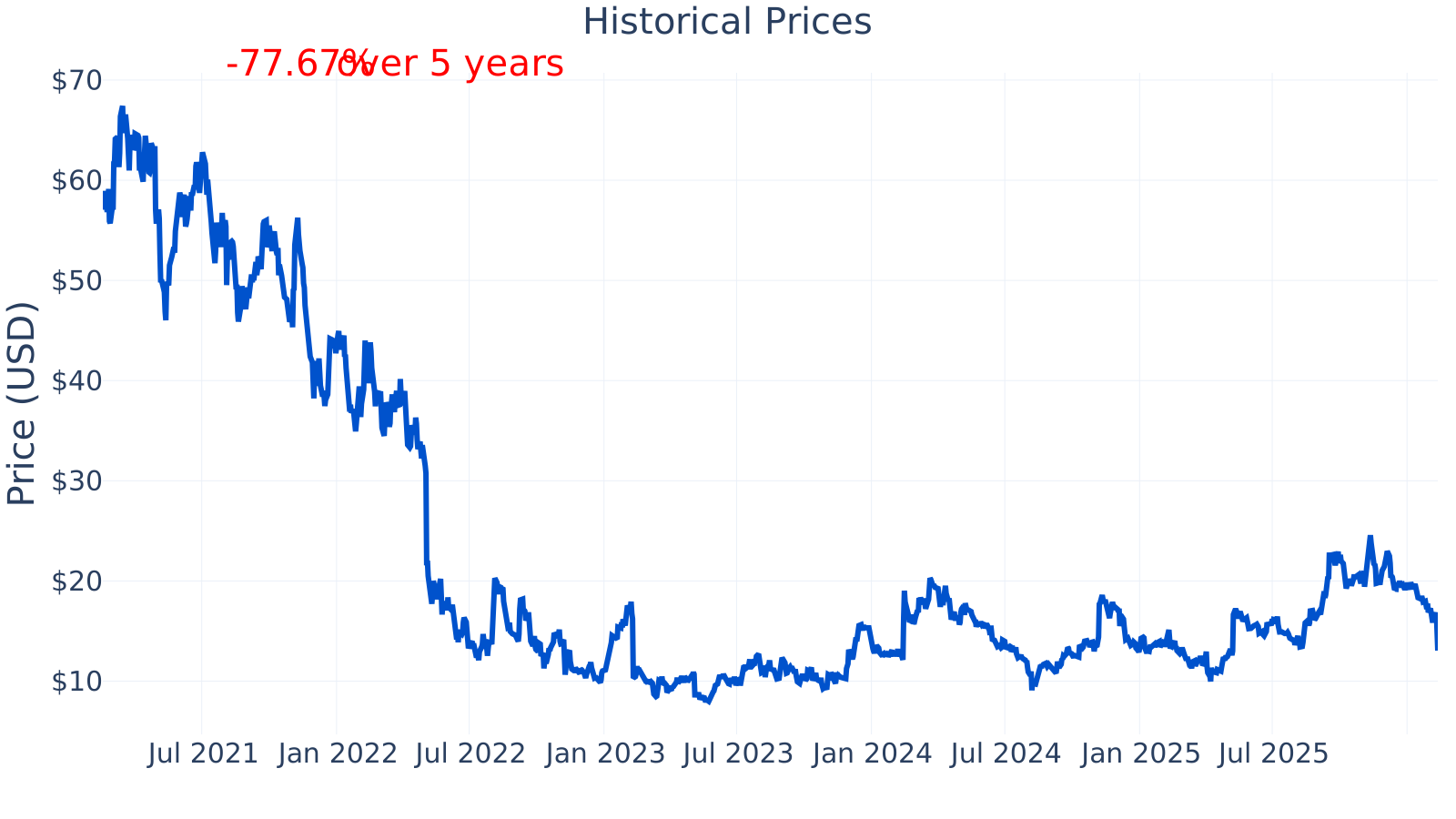
Overview
LYFT, Inc. operates a ride-hailing marketplace in the United States and Canada. Through its mobile app, the company connects riders who want transportation with drivers who provide rides. Lyft’s platform also supports related offerings such as bikes and scooters in certain markets, and it works with third parties (including insurance providers and payment processors) to run the overall service.
Lyft’s revenue is primarily generated from fees it earns when a ride (or other trip) happens on its marketplace. In simple terms, a rider pays a fare, the driver receives a portion, and Lyft keeps a portion as its platform revenue. Based on Lyft’s public filings, revenue is reported largely as a single line item rather than broken into many separate product lines, but it is commonly understood to be driven mainly by:
- Rides marketplace revenue (the large majority of revenue): fees and commissions from ride transactions
- Other platform-related revenue (smaller portion): items such as revenue from bikes/scooters in certain markets and other ancillary sources described in filings
One notable operating trend visible in the company’s multi-year income flow is that total revenue has increased substantially from 2021 through 2025, while earlier large operating losses narrowed and then moved into positive operating income in 2024 (before shifting again in 2025). Costs to run the service and operating expenses remain the key swing factors in profitability.
Key Figures
| Metric | Value | Industry ⓘ |
|---|---|---|
| Date | Feb 13, 2026 | |
| Context | ||
| Sector | Technology | |
| Industry | Software - Application | |
| Market Cap ⓘ | $5.21B | |
| Beta ⓘ | 1.90 | |
| Fundamental | ||
| P/E Ratio ⓘ | 2.06 | 27.28 |
| Profit Margin ⓘ | 45.03% | 7.09% |
| Revenue Growth ⓘ | 2.70% | 15.80% |
| Debt to Equity ⓘ | 5.74% | 25.00% |
| PEG ⓘ | 0.28 | |
| Free Cash Flow ⓘ | $1.15B | |
Lyft’s market capitalization is about $5.2 billion, placing it in the mid-cap range. The stock’s beta of ~1.90 indicates that its share price has historically moved more than the broader market, which can matter for long-term holders who want to understand volatility.
The table shows a P/E ratio of ~2.1 versus an industry median around 27.3. Very low P/E readings can occur when earnings are unusually high in a given period (for example due to one-time accounting items), so it is typically more informative when paired with margin and cash-flow context.
Profit margin is shown at about 45.0% versus an industry median near 7.1%. This is a large gap and may reflect non-recurring items or period-specific effects rather than a stable “run-rate,” especially given Lyft’s history of losses in prior years.
Year-over-year revenue growth is about 2.7%, below the industry median shown (~15.8%). Free cash flow over the trailing twelve months is about $1.15 billion, a meaningful shift compared with earlier periods where free cash flow was negative.
Growth (Medium)
Ride-hailing is tied to large, long-lasting needs: commuting, airport travel, local errands, and replacing (or supplementing) car ownership in dense areas. Demand tends to be influenced by employment levels, consumer spending, travel activity, and the availability of drivers. The industry also competes with public transit, personal vehicles, car rentals, and newer mobility options.
Lyft’s growth strategy, as described across its public disclosures, generally centers on improving the rider experience (reliability, wait times, pricing), strengthening driver supply (earnings opportunities and efficiency), and improving marketplace health through product and operational changes. For long-term outcomes, the key question is whether Lyft can grow ride volume while keeping incentive spending and overhead under control.
The revenue growth pattern over time shows periods of strong expansion (especially during the post-pandemic normalization) followed by a clear slowdown more recently, ending near low-single-digit year-over-year growth. That typically implies that future growth may depend more on share gains, new offerings, or improved frequency per user rather than a broad “rising tide” alone.
Free cash flow has improved sharply from deeply negative levels in 2021 to positive in the most recent period shown. If sustained, positive free cash flow can give a company more flexibility to invest in product improvements, withstand downturns, and strengthen its balance sheet without relying as heavily on external financing.
Potential catalysts for growth and financial improvement tend to be operational rather than purely macro-driven: better matching efficiency (reducing wasted driver time), improved pricing and take-rate discipline, and continued reductions in fixed costs per trip as scale increases. However, the ability to turn these levers depends on competitive conditions and regulatory requirements.
Risks (High)
Lyft operates in a highly competitive market where pricing, driver availability, and rider loyalty can shift quickly. Competitive pressure can lead to higher incentives for drivers, discounts for riders, or increased marketing spend—all of which can reduce profitability. The company also relies on third-party platforms and services (payments, mapping, insurance and claims management, cloud infrastructure), creating operational dependency and cost exposure.
Regulatory and legal risk is also central. Rules about worker classification, minimum earnings standards, local licensing requirements, and insurance obligations can materially change costs and business operations. Because Lyft’s service is delivered by drivers, changes in labor-related regulations can have an outsized effect compared with many other app-based businesses.
Debt-to-equity is shown at roughly 5.7% most recently, below the industry median (~25.0%). The longer history on the chart is more volatile, with materially higher readings in earlier periods. A lower current leverage ratio can reduce financial strain, but the big historical swings suggest capital structure and equity levels have changed meaningfully over time, so it is useful to monitor consistency.
Profitability has improved substantially over time: the company moved from large negative margins in 2021–2023 toward modestly positive margins in 2024–2025, with a very large margin shown in the most recent point. Because that last margin level is unusually high relative to the past and relative to the industry median, it may be influenced by one-time items, accounting adjustments, or non-operating effects rather than reflecting ongoing unit economics of rides. Long-term analysis typically focuses on whether improvements persist across multiple periods.
In terms of competitive position, Lyft is a major ride-hailing platform in North America but it is not the only scaled player. Its main direct competitor in U.S./Canada ride-hailing is Uber. Lyft also faces indirect competition from public transportation, personal vehicles, taxis, and micromobility alternatives. Competitive advantages in this business usually come from network effects (more drivers can reduce wait times; more riders can improve driver utilization), brand trust/safety perception, and efficient marketplace algorithms. These advantages can be real, but they are difficult to fully “lock in,” which is why competition remains a defining risk.
Valuation
The P/E ratio shown for Lyft declines from very high levels earlier in 2025 to about 54.5 by late 2025 on the historical series, while the industry median is shown around 42.4 at that time. This places Lyft’s multiple in a broadly comparable range to the median of its software-application peer set on that snapshot, though the comparison is imperfect because Lyft is a marketplace/transportation platform and many “software” peers have different margin structures and growth profiles.
The latest table shows a much lower current P/E (~2.1) than the historical readings, which is a sign that earnings used in that calculation may be unusually elevated in the most recent period. When valuation signals conflict like this, it usually means the market is working through questions about the durability of profits, the stability of margins, and the pace of future revenue growth. Given the company’s comparatively low most-recent year-over-year revenue growth (~2.7%), valuation tends to hinge more on whether Lyft can sustain improved cash generation and stable profitability through a competitive cycle.
Conclusion
Lyft is a well-known North American ride-hailing platform whose business is driven mainly by transaction revenue from rides. Over the past several years, the company has grown revenue and has shown meaningful improvement in cash generation and reported profitability compared with earlier periods of large losses.
At the same time, Lyft operates in a market with intense competition and meaningful regulatory exposure, and recent revenue growth has slowed to low single digits. The long-term picture therefore depends on execution: maintaining a healthy balance between rider demand, driver supply, pricing, and operating cost discipline across economic conditions.
From a valuation perspective, the company’s earnings-based multiples are sensitive to how “repeatable” recent profitability is, especially given unusually large swings in reported margins and P/E over time. For long-term analysis, the most informative areas to monitor are sustained free cash flow, the consistency of operating margins (excluding unusual items), and competitive dynamics that influence incentives and pricing.
Sources:
- SEC EDGAR — LYFT, Inc. Form 10-K (Annual Report)
- SEC EDGAR — LYFT, Inc. Form 10-Q (Quarterly Reports)
- Lyft, Inc. Investor Relations — Shareholder letters / quarterly results materials (company-hosted)
- Wikipedia — “Lyft” (basic company background)
This article is for informational purposes only and does not constitute financial advice. Some content is AI-generated. See Disclaimer


