Stock Analysis · Lumentum Holdings Inc (LITE)
Overview
Lumentum Holdings Inc. (LITE) is a technology company that designs and manufactures optical and photonic products. In simple terms, it makes high-precision components that help transmit, direct, and measure light. These products are used in places like data centers and telecom networks (to move large amounts of data through fiber), as well as in industrial and other specialized applications that rely on lasers and optical sensing.
The company reports its business in two main segments, which are commonly described as:
- Cloud & Networking: Optical components and modules used in telecom networks and cloud/data center infrastructure.
- Industrial Tech: Lasers and photonic products used for industrial processes, sensing, and other non-telecom applications.
Public filings describe revenue primarily by these segments (rather than a simple product “menu”), and the exact percentage split can change meaningfully from year to year depending on telecom and cloud spending cycles.
The profitability bridge over time shows that revenue and gross profit have moved noticeably, with a particularly weak period around mid-2024 (lower revenue and negative net income), followed by improvement into mid-2025 (higher revenue and a return to positive net income). It also highlights that operating costs (notably R&D and selling/general/admin) remain substantial relative to gross profit, which can significantly affect bottom-line results when demand softens.
Key Figures
| Metric | Value | Industry ⓘ |
|---|---|---|
| Date | Feb 07, 2026 | |
| Context | ||
| Sector | Technology | |
| Industry | Communication Equipment | |
| Market Cap ⓘ | $39.41B | |
| Beta ⓘ | 1.53 | |
| Fundamental | ||
| P/E Ratio ⓘ | 158.62 | 39.43 |
| Profit Margin ⓘ | 11.95% | 4.65% |
| Revenue Growth ⓘ | 65.50% | 14.10% |
| Debt to Equity ⓘ | 392.48% | 59.08% |
| PEG ⓘ | 0.97 | |
| Free Cash Flow ⓘ | $130.30M | |
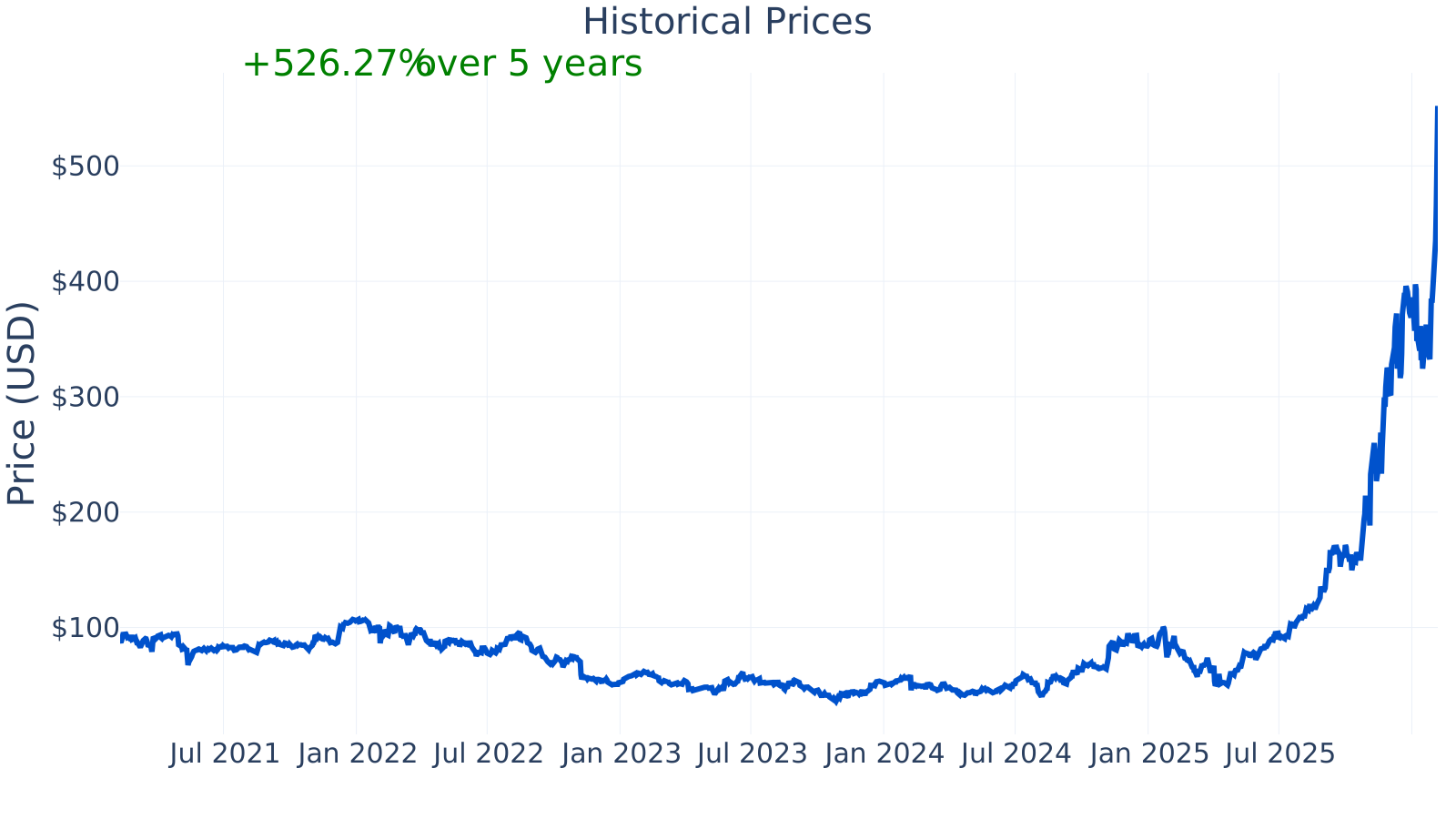
Lumentum’s market capitalization is about $39.4B. The stock has a beta of ~1.53, which signals that share price moves have historically been more volatile than the overall market.
On valuation and profitability metrics, the latest P/E ratio is ~158.6 versus an industry median around 39.4, while the latest profit margin is ~12.0% versus an industry median around 4.7%. Reported year-over-year revenue growth is ~65.5% versus an industry median around 14.1%. However, debt-to-equity is ~392% versus an industry median around 59%, suggesting substantially higher financial leverage than many peers.
The company’s PEG ratio (~0.97) implies the market’s earnings multiple is roughly in line with expected growth assumptions embedded in that metric, but PEG is sensitive to the growth inputs and can change quickly when business conditions shift. Trailing twelve-month free cash flow is about $130.3M, which indicates positive cash generation recently, though cash flow has been volatile over the past several years.
Growth (Medium)
Lumentum operates in markets tied to long-term data growth: more cloud usage, more video and AI-related traffic, and ongoing upgrades in fiber networks. These forces can support multi-year demand for faster optical links and more capable components. At the same time, this is a cyclical area: customers can pause or accelerate purchases depending on inventory levels, capital spending plans, and technology transitions.
The chart below shows that Lumentum’s year-over-year revenue growth has swung from negative to strongly positive. The recent readings are notably high, culminating around 65% in the most recent period shown, which is well above the industry median in the table.
Free cash flow (cash left after operating needs and capital spending) helps indicate whether growth is being achieved with healthy cash generation. Here, the pattern shows meaningful volatility: strongly positive in 2021, declining into negative territory in 2024 and 2025 (as shown on the time series), and then the latest metrics table indicates a return to positive trailing twelve-month free cash flow.
Potential catalysts in this type of business typically include (1) customer spending recoveries after inventory corrections, (2) new product cycles (for example, higher-speed optical links), and (3) mix shifts toward higher-margin offerings. Whether those catalysts translate into durable improvements depends on execution, competitive positioning, and the timing of customer build-outs.
Risks (High)
This article is for informational purposes only and does not constitute financial advice. Some content is AI-generated. See Disclaimer