Stock Analysis · Lucid Group Inc (LCID)
Overview
Lucid Group Inc. designs, manufactures, and sells electric vehicles (EVs), focusing on premium sedans and SUVs, along with related software and services. The company’s approach centers on building its own EV technology (such as powertrain and battery-related systems) and assembling vehicles at its manufacturing facilities, then delivering them through a mix of direct sales and service operations.
In practice, Lucid’s business model looks closer to a “full-stack” automaker than a component supplier: it must manage product development, manufacturing scale-up, quality control, pricing, and customer deliveries—all while the EV market is still evolving and competition remains intense.
Main sources of revenue generally include:
- Vehicle sales (the largest source)
- Leasing and other vehicle-related revenue (typically smaller than direct sales)
- Other revenue (items such as services and other automotive-related revenue, usually the smallest portion)
Percentages by revenue line are not included here because they vary by reporting period and are best read directly from the company’s most recent annual report and quarterly filings.
From 2021 to 2025, total revenue increased substantially (from about $27 million in 2021 to about $1.35 billion in 2025). At the same time, costs and operating expenses remained far above revenue, resulting in negative gross profit and large operating losses each year. Research and development and selling/general/administrative spending are major cost areas, reflecting continued product development and the ongoing cost of building out a commercial-scale automaker.
Key Figures
| Metric | Value | Industry ⓘ |
|---|---|---|
| Date | Mar 16, 2026 | |
| Context | ||
| Sector | Consumer Cyclical | |
| Industry | Auto Manufacturers | |
| Market Cap ⓘ | $3.24B | |
| Beta ⓘ | 1.19 | |
| Fundamental | ||
| P/E Ratio ⓘ | N/A | 17.75 |
| Profit Margin ⓘ | -199.30% | -4.04% |
| Revenue Growth ⓘ | 122.90% | 8.60% |
| Debt to Equity ⓘ | 119.97% | 108.09% |
| PEG ⓘ | N/A | |
| Free Cash Flow ⓘ | -$3.83B | |
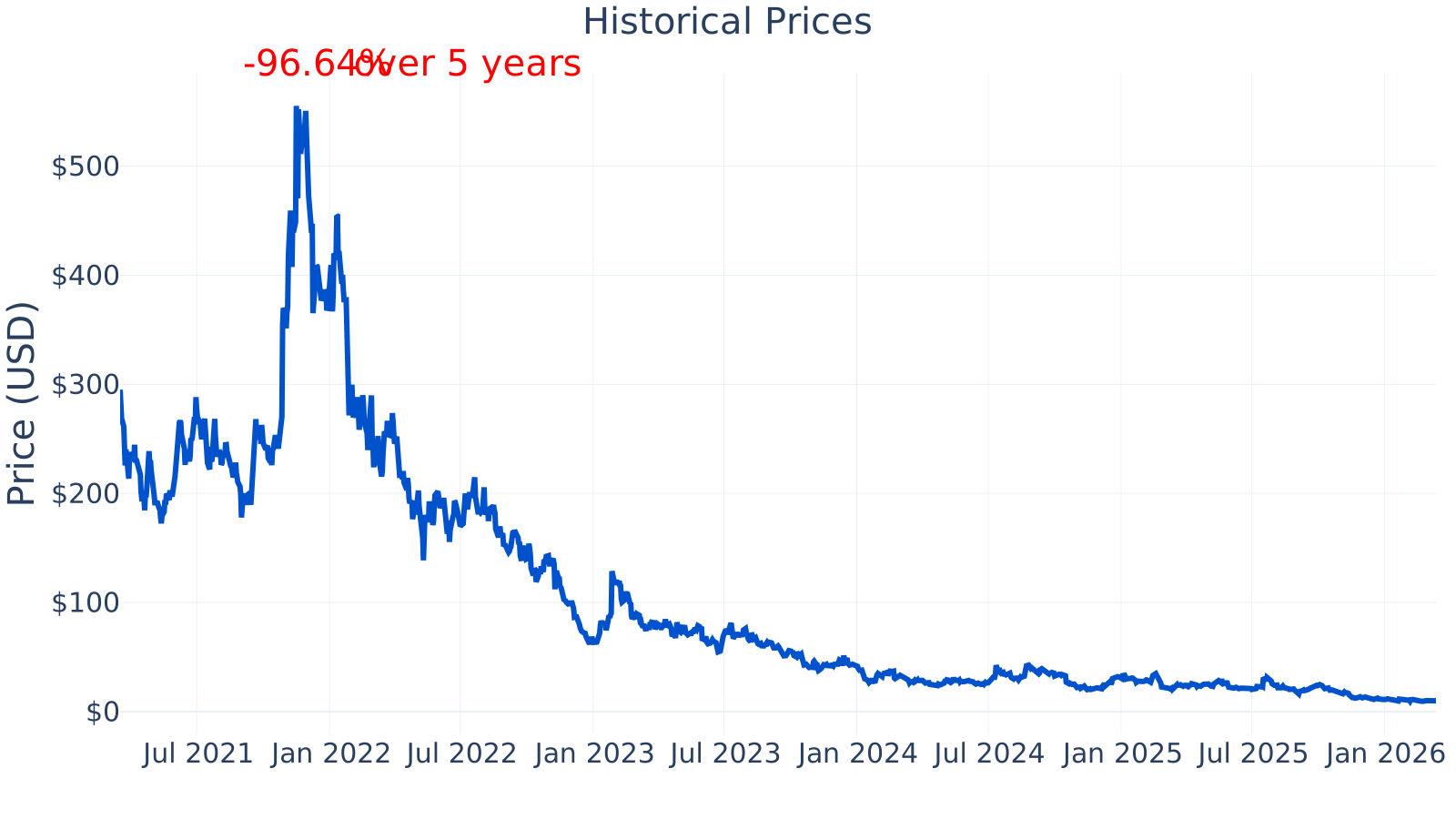
Lucid’s market capitalization is about $3.24 billion, and its beta of ~1.19 suggests the stock has tended to move somewhat more than the overall market. Profitability remains a key challenge: the most recent profit margin is about -199% (vs. an industry median around -4%), meaning the company is losing substantially more than $1 for every $1 of revenue. On growth, the latest year-over-year revenue growth is about 123% (vs. an industry median around 8.6%), showing rapid top-line expansion from a smaller base. Balance-sheet leverage, measured as debt-to-equity of ~120%, is somewhat above the industry median near 108%. Free cash flow over the last twelve months is about -$3.83 billion, highlighting that operations and expansion are still consuming large amounts of cash.
Growth (Medium)
Lucid operates in the EV industry, which is part of the broader global transition toward electrification in passenger vehicles. Over the long term, this transition is supported by continuing improvements in battery technology, charging infrastructure buildout, and the ongoing introduction of new EV models across price points. Even so, growth can be uneven year to year, and consumer demand is sensitive to interest rates, incentives, and pricing pressure from competitors.
Lucid’s strategy targets the premium segment, where buyers may value range, performance, and technology. This positioning can help differentiate the brand, but it also narrows the addressable customer base compared with mass-market EVs. For future growth, the core operational question is whether Lucid can increase production and deliveries while bringing unit costs down enough to improve gross margin over time.
Revenue growth has been volatile across quarters (including periods of decline), which is common for a manufacturer still scaling production and working through model mix, pricing changes, and delivery timing. The most recent reading shows very strong year-over-year growth, but it is occurring alongside continued losses, so the durability of that growth depends heavily on manufacturing execution and demand at Lucid’s price points.
Free cash flow has remained deeply negative over multiple years (roughly between -$1.16 billion and -$3.66 billion in the periods shown). That pattern is consistent with heavy investment in production capacity, engineering, and commercialization, but it also means funding needs can remain significant until the business approaches break-even on a cash basis.
Risks (Very High)
The biggest risk factor is that Lucid is still in a phase where profitability and self-funded operations have not been demonstrated. Negative gross profit indicates that, in the periods shown, the company’s direct costs to produce vehicles exceeded the revenue earned from them. Sustained negative free cash flow also raises the possibility of continued external financing needs, which can introduce dilution risk for shareholders and/or increased debt service costs.
Manufacturing and scaling risk is also central. Automaking requires consistent supply chains, quality control, and stable production yields. Small changes in volume, warranty costs, component pricing, and factory utilization can have an outsized impact on margins. Additionally, EV demand can shift quickly due to competitive price cuts, changes in incentives, or macroeconomic conditions.
Lucid’s debt-to-equity ratio increased over time and is about 120% in the latest value shown, compared with an industry median near 108%. This indicates a meaningful reliance on debt relative to equity, and the upward trend can matter when combined with ongoing cash burn.
Profit margins have improved from extremely negative levels earlier in the timeline, but they remain very negative in the latest period (about -199%), far below the industry median (around -36% in the latest value shown). This gap highlights that Lucid’s cost structure is still not aligned with its current revenue scale.
On competitive positioning, Lucid competes with both EV-focused companies and established global automakers offering premium electric models. Key competitors include Tesla and premium internal-combustion and EV brands from large automakers (such as Mercedes-Benz, BMW, Audi, Porsche, and others), as well as newer EV entrants targeting the higher end of the market. Lucid’s competitive advantages are generally described as its technology and product attributes (notably efficiency and performance claims in its vehicles), but it is not the market leader by volume, scale, or profitability. Larger competitors often have advantages in manufacturing scale, supply-chain leverage, brand reach, and the ability to fund price competition across a broader portfolio.
Valuation
For many companies, valuation discussions rely heavily on earnings-based metrics like the price-to-earnings (P/E) ratio. For Lucid, the P/E ratio is not meaningful in the periods shown because the company has reported net losses, which typically makes P/E unusable or not comparable to profitable peers.
With P/E not informative here, valuation tends to be discussed more in terms of scale and fundamentals such as revenue trajectory, gross margin direction, cash burn, and balance-sheet strength. In that context, the key question is whether the company can grow deliveries and revenue while materially improving unit economics, because continued large operating losses and negative free cash flow can dominate the long-term outcome regardless of near-term revenue growth.
Conclusion
Lucid is building a premium EV automaker with fast revenue growth in the latest period shown and a long runway tied to electrification trends. However, the financial profile remains defined by very large losses, negative gross profit in the years shown, and persistently negative free cash flow, alongside rising leverage over time.
As a long-term business case, the central factors to watch are execution milestones: sustained demand at Lucid’s pricing levels, production scale and consistency, cost reductions that move gross margin toward positive territory, and a clear path to reduced cash burn. Until those elements are demonstrated, the company’s risk profile remains elevated relative to mature automakers and profitable EV producers.
Sources:
- SEC EDGAR — Lucid Group Inc filings (Form 10-K, Form 10-Q, Form 8-K)
- Lucid Group, Inc. Investor Relations — SEC filings and shareholder materials (company-hosted)
- Wikipedia — “Lucid Group” (basic company background)
This article is for informational purposes only and does not constitute financial advice. Some content is AI-generated. See Disclaimer


