Stock Analysis · Liveramp Holdings Inc (RAMP)
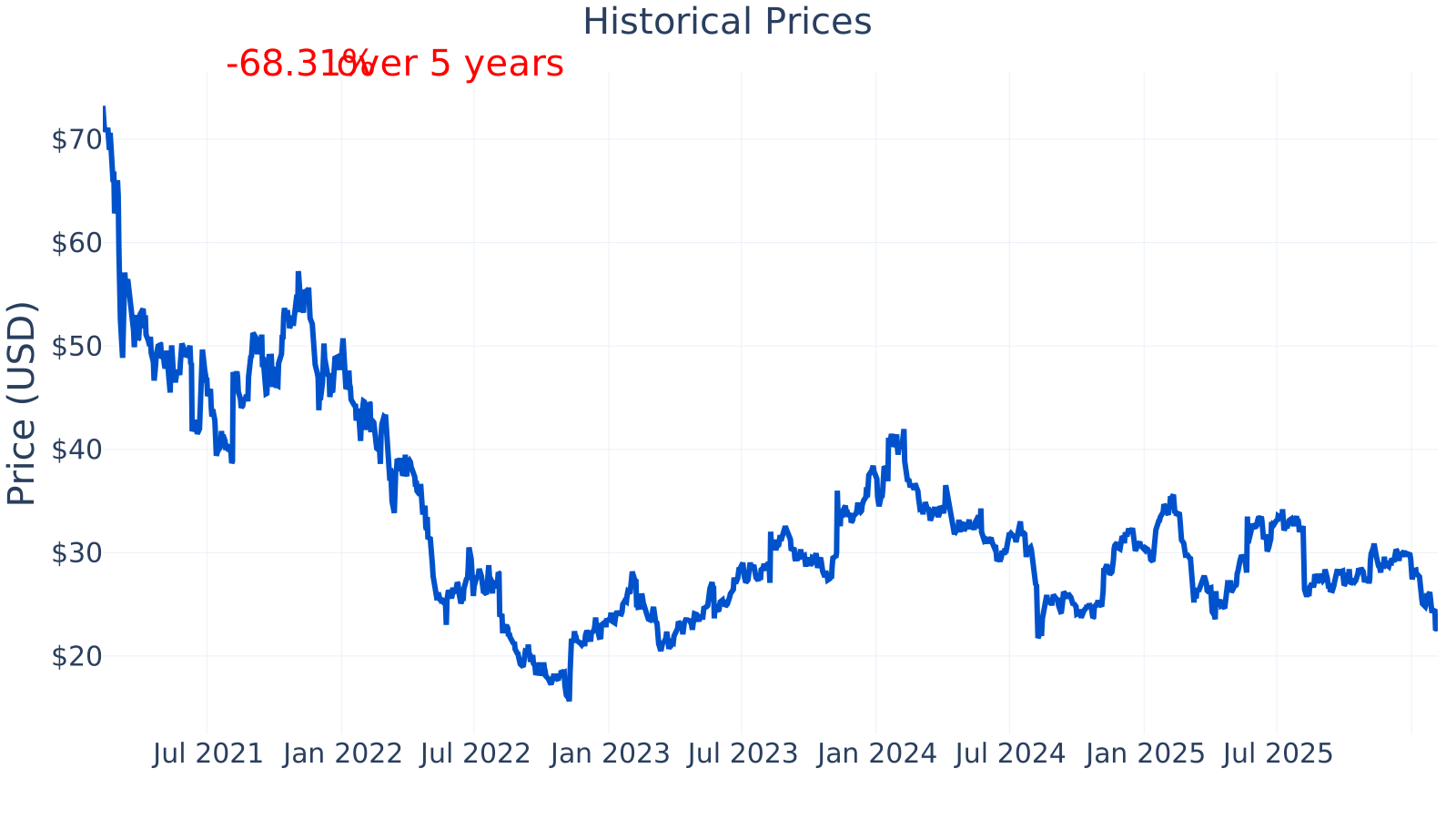
Overview
LiveRamp Holdings Inc. is a technology company focused on helping organizations use data for marketing, measurement, and analytics while aiming to protect consumer privacy. In simple terms, it provides software that helps companies “connect” information coming from different places (for example, a brand’s website, mobile app, customer relationship tools, and advertising platforms) so they can understand audiences and measure results across channels.
LiveRamp is best known for its identity and connectivity capabilities, which are designed to work across many partners in the advertising and marketing ecosystem. This position as an “intermediary” can matter because modern marketing often involves multiple platforms, and privacy rules have made it harder to match people and devices in consistent ways.
In its financial reporting, LiveRamp primarily describes revenue as coming from subscriptions to its software and services, with professional services typically a smaller component. A simple way to think about the revenue model is recurring software fees (the core) plus services that support implementations and specific customer needs.
Main sources of revenue (typical structure based on company reporting categories):
- Subscription revenue (recurring fees for access to the platform and its capabilities)
- Services revenue (implementation, support, and other professional services)
Percentages can vary by period; the company’s filings are the appropriate reference for the exact split in the most recent fiscal year.
Across recent fiscal years, total revenue has risen meaningfully (from about $443M in FY2021 to about $746M in FY2025). Over the same span, operating income moved from negative to positive, which suggests the company has been working to balance growth investments (like research and development) with a path toward profitability.
Key Figures
| Metric | Value | Industry ⓘ |
|---|---|---|
| Date | Feb 08, 2026 | |
| Context | ||
| Sector | Technology | |
| Industry | Software - Infrastructure | |
| Market Cap ⓘ | $1.48B | |
| Beta ⓘ | 1.15 | |
| Fundamental | ||
| P/E Ratio ⓘ | 22.32 | 25.67 |
| Profit Margin ⓘ | 8.64% | 6.91% |
| Revenue Growth ⓘ | 8.60% | 15.20% |
| Debt to Equity ⓘ | 3.53% | 19.82% |
| PEG ⓘ | 0.59 | |
| Free Cash Flow ⓘ | $169.25M | |
LiveRamp’s market capitalization is about $1.48B, and its beta of 1.15 indicates the stock has tended to move somewhat more than the broader market. The latest P/E ratio shown is 22.3 versus an industry median near 25.7, while the latest net profit margin is about 8.6% (industry median roughly 6.9%). Year-over-year revenue growth is about 8.6%, below the industry median near 15.2%. Debt-to-equity is about 3.5%, which is notably lower than the industry median near 19.8%. Trailing twelve-month free cash flow is about $169M, indicating the business has recently generated cash after operating costs and capital spending.
Growth (Medium)
LiveRamp operates in marketing technology and data infrastructure—areas influenced by long-term trends such as digital advertising, the need to measure marketing outcomes across many channels, and increasing privacy regulation. As third-party tracking becomes more constrained, many organizations have placed more emphasis on using their own customer relationships and consent-based data, which generally increases the value of tools that can connect systems and support privacy-conscious identity resolution.
The company’s strategy is centered on being broadly interoperable across many platforms (rather than being tied to a single “walled garden”). If successful, that approach can remain relevant as marketing stacks change, because customers typically want flexibility to work with multiple partners and avoid being locked into one ecosystem.
Recent year-over-year revenue growth has generally been positive, with growth rates moving from higher levels earlier in the period (around the high teens to low 20% range in parts of 2021–2022) to more moderate levels more recently (roughly high single digits in the latest period shown). That pattern can be interpreted as a shift from earlier expansion to a more mature growth pace, or it may reflect changing customer spending conditions and product mix over time.
Free cash flow has improved substantially over the period shown, from negative levels in 2021 to more consistently positive levels later, reaching about $155M–$169M in the most recent years shown. For a software-oriented business, sustained positive free cash flow can increase financial flexibility, because it can help fund product development and operations without relying as much on external financing.
Risks (High)
LiveRamp sits in a complex and fast-changing environment. A central risk is that major platform shifts (for example, changes by large browsers, mobile operating systems, or major advertising platforms) can alter how identity, measurement, and data connectivity work. If industry standards change in ways that reduce the need for independent connectivity providers, LiveRamp could face pressure on growth and pricing.
Competition is also a meaningful factor. LiveRamp’s ecosystem includes large advertising and cloud platforms that can offer overlapping capabilities, along with specialized marketing technology vendors. Competitors can range from identity and customer data providers to cloud-based analytics and activation tools. In many cases, large platforms benefit from scale, distribution, and deeply integrated product suites, while smaller specialists may compete on niche features or pricing.
LiveRamp’s competitive advantages are generally associated with (1) its network of integrations/partners, (2) its focus on interoperability across many endpoints, and (3) its emphasis on privacy-oriented identity and data collaboration. However, the company is not the only provider pursuing these themes, and it must keep earning trust with customers and partners to maintain its position.
Financial leverage appears low relative to peers: the latest debt-to-equity is about 3.5%, and it has remained low across the period shown (generally in the low single digits). Lower leverage can reduce certain financial risks, but it does not remove operating risks tied to competition or shifts in the advertising ecosystem.
Profitability has been volatile. Net profit margin was negative for an extended period and then moved closer to break-even before turning positive in the most recent periods shown, reaching about 8.6% most recently. Because margins have swung over time, readers may want to treat profitability as still in a “prove it and sustain it” phase rather than assuming a stable long-term level.
Valuation
The latest P/E ratio is about 22.3, below the industry median near 25.7. However, the historical P/E series shown is uneven, including periods where a meaningful P/E was not displayed (often a symptom of very low or negative earnings, where P/E becomes less informative). In other words, while the current P/E may look moderate versus peers, it should be interpreted in the context of LiveRamp’s historically variable profitability.
Another way to frame valuation is to compare it with business momentum and risk characteristics visible elsewhere: recent revenue growth is in the high single digits (below the industry median), free cash flow has strengthened, and leverage is low. Taken together, the valuation picture is mixed: the company shows improving cash generation and low debt, while growth has moderated and competition/platform dependence remains significant.
Conclusion
LiveRamp is positioned in the intersection of marketing technology, identity, and privacy-aware data connectivity—areas that are likely to remain important as companies try to measure and improve marketing performance across multiple channels. Financially, revenue has grown over several years and free cash flow has improved markedly, while debt levels appear low.
At the same time, the business operates in a highly competitive landscape shaped by large platforms and frequent industry changes. Profitability has improved recently but has also been inconsistent over time, which can make long-term forecasting more uncertain. A long-term assessment typically hinges on whether LiveRamp can sustain positive margins and keep its role as a trusted, widely integrated connectivity layer as the advertising ecosystem evolves.
Sources:
- U.S. SEC EDGAR — LiveRamp Holdings, Inc. filings (Form 10-K, 10-Q)
- LiveRamp Investor Relations — SEC filings and shareholder materials (company-hosted)
- Wikipedia — “LiveRamp” (company background)
This article is for informational purposes only and does not constitute financial advice. Some content is AI-generated. See Disclaimer


