Stock Analysis · Littelfuse Inc (LFUS)
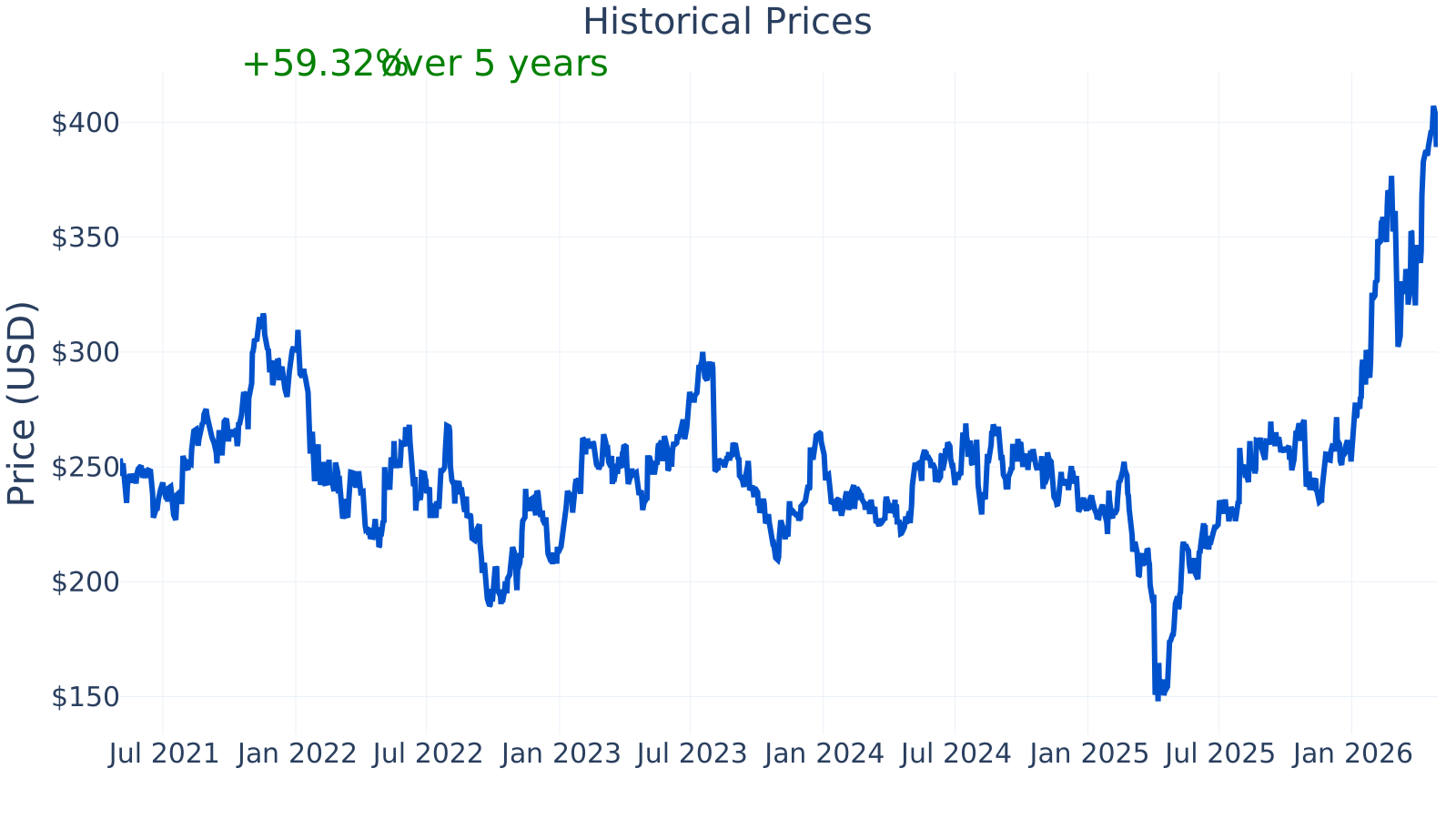
Overview
Littelfuse Inc. (LFUS) is a manufacturer of components that help protect, control, and sense electricity inside equipment. In practical terms, its products are often “behind-the-scenes” parts that help prevent damage from power surges or overcurrent, help manage power safely, and help equipment detect conditions (such as temperature, current, or position). These components are used across many end-markets, with meaningful exposure to automotive electronics, industrial equipment, and electronics used in data/communications and consumer devices.
Because Littelfuse sells many small but critical parts, its business is tied to the overall level of manufacturing activity and electronics production. Demand can rise when customers are building more vehicles, machines, and electronics—and can soften when those markets slow or customers reduce inventories.
Public filings typically describe revenue using business segments and/or end markets. Commonly discussed categories include:
- Electronics segment: circuit protection and power control used across electronics and electrical applications
- Transportation segment: products used in vehicles (including internal combustion and electrified vehicles), charging, and related vehicle electronics
- Industrial segment: protection, sensing, and power-related components used in industrial equipment and automation-oriented applications
Percentages by segment vary by year and should be taken from the most recent annual report for a precise split.
Over the 2021–2025 period shown, revenue rose from about $2.08B (2021) to about $2.39B (2025), but profitability tightened materially: operating income fell from about $360M (2021) to about $38M (2025), and net income moved from a profit (2021–2024) to a loss in 2025. This kind of shift is often associated with a mix of weaker demand in certain end markets, cost pressures, and/or one-time items that affect reported earnings.
Key Figures
| Metric | Value | Industry ⓘ |
|---|---|---|
| Date | May 01, 2026 | |
| Context | ||
| Sector | Technology | |
| Industry | Electronic Components | |
| Market Cap ⓘ | $10.17B | |
| Beta ⓘ | 1.39 | |
| Fundamental | ||
| P/E Ratio ⓘ | N/A | 45.47 |
| Profit Margin ⓘ | -3.01% | 6.11% |
| Revenue Growth ⓘ | 12.20% | 17.40% |
| Debt to Equity ⓘ | 39.00% | 39.00% |
| PEG ⓘ | 2.51 | |
| Free Cash Flow ⓘ | $366.13M | |
Littelfuse’s market capitalization is about $10.17B, placing it in the mid-cap range. The stock’s beta of ~1.39 suggests it has tended to move more than the overall market (higher ups and downs). The latest profit margin is about -3.0%, below the industry median of about 6.1%, which aligns with the recent net loss seen in the income statement view. Year-over-year revenue growth is about 12.2%, below the industry median of about 17.4%. Debt-to-equity is about 39%, roughly in line with the industry median shown. Trailing twelve-month free cash flow is about $366M, indicating the business has continued to generate cash even while reported profitability has been pressured.
Growth (Medium)
Littelfuse operates in areas that generally benefit from long-term trends: more electronics content in vehicles, increasing focus on electrical safety and reliability, and continued investment in industrial automation and electrification. Circuit protection and power control are not “optional” features—designers typically need them to meet performance, reliability, and regulatory expectations—so demand can be resilient over long periods, even if it fluctuates in the short term with manufacturing cycles.
The revenue growth pattern shown is cyclical. After very strong growth in 2021–2022, growth turned negative across much of 2023–2024, then returned to positive territory in 2025, reaching about 12% by late 2025. This kind of swing is consistent with electronics and industrial supply chains where customers sometimes over-order and later work down inventories.
Free cash flow has been meaningful in recent years: roughly $269M (2022), $321M (2023), $385M (2024), then about $293M (2025). Even with the dip in 2025, the company continued to generate cash, which can matter for funding capital spending, research and development, acquisitions, and debt service.
Potential catalysts over a multi-year horizon typically include (1) a sustained recovery in industrial and electronics demand, (2) growing vehicle electrification and higher electronic content per vehicle, and (3) execution on product development and portfolio positioning in protection, sensing, and power-control categories.
Risks (Medium)
The most important risk is that Littelfuse’s end markets can be cyclical. Automotive production, industrial demand, and broader electronics volumes can slow during economic downturns, and customers can reduce purchases when they are correcting excess inventory. This can pressure revenue and, because manufacturing and operating costs do not adjust instantly, can also compress margins.
Profitability has weakened substantially over time in the series shown. Net profit margin moved from roughly 14–15% in 2021–2022 to mid-single digits in 2024, and then to about -3% by late 2025 (versus an industry median near 6%). For long-term analysis, it can be important to distinguish between (a) structural margin pressure (such as persistent pricing pressure or unfavorable mix) and (b) temporary factors (such as a cyclical downturn or non-recurring charges) that may reverse.
Leverage appears moderate in this view. Debt-to-equity has generally ranged from the mid-30% to high-40% area over the period shown, ending around 39%, broadly similar to the industry median. Even moderate leverage can become more consequential if earnings are under pressure, so the direction of profitability and cash generation remains relevant.
Competitive positioning is another consideration. Littelfuse participates in electronic components markets with multiple established players. Competition can involve pricing, reliability, qualification with large customers, and the ability to support customers’ design cycles globally. The company’s potential advantages typically come from its specialized product know-how, broad catalog across protection/control/sensing, long-standing customer relationships, and the fact that these components are often designed into systems where reliability matters. However, it is not a “winner-takes-all” market, and customers may dual-source for supply-chain resilience.
Main competitors vary by product line and end market, but generally include other large circuit-protection and electronic component suppliers (for example, companies known for fuses, power-control devices, connectors, sensors, and related components). Competitive intensity can be higher in more standardized parts and lower in highly specialized or safety-critical applications.
Valuation
The historical P/E ratios shown were mostly in the mid-teens to low-30s range from 2021 through 2024, then rose notably in 2025 (often above 50x in the series shown). A rising P/E can happen when the stock price rises, when earnings fall, or both. Given the profitability pressure reflected elsewhere (including the latest negative profit margin), P/E can become a less informative metric because it relies on positive, stable earnings.
Compared with the industry median P/E values shown (often in the 20s to 40s), Littelfuse has at times traded above and at times near peers. Interpreting today’s valuation depends heavily on whether earnings normalize (making P/E more meaningful again) and whether margins recover to levels closer to the company’s earlier history.
With cyclical businesses, valuation discussions often benefit from looking at multiple measures (such as cash flow generation and balance-sheet strength) rather than relying on a single earnings-based ratio, especially during periods of unusually weak or volatile profitability.
Conclusion
Littelfuse is a long-established electronic components company focused on protection, control, and sensing—products that are widely used across automotive, industrial, and electronics applications. The long-term backdrop (electrification, growing electronics content, and safety/reliability requirements) supports ongoing demand for these types of components, but results can fluctuate with industrial and electronics cycles.
The key factual tension in the current picture is that revenue has returned to positive growth while profitability has recently weakened sharply, culminating in a net loss in 2025 and a negative recent profit margin. At the same time, free cash flow has remained meaningfully positive, and leverage appears moderate in relation to equity. Over a multi-year horizon, how margins and earnings evolve—relative to past levels and relative to peers—can be a central determinant of how the company’s fundamentals are ultimately viewed.
Sources:
- SEC EDGAR — Littelfuse Inc. Form 10-K (Annual Report)
- SEC EDGAR — Littelfuse Inc. Form 10-Q (Quarterly Reports)
- Littelfuse Investor Relations — Annual Report materials and SEC filings
- Wikipedia — “Littelfuse” (general company background)
This article is for informational purposes only and does not constitute financial advice. Some content is AI-generated. See Disclaimer


