Stock Analysis · Liquidity Services Inc (LQDT)
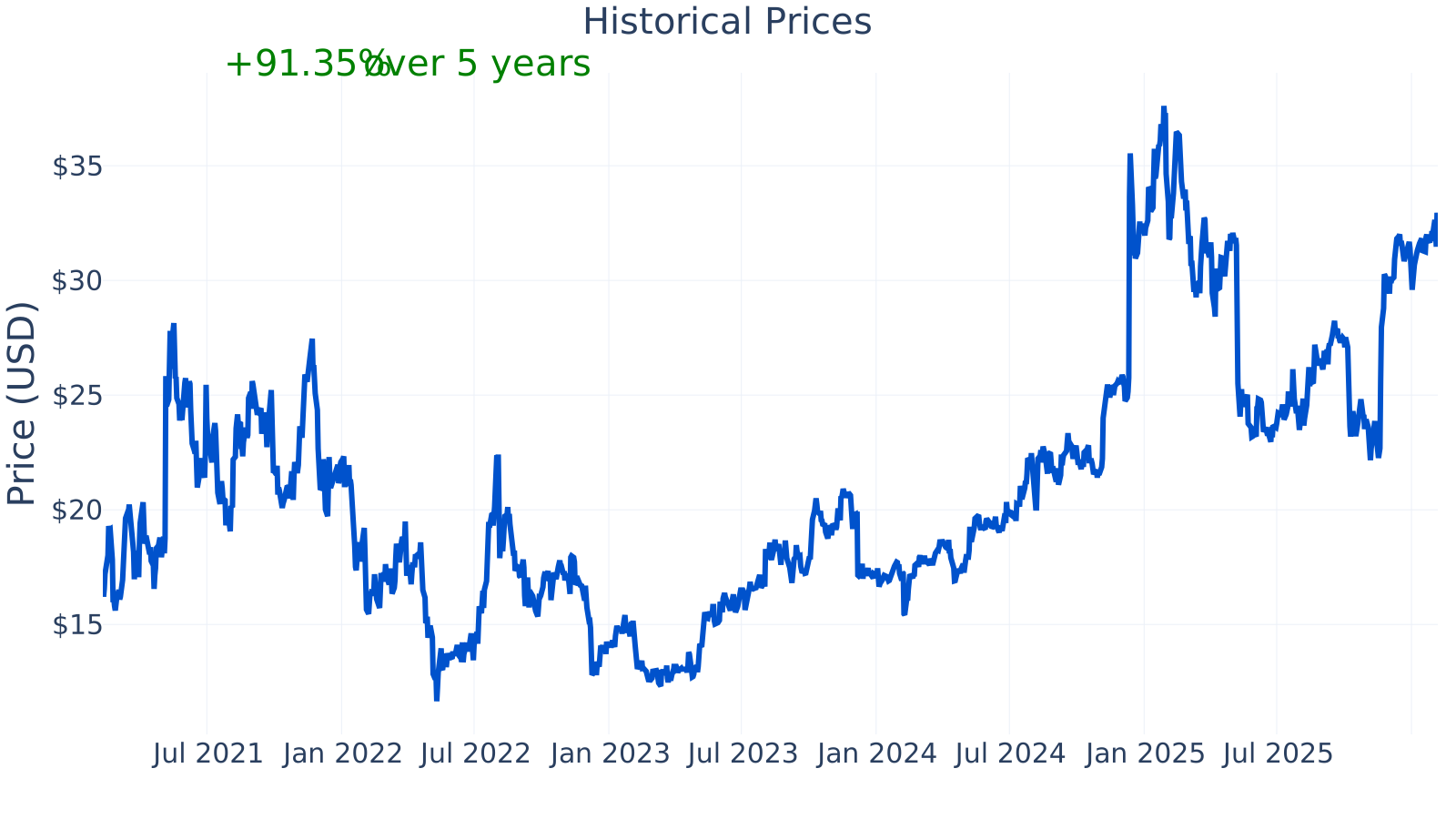
Overview
Liquidity Services Inc. (LQDT) operates online marketplaces that help organizations sell surplus, returned, and end-of-life inventory. Instead of these items being stored, scrapped, or written off, the company runs digital auctions and other selling formats to connect sellers (often large institutions) with a broad base of buyers. In practice, this can include consumer goods, industrial equipment, electronics, vehicles, and other categories where resale value exists but traditional retail channels are not a fit.
The company generally earns money by providing services that make these sales possible—such as marketplace access, transaction processing, and value-added services tied to the disposition of assets. The specific revenue mix can vary by marketplace and client contract structure, but it typically centers on fees and commissions associated with transactions conducted on its platforms.
Main revenue sources commonly described in company filings include:
- Transaction fees / commissions tied to completed sales on the company’s marketplaces
- Service revenue from programs that help clients manage, market, and sell surplus assets (which may include logistics or other support services depending on the contract)
- Other revenue from additional marketplace-related services (generally smaller and more variable)
Looking at the multi-year income flow summary, total revenue increased meaningfully over time (from about $258M in the period shown for 2021 to about $477M for 2025). Over the same snapshots, operating income is positive each year shown, while net income fluctuates but remains positive in the periods displayed—suggesting the business has generally been operating profitably while scaling revenue.
Key Figures
| Metric | Value | Industry ⓘ |
|---|---|---|
| Date | Feb 08, 2026 | |
| Context | ||
| Sector | Consumer Cyclical | |
| Industry | Internet Retail | |
| Market Cap ⓘ | $1.01B | |
| Beta ⓘ | 1.07 | |
| Fundamental | ||
| P/E Ratio ⓘ | 35.34 | 34.01 |
| Profit Margin ⓘ | 6.26% | 6.32% |
| Revenue Growth ⓘ | -0.90% | 11.35% |
| Debt to Equity ⓘ | 10.28% | 34.80% |
| PEG ⓘ | 1.78 | |
| Free Cash Flow ⓘ | $70.12M | |
Liquidity Services’ market capitalization is about $1.01B, placing it in the small-cap range. The stock’s beta is ~1.07, which indicates price movements have historically been roughly in line with the broader market (though any single stock can be more volatile over shorter timeframes).
On profitability, the company’s profit margin is ~6.26%, very close to the industry median (~6.32%). On growth, the latest year-over-year revenue growth is about -0.91%, below the industry median (~11.35%), indicating the most recent year-over-year comparison was softer than many peers in the same broad industry grouping.
Balance-sheet leverage appears modest: debt-to-equity is ~10.28% versus an industry median of ~34.80%. Free cash flow over the trailing twelve months is shown at about $70.1M. The P/E ratio is ~35.34, close to the industry median (~34.01), and the PEG ratio is ~1.78 (a metric that relates valuation to growth expectations, though it depends heavily on how “growth” is measured).
Growth (Medium)
Liquidity Services operates in areas supported by long-term trends: organizations increasingly use online channels to sell surplus and returned goods, and many are focused on improving recovery values rather than treating excess inventory as a pure loss. Digital auctions and managed resale programs can also align with cost control, supply-chain optimization, and sustainability goals (extending product life and reducing waste). These themes can create a supportive backdrop for marketplace-based platforms, especially when they offer broad buyer reach and efficient selling processes.
The company’s strategy—running specialized marketplaces and providing structured disposition programs—can make sense in this context because it is designed to handle complex seller needs (large volumes, variable product types, compliance requirements) while aggregating demand from many buyers. Potential catalysts (in a purely business-sense, not stock-price sense) can include expansion of large client programs, stronger supply of goods needing resale (which can rise when retailers and manufacturers face higher returns or inventory normalization), and continued adoption of online disposition processes by enterprises and government entities.
Revenue growth has been uneven quarter-to-quarter/year-to-year. The chart shows multiple periods of strong positive growth (including spikes above 30% and a very high point above 70%), followed by a recent return to slightly negative growth (about -0.9%). This pattern is consistent with a business that can be influenced by the timing and size of large client programs, the flow of goods available for sale, and broader conditions affecting surplus generation and secondary-market demand.
Free cash flow over the periods shown is consistently positive, moving from about $56.1M (2021) to roughly $45.3M (2025, as of the period displayed), with a dip in 2022 and relative stability afterward. Positive free cash flow can matter for long-term durability because it may help fund technology investment, withstand weaker periods, and provide flexibility without relying heavily on external financing.
Risks (Medium)
A key risk is that results can be sensitive to the volume and mix of goods available for resale and to the pace at which large customers onboard, expand, or change programs. If fewer assets flow through the marketplaces, or if the mix shifts toward lower-value categories, revenue and profitability can be affected. Another operational risk is maintaining trusted, efficient marketplaces: platform reliability, buyer fraud prevention, dispute management, and consistent execution for large sellers are important to protect reputation and retention.
Competition is another meaningful factor. Liquidity Services operates in a broad ecosystem that includes other online liquidation marketplaces, traditional auctioneers, specialized brokers, and in-house programs run by large retailers or manufacturers. Competitive pressure can show up through pricing (lower commissions), efforts by clients to bring the process in-house, or rivals winning large contracts. The company’s potential competitive advantages generally relate to its established marketplaces, buyer networks, experience running large-scale programs, and data/operational know-how built over time. Still, leadership is often category- or contract-specific rather than absolute across the entire resale/liquidation landscape.
Leverage appears relatively low. The latest debt-to-equity is about 10.28%, compared with an industry median of ~34.80%. Over time in the chart, the company generally stays well below the industry median, which can reduce financial risk during downturns—though it does not remove business-cycle risk.
Profit margins have moderated compared with earlier unusually high levels shown in 2021–2022, settling closer to mid-single digits more recently. The latest profit margin is about 6.26%, essentially in line with the industry median (~6.26%) at the most recent point. This suggests recent profitability is comparable to peers, but also highlights that margins can move over time as volume, pricing, and cost structure change.
Valuation
At a high level, LQDT’s valuation metrics look close to the industry median. The latest P/E ratio is ~35.34 versus an industry median of ~34.01. That positioning implies the market is valuing its earnings at a level broadly consistent with similar companies in the same industry classification, rather than giving it a large premium or discount based on this single measure.
The historical P/E trend shows periods where the company traded at much lower multiples (notably around 2022) and then moved higher again as the stock price and/or earnings expectations changed. In more recent periods displayed, LQDT’s P/E often appears around the same neighborhood as the industry median, sometimes below and sometimes above. Interpreting whether today’s price is “expensive” depends heavily on whether revenue growth re-accelerates, how stable margins remain, and whether free cash flow stays consistently positive—because a P/E near the peer median can still prove high or low relative to future business performance.
Conclusion
Liquidity Services is a marketplace business focused on helping organizations convert surplus and returned assets into cash through online selling channels. The company shows signs of operational durability: positive operating income in the periods shown, consistently positive free cash flow across multiple years, and comparatively low leverage versus the industry median.
At the same time, growth has been uneven, with the latest year-over-year revenue change slightly negative and below the industry median. This reinforces that results can vary with the timing and size of asset flows and large client programs, as well as competition from other liquidation channels. Valuation, based on P/E, appears broadly in line with the industry median, meaning the market’s pricing (on that measure) looks more dependent on whether the company can sustain margins and re-accelerate growth than on a clear valuation gap versus peers.
Sources:
- SEC EDGAR — Liquidity Services, Inc. filings (Form 10-K, Form 10-Q, Form 8-K)
- Liquidity Services, Inc. Investor Relations — SEC filings and investor materials
- Wikipedia — “Liquidity Services” (basic company background)
This article is for informational purposes only and does not constitute financial advice. Some content is AI-generated. See Disclaimer


