Stock Analysis · Lindblad Expeditions Holdings Inc (LIND)
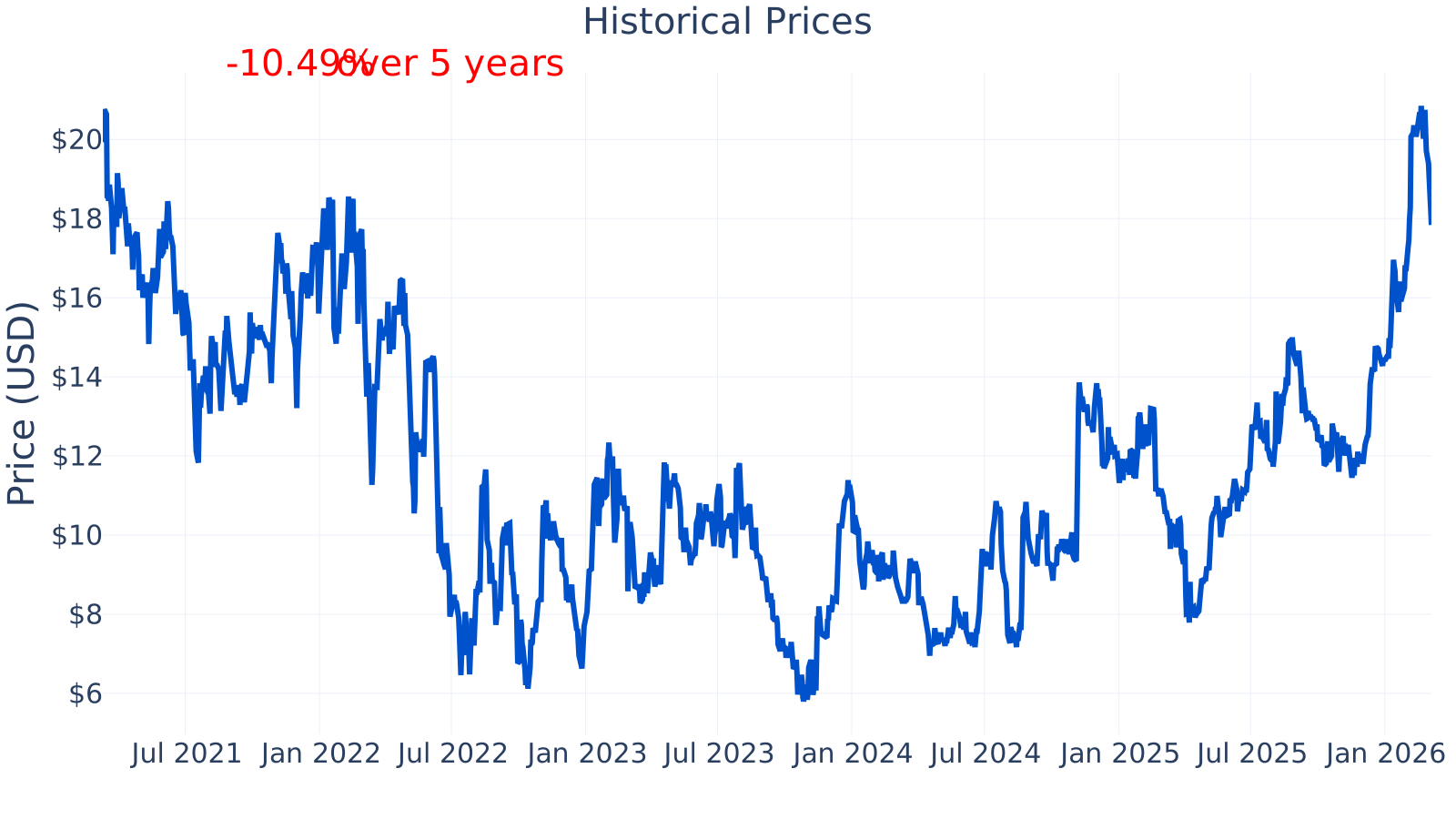
Overview
Lindblad Expeditions Holdings Inc. (LIND) is an expedition travel company focused on small-ship cruises and adventure-oriented trips to destinations such as Antarctica, the Arctic, the Galápagos, Alaska, and other remote regions. The company sells complete travel experiences that typically bundle the voyage with onboard services and guided excursions, positioning its offering as a premium, nature- and education-focused alternative to mass-market cruising.
Operationally, Lindblad’s business depends on (1) attracting travelers willing to pay for specialized itineraries, (2) maintaining high occupancy and pricing on a relatively small fleet, and (3) managing voyage-related costs (fuel, crew, port fees, food, and logistics). Over time, revenue growth tends to come from a mix of higher guest demand, higher pricing, expanded capacity (fleet/charters), and improved onboard revenue capture.
In company reporting, revenue is primarily tied to expedition voyages, with smaller contributions from ancillary items associated with those trips. Percentages by revenue line are not included here because they vary by period and reporting format in filings.
- Expedition cruise ticket revenue (the core of the business)
- Onboard and travel-related revenue (items connected to voyages, such as certain onboard offerings and trip-related services)
From 2021 to 2025, total revenue increased substantially (from about $147.1M in 2021 to about $771.0M in 2025), while operating income moved from deeply negative to positive, indicating a business that has been scaling back toward normalized travel demand and improved utilization.
Across the years shown, total revenue rises meaningfully, and operating income turns positive by 2023 and continues improving through 2025. At the same time, interest expense remains a sizable cost each year (roughly mid-$40M range in 2023–2025), which helps explain why net income stays negative despite positive operating income.
Key Figures
| Metric | Value | Industry ⓘ |
|---|---|---|
| Date | Mar 09, 2026 | |
| Context | ||
| Sector | Consumer Cyclical | |
| Industry | Travel Services | |
| Market Cap ⓘ | $1.16B | |
| Beta ⓘ | 2.26 | |
| Fundamental | ||
| P/E Ratio ⓘ | N/A | 25.63 |
| Profit Margin ⓘ | -3.86% | 8.78% |
| Revenue Growth ⓘ | 23.30% | 12.00% |
| Debt to Equity ⓘ | -329.53% | 96.47% |
| PEG ⓘ | N/A | |
| Free Cash Flow ⓘ | $75.61M | |
Lindblad’s equity market value is about $1.16B, placing it in a small-cap range where business results and sentiment can move the stock more sharply. That sensitivity also shows up in the beta of ~2.26, which signals that the shares have historically been much more volatile than the broader market.
On profitability, the latest profit margin is about -3.86% versus an industry median near 8.78%, meaning the company is still reporting a net loss margin while the broader travel services peer set is positive on average. Growth has been stronger than the peer median recently: year-over-year revenue growth is ~23.3% versus an industry median near 12%.
Cash generation has improved: free cash flow (TTM) is about $75.6M. Finally, the debt-to-equity ratio is negative (and meaningfully different from the industry median), which often occurs when accounting equity is negative; in that situation, the ratio can be hard to interpret in the usual “leverage” sense and is better evaluated using the balance sheet and debt disclosures in filings.
Growth (Medium)
Lindblad operates in the travel services industry, which is cyclical but can grow over time as consumer spending increases and experiential travel remains popular. Expedition cruising is a niche within travel: it is smaller than mass-market cruising but can benefit from customers seeking “once-in-a-lifetime” destinations and guided nature experiences. Because Lindblad focuses on remote itineraries and smaller ships, demand drivers can differ from mainstream vacation travel, but the business is still exposed to broad travel cycles.
A key part of the company’s growth logic is that modest changes in occupancy and pricing can have an outsized effect on results because ship-related costs are significant and many are relatively fixed per voyage. That dynamic can help when demand is strong, but it can also work in reverse during slowdowns.
Recent year-over-year revenue growth is around the low-to-mid 20% range (about 23% in the most recent period shown), above the travel services industry median (about 12%). Earlier years show extreme swings that align with pandemic-era disruptions and subsequent recovery, so the more recent quarters are typically more informative for “normal” momentum.
Free cash flow has shifted from negative (2021–2023) to positive (2024–2025). The latest trailing figure of roughly $75.6M suggests improved cash generation, which can matter for a capital-intensive travel operator because it can support debt service, fleet investment, and operational flexibility.
Potential catalysts for future growth generally come from company-specific execution (pricing, occupancy, itinerary mix, cost control), disciplined capacity decisions (fleet deployment/charters), and the pace at which interest costs and other non-operating items allow operating improvements to translate into net profitability.
Risks (High)
Lindblad’s risk profile is shaped by cyclicality and operating leverage. Demand for premium travel can weaken in recessions or when consumers pull back on discretionary spending. Expedition itineraries also carry operational complexity: weather disruptions, itinerary changes, and higher logistics costs can affect customer experience and profitability.
The debt-to-equity ratio is negative and far from the industry median, which commonly indicates negative shareholder equity. In practical terms, that can be a signal of balance-sheet fragility and makes comparisons using debt-to-equity less straightforward. For long-term business resilience, investors typically look closely at liquidity, debt maturities, and covenant details in the company’s filings.
Net profit margin has improved materially from very large losses in 2021 (driven by pandemic impacts) toward a small loss more recently (about -3.85%). However, it remains below the industry median (around 7%–10% in the later periods shown). Another important factor is that interest expense has remained sizable in recent years, which can keep net income negative even when operating income is positive.
On competitive positioning, Lindblad is a recognized brand in expedition travel and emphasizes guided experiences in remote destinations. That said, it competes in a broader market that includes both expedition specialists and large cruise groups that offer expedition-style products. Competitors can vary by destination and trip format, and they may include:
- Large global cruise companies with expedition brands or smaller-ship offerings
- Private expedition operators and regional adventure travel providers
- Land-based adventure travel companies that compete for similar “experience travel” budgets
Because competition is not purely price-based (itinerary access, safety record, guides, ship quality, and brand trust matter), Lindblad’s advantages are often tied to reputation, experience in remote operations, and product differentiation. The main question for durability is whether that differentiation consistently supports premium pricing and high occupancy across travel cycles.
Valuation
A common valuation metric, the price-to-earnings (P/E) ratio, is not meaningful here based on the values shown (the company P/E appears as 0 over the period displayed), which typically happens when earnings are negative or otherwise not suitable for a standard P/E calculation. In those cases, comparisons to the industry median P/E (around the mid-20s in the periods shown) do not provide a like-for-like valuation read.
With earnings-based valuation less informative, valuation discussions often lean more on the business context visible in filings: revenue scale and trajectory, operating income progression, cash flow generation, and balance-sheet constraints (including interest expense and leverage). In Lindblad’s case, revenue growth and improving operating performance contrast with continued net losses and balance-sheet complexity, so the stock price can be sensitive to whether operating gains ultimately translate into sustained net profitability over time.
Conclusion
Lindblad Expeditions is a specialized travel operator focused on premium expedition cruising. The company has shown strong revenue expansion from 2021 to 2025 and has moved to positive operating income, while free cash flow has turned positive more recently. These are signs of operational recovery and better utilization.
At the same time, the current profile includes meaningful risks: net profit margin remains negative, interest expense is substantial, and the negative debt-to-equity reading suggests the balance sheet requires careful attention beyond simple ratios. The share price has also been volatile historically, consistent with a cyclical, small-cap travel business.
Overall, the long-term outlook depends on execution (maintaining pricing and occupancy, controlling costs), the ability to keep generating cash through the cycle, and whether operating improvements can overcome financing costs and translate into durable net profitability.
Sources:
- SEC EDGAR — Lindblad Expeditions Holdings Inc. Form 10-K (Annual Report)
- SEC EDGAR — Lindblad Expeditions Holdings Inc. Form 10-Q (Quarterly Report)
- Lindblad Expeditions Holdings Inc. Investor Relations — Press Releases and SEC Filings archive
- Wikipedia — “Lindblad Expeditions” (company overview/background)
This article is for informational purposes only and does not constitute financial advice. Some content is AI-generated. See Disclaimer


