Stock Analysis · Life Time Group Holdings Inc (LTH)
Overview
Life Time Group Holdings Inc (Life Time) operates large, multi-purpose athletic resorts in the U.S. that combine fitness, sports, and lifestyle offerings in one location. A typical Life Time center includes gyms and studios, personal training, pools, basketball/pickleball/tennis, family programs and child care, and often wellness services and a café. The company’s model is designed around recurring membership relationships, supported by additional spending inside the clubs.
In its SEC filings, Life Time generally describes revenue as coming primarily from membership dues and from in-center services and products (for example, personal training and other programs). When the company provides a detailed split by category, it is typically presented as a mix of:
- Membership dues (recurring monthly memberships)
- In-center revenue (programs and services such as personal training, classes, child care, and other club-based offerings)
- Other revenue (which can include items like merchandise, food and beverage, and other ancillary streams)
The exact percentages can vary by period and are best taken directly from the most recent Form 10-K/10-Q revenue footnotes and segment/category discussion.
From 2021 to 2025, total revenue increased substantially, and the company moved from large operating losses toward positive operating income and net income. One notable line item is interest expense, which remains meaningful, reflecting a capital-intensive business that relies on debt and long-lived assets.
Key Figures
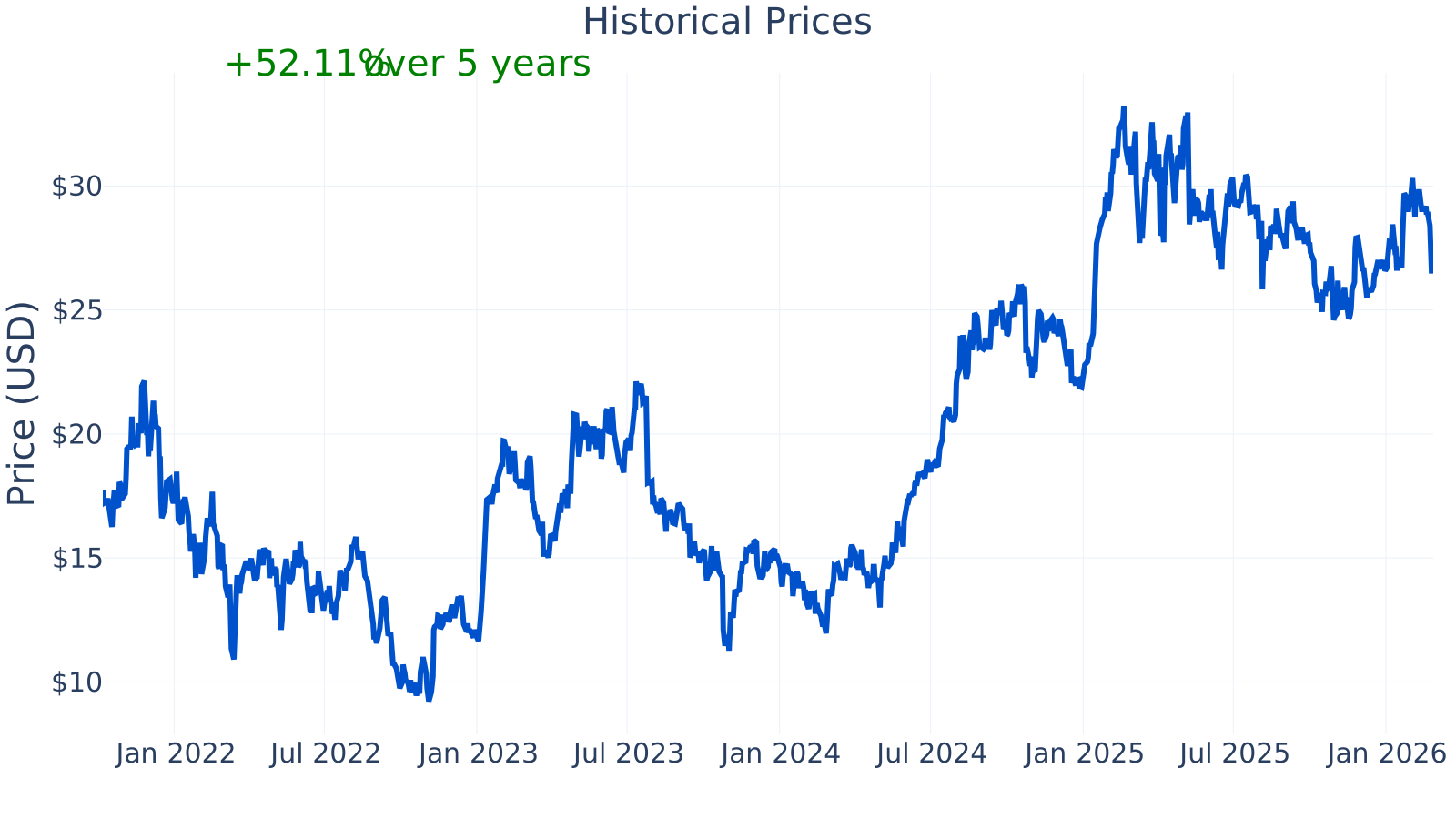
The stock price history shows notable swings since 2021, with a low around late 2022 and a higher range reached in 2025 before pulling back into early 2026. This pattern is consistent with a business where expectations about growth, profitability, and financing conditions can change quickly.
| Metric | Value | Industry ⓘ |
|---|---|---|
| Date | Mar 02, 2026 | |
| Context | ||
| Sector | Consumer Cyclical | |
| Industry | Leisure | |
| Market Cap ⓘ | $5.95B | |
| Beta ⓘ | 1.68 | |
| Fundamental | ||
| P/E Ratio ⓘ | 21.09 | 27.73 |
| Profit Margin ⓘ | 12.48% | 7.37% |
| Revenue Growth ⓘ | 12.30% | 7.30% |
| Debt to Equity ⓘ | 215.90% | 42.62% |
| PEG ⓘ | N/A | |
| Free Cash Flow ⓘ | -$20.96M | |
Life Time’s market capitalization is about $6.0B, and the stock’s beta of 1.68 indicates it has tended to move more than the overall market. The latest P/E ratio is about 21.1, below the industry median (~27.7). Profitability appears stronger than the industry median on this snapshot (profit margin ~12.5% vs. industry median ~7.4%). Revenue growth is also higher than the industry median (~12.3% year over year vs. ~7.3%). A key offset is balance-sheet leverage: debt-to-equity ~216% versus an industry median near 43%. Free cash flow over the trailing twelve months is slightly negative (about -$21M).
Growth (Medium)
Life Time operates in the health and fitness/leisure space, where demand is influenced by long-term wellness trends, consumer spending, and how consistently people use memberships. For club operators, growth often comes from a combination of adding new locations, improving membership levels at existing clubs, and increasing in-club spending through services and programs.
The year-over-year revenue growth rate has cooled from very high levels earlier in the period (coming out of the pandemic-era recovery) to the low-teens more recently (about 12% in the latest point shown). A slowing growth rate is not unusual as comparisons get harder; the key question for long-term monitoring is whether growth stabilizes at a healthy level without requiring outsized discounting or unusually high marketing spend.
Free cash flow has improved materially over time, moving from large negative levels to positive in 2025, and then to slightly negative on a trailing basis in the latest metric snapshot. For a company that builds, renovates, and maintains large athletic centers, free cash flow can swing depending on the timing of club openings and capital expenditures. In this business model, consistent positive free cash flow over full cycles can be an important sign that expansion and maintenance needs are being funded sustainably.
Potential catalysts for continued growth typically include successful new-club openings, higher utilization of premium offerings (training, classes, sports programming), and improved operating efficiency as clubs mature. Execution matters: building and ramping large sites can produce strong results, but it also increases complexity and capital needs.
Risks (High)
A major risk is leverage. Debt-to-equity is high (about 216% currently) and has generally been well above the industry median across the period shown, with a noticeable increase in the most recent point on the chart. Higher leverage can amplify outcomes: it may help fund growth when business trends are favorable, but it can reduce flexibility during downturns or periods of higher interest rates. Interest expense has also been a meaningful cost historically, which can pressure net income when financing costs rise or when operating performance softens.
Profit margins have improved dramatically over the last few years, moving from deeply negative levels to positive, and reaching around 12.5% most recently, above the industry median in the latest snapshot. The risk is that margins can be sensitive to wage inflation, utilities, occupancy costs, and the need for ongoing spending on club upkeep. Because the company operates physical locations with substantial fixed costs, a drop in member visits or cancellations can affect profitability more quickly than in asset-light business models.
Competition is another meaningful factor. Life Time competes with:
- Premium athletic club operators (direct competition for higher-income households seeking full-service clubs)
- Mass-market gyms (lower-priced options that may pressure pricing power in some markets)
- Boutique studios and specialized concepts (yoga, cycling, Pilates, strength training) that can take share of higher-margin class-based spending
- At-home and digital fitness (can substitute for some gym usage, depending on consumer preferences)
Life Time’s competitive advantages are mainly tied to scale and the breadth of its offering: large facilities, many amenities under one roof, and a family-oriented experience that can be harder to replicate in small-box formats. At the same time, those same large facilities make expansion and operations more capital-intensive than many competitors, increasing exposure to real estate decisions and local market demand.
Additional risks commonly disclosed for club operators include membership churn during weaker economic periods, the cost and availability of labor, the need to continually refresh facilities to maintain premium positioning, and potential site-level underperformance if a new location does not ramp as expected.
Valuation
The company’s latest P/E ratio is about 21.1, which is lower than the industry median (~27.7) in the provided comparison set. Over the period shown, the P/E ratio has trended down from higher levels in 2023–2024 toward the mid-teens in early 2026, which can happen when earnings rise faster than the stock price, when the stock price falls, or both.
How “expensive” the stock looks depends on whether current profitability is considered durable and whether future growth can be achieved without heavy dilution or a return to persistently negative free cash flow. The valuation picture is therefore mixed: profitability and revenue growth compare favorably to the industry snapshot, while leverage and free-cash-flow variability add uncertainty and can justify a more cautious valuation approach in many frameworks.
Conclusion
Life Time is a premium, membership-driven fitness and leisure operator with a business model built around recurring dues plus additional spending on in-club services. Financial results over the last several years show a clear shift toward higher revenue and improved profitability, with profit margins rising into the low-teens most recently and revenue growth moderating into the low-teens.
The main trade-off evident in the fundamentals is the combination of improving earnings power alongside relatively high leverage and the capital intensity of running and expanding large athletic resorts. For long-term analysis, the most important areas to track over time are membership trends and retention, new-club performance, sustained positive free cash flow across investment cycles, and whether leverage and interest costs remain manageable as the company grows.
Sources:
- Life Time Group Holdings, Inc. — SEC filings (Form 10-K, Form 10-Q) available via SEC EDGAR
- U.S. Securities and Exchange Commission — EDGAR Company Filings (Life Time Group Holdings, Inc.)
- Life Time Group Holdings, Inc. — Investor Relations materials and press releases (company-hosted)
- Wikipedia — “Life Time (company)” (basic background only)
This article is for informational purposes only and does not constitute financial advice. Some content is AI-generated. See Disclaimer


