Stock Analysis · Liberty Broadband (LBRDK)
Overview
Liberty Broadband (LBRDK) is a holding company. Instead of running a large consumer-facing telecom network itself, it primarily owns investments in other communications-related businesses. Historically, its results have been heavily influenced by the performance of Charter Communications (a major U.S. cable and broadband provider), because Liberty Broadband has held a significant equity stake in Charter. In addition, Liberty Broadband has held other assets and investments that can change over time based on corporate actions.
Because Liberty Broadband is structured as a holding company, its reported revenue can look different from an operating telecom company. A meaningful portion of value and performance can come from changes in the market value of its investments and from accounting items tied to those holdings, rather than from selling services directly to households.
Main sources of revenue can include:
- Operating revenue from consolidated subsidiaries (if any) (varies by reporting period depending on what is consolidated under accounting rules)
- Other income and investment-related items (may include dividends, interest, and gains/losses depending on structure and filings)
In practice, understanding Liberty Broadband often requires focusing on what it owns (especially large strategic stakes) and how those holdings are evolving, rather than only on traditional “sales growth” of a single operating business.
The income statement profile shown here highlights how results can be heavily affected by non-operating factors. For example, net income can move sharply even when revenue changes are modest, which is typical when investment-related accounting items (and not only day-to-day service revenue) play a large role.
Key Figures
| Metric | Value | Industry ⓘ |
|---|---|---|
| Date | May 05, 2026 | |
| Context | ||
| Sector | Communication Services | |
| Industry | Telecom Services | |
| Market Cap ⓘ | $5.75B | |
| Beta ⓘ | 0.70 | |
| Fundamental | ||
| P/E Ratio ⓘ | N/A | 14.31 |
| Profit Margin ⓘ | N/A | 7.29% |
| Revenue Growth ⓘ | 6.10% | 4.10% |
| Debt to Equity ⓘ | 43.49% | 102.25% |
| PEG ⓘ | N/A | |
| Free Cash Flow ⓘ | -$167.00M | |
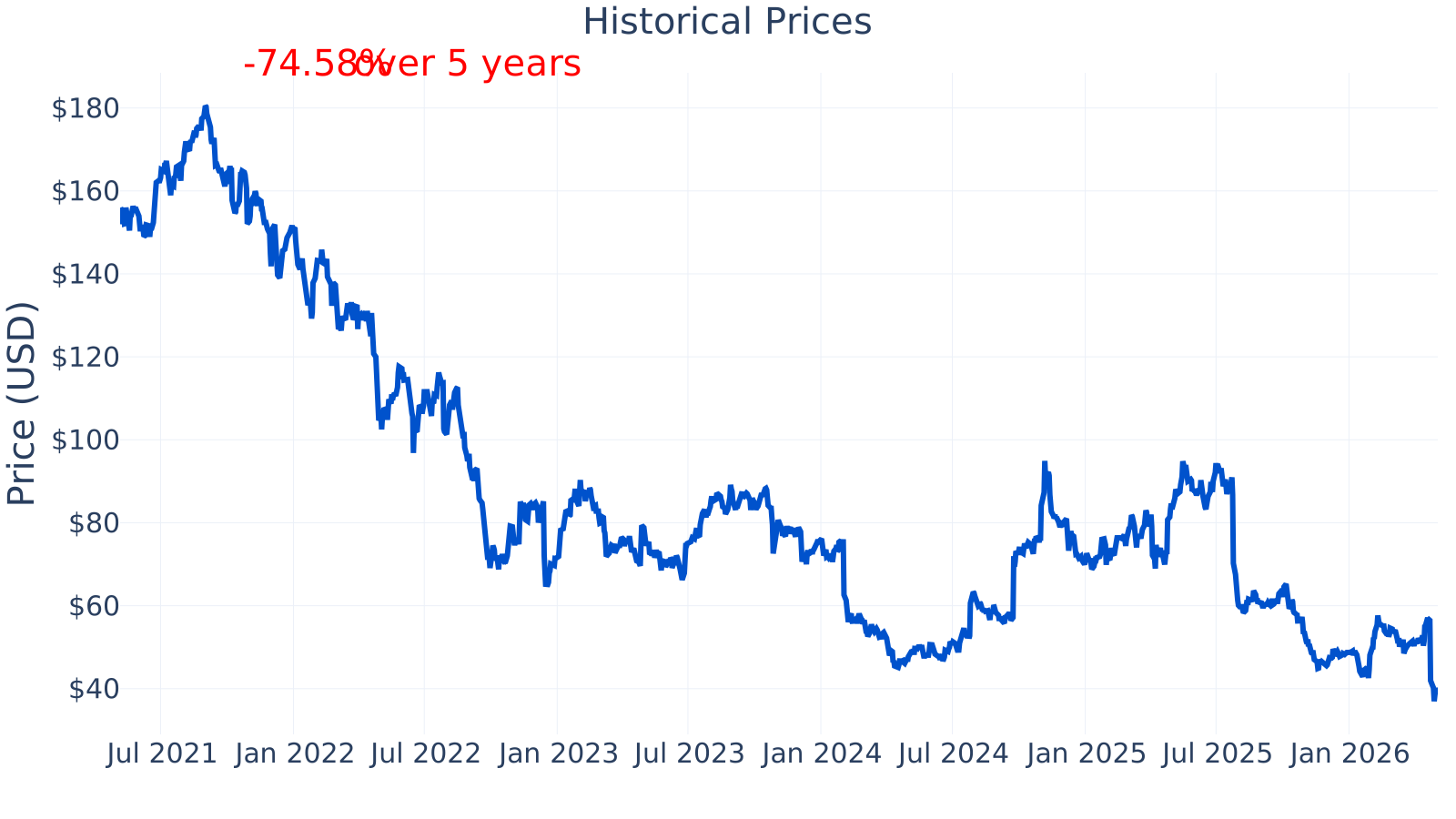
Liberty Broadband’s market capitalization is about $5.75B, and the stock’s beta (~0.70) suggests it has historically been less volatile than the broader market on average.
Year-over-year revenue growth is shown at about 6.1% versus an industry median near 4.1%, but revenue is not always the best “core” indicator for a holding-company structure. Profitability metrics are also unusual: the latest profit margin shown is 0% while the industry median is about 7.3%, and the margin history (discussed below) has been extremely volatile, including recent negative values.
Free cash flow over the trailing twelve months is shown at about -$167M, which is a key figure to monitor because persistent negative free cash flow can reduce financial flexibility over time.
Growth (medium)
Liberty Broadband’s long-term growth exposure has been closely tied to U.S. broadband connectivity demand. Broadband remains a critical utility-like service for households and businesses, with ongoing needs driven by video streaming, remote work, cloud applications, and connected devices. That said, the U.S. connectivity market is mature, and growth is often shaped by competitive intensity (cable vs. fiber vs. fixed wireless), pricing discipline, and customer churn rather than rapid market expansion.
Because Liberty Broadband is a holding company, “strategy” is often expressed through capital allocation: how it builds, maintains, or reshapes its major holdings. When the company’s primary assets are stakes in large operating businesses, potential catalysts tend to be corporate actions (reorganizations, mergers, asset sales, or changes in ownership structure), plus the underlying operational execution of the major investees.
The year-over-year revenue trend shown here is mixed: after earlier very large swings, more recent periods cluster around low single-digit to mid single-digit changes (including some quarters negative and some positive). This pattern fits a business profile where reported revenue may be relatively stable in normal conditions, while overall results can still fluctuate due to non-revenue items.
Free cash flow remains negative across the periods shown (roughly -$238M to -$121M, most recently about -$167M). Even if net income can be positive in some years, negative free cash flow can indicate that cash outflows (such as interest, taxes, investment activity, or other uses of cash) are outweighing cash generated within the period.
Risks (high)
A central risk is that Liberty Broadband’s financial outcomes can be dominated by a small number of large holdings. This concentration means results can be strongly influenced by the operating performance, valuation, and strategic decisions of those investees. If the main underlying business faces customer losses, pricing pressure, higher capital spending needs, or regulatory changes, the holding company can feel those effects even if Liberty Broadband itself does not run the networks.
Another key risk is that accounting results can be volatile and sometimes difficult for non-specialists to interpret. Large swings in reported profit margin (including very high positive margins and more recent sharply negative margins) suggest that one-time items and investment-related accounting effects may be significant drivers of bottom-line results.
The debt-to-equity ratio is about 43% in the latest period shown, compared with an industry median near 102%. Over time it has generally stayed below the industry median, which can indicate a comparatively more conservative balance-sheet profile. However, the ratio has also moved meaningfully from period to period, so it is important to watch whether leverage rises during weaker operating or market environments.
Profit margins have been unusually volatile. Earlier periods show extremely high positive margins (well above typical telecom service economics), while the most recent periods shown swing to deeply negative (for example, around -508% and -1,050%). This kind of pattern often signals that net income is being driven by large non-recurring items or valuation/accounting impacts rather than steady operating profitability.
In terms of competitive position, Liberty Broadband is not a traditional “operator competing for subscribers” in the way a cable or wireless carrier does; its competitive advantages are more about the quality of its holdings, governance influence where applicable, and capital allocation discipline. The main competitive pressures relevant to its largest exposure typically come from:
- Large U.S. cable and broadband providers (competition for broadband subscribers and pricing)
- Fiber network operators (often competing on speed, upload performance, and perceived reliability)
- Fixed wireless access offerings from mobile network operators (competing on price and installation convenience)
How well Liberty Broadband is “positioned” depends heavily on whether its primary holdings can defend broadband share, manage network investment needs, and maintain pricing power in an increasingly competitive last-mile connectivity market.
Valuation
The P/E ratio history shown varies widely over time. In earlier periods, Liberty Broadband traded at much higher P/E levels (for example, around 60–72 in parts of 2021), then moved into the teens and single digits across several later periods (often below the industry median). In the latest point shown, the company P/E is not displayed (set to 0 on the chart), which typically happens when earnings are negative or otherwise not meaningful for a P/E calculation.
For a holding company with potentially volatile net income, P/E can be a blunt tool: if earnings are distorted by one-time items, the P/E may look artificially low, high, or not meaningful at all. In this context, valuation discussions often require looking beyond a single multiple and focusing on what the company owns, the stability of cash flows associated with those holdings, leverage, and any structural transactions that could change the asset mix.
Conclusion
Liberty Broadband is best understood as a concentrated ownership vehicle with significant exposure to the U.S. broadband and connectivity ecosystem through its major holdings. This structure can create a very different financial “feel” than a typical operating telecom business: revenue growth may appear modest, while net income and margins can swing sharply due to investment- and accounting-driven effects.
The main fundamental questions for long-term analysis tend to center on (1) the durability of broadband demand and competitive dynamics affecting the major underlying assets, (2) the company’s ability to manage leverage and maintain flexibility (especially with negative trailing free cash flow), and (3) the likelihood and impact of corporate actions that could reshape the portfolio. The facts above point to a business with meaningful sector exposure but elevated complexity and earnings volatility relative to many straightforward operating companies.
Sources:
- SEC EDGAR — Liberty Broadband Corp. filings (Form 10-K, Form 10-Q, Form 8-K)
- Liberty Broadband — Investor Relations materials and press releases (company-hosted)
- Wikipedia — “Liberty Broadband” (basic company background)
This article is for informational purposes only and does not constitute financial advice. Some content is AI-generated. See Disclaimer