Stock Analysis · Liberty Broadband (LBRDA)
Overview
Liberty Broadband is a holding company. Instead of operating a large consumer brand itself, it primarily owns investments in other media and broadband-related businesses. Historically, its value has been closely tied to its stake in Charter Communications (which operates the “Spectrum” broadband and cable business in the U.S.), along with smaller holdings and corporate-level cash/debt.
Because it is a holding company, the way it “makes money” can look different from a typical operating business. Results can be driven by (1) dividends or distributions from investees, (2) changes in the market value of its investments, and (3) any corporate-level interest income/expense and operating costs.
In Liberty Broadband’s financial statements, revenue is typically not the main story in the same way it would be for an operating telecom company. Reported revenue largely reflects smaller consolidated activities and/or accounting presentation, while the company’s economic exposure is largely tied to the performance of its investments (especially Charter Communications).
Main economic value drivers (high-level):
- Equity ownership in Charter Communications (historically the dominant exposure)
- Other investments and assets (smaller positions, cash, and other corporate items)
- Corporate-level financing (interest expense and cash management can materially affect net results)
The income statement flow highlights how results can be influenced by corporate expenses and financing costs. In several years, operating income is relatively small compared with net income, which can happen when a holding company’s bottom line is affected by investment-related items and other non-operating factors rather than day-to-day operating margins alone.
Key Figures
| Metric | Value | Industry ⓘ |
|---|---|---|
| Date | Feb 07, 2026 | |
| Context | ||
| Sector | Communication Services | |
| Industry | Telecom Services | |
| Market Cap ⓘ | $7.74B | |
| Beta ⓘ | 0.98 | |
| Fundamental | ||
| P/E Ratio ⓘ | 6.44 | 15.18 |
| Profit Margin ⓘ | N/A | 6.18% |
| Revenue Growth ⓘ | 6.10% | 2.10% |
| Debt to Equity ⓘ | 19.76% | 113.97% |
| PEG ⓘ | -657.00 | |
| Free Cash Flow ⓘ | $88.00M | |
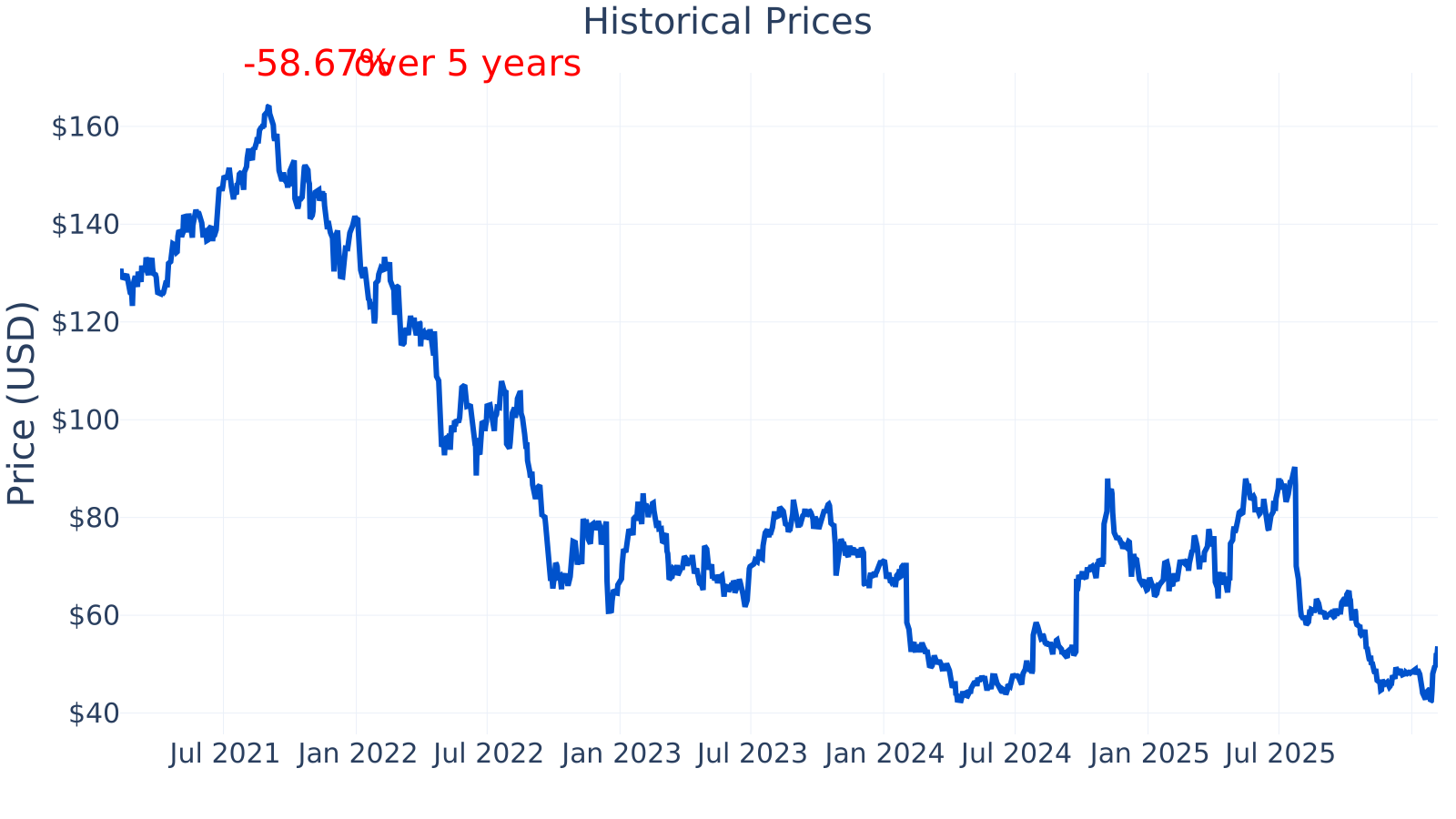
Liberty Broadband’s market capitalization is about $7.7B, placing it among mid-sized public companies. The stock’s beta of about 0.98 indicates price moves that have been broadly similar to the overall market in many periods, though holding-company structures can still experience sharp swings when a major underlying investment moves.
The latest P/E ratio is ~6.44, below the telecom services industry median (~15.18). For holding companies, P/E can be less straightforward to interpret because earnings may include sizable non-operating or investment-related gains/losses that do not repeat every year.
Revenue growth in the latest snapshot is about 6.1% year over year, higher than the industry median shown (~2.1%). Debt-to-equity is about 19.8%, far below the industry median shown (~114%), suggesting comparatively lower balance-sheet leverage versus many telecom peers (noting that the biggest underlying exposure—Charter—has its own separate capital structure).
Growth (Medium)
Liberty Broadband’s long-term trajectory has been strongly linked to U.S. broadband demand. Broadband is widely viewed as a durable consumer utility-like service, supported by ongoing data usage growth, streaming, remote work, and connected devices. However, mature U.S. broadband markets can also face slower subscriber growth and more competition over time, making price, churn, and network quality increasingly important.
As a holding company, Liberty Broadband’s growth “strategy” is less about launching new products and more about capital allocation: maintaining/adjusting its investment exposure, managing corporate debt, and potentially executing transactions that affect how investors access the underlying assets.
The year-over-year revenue growth pattern shown is uneven: very high growth earlier in the period (notably in 2021), followed by slower or slightly negative growth across parts of 2022–2024, and then a pickup into the mid-single digits and higher in more recent quarters (roughly mid–single digits to high–single digits in the latest points shown). For a holding company, this line should be read cautiously because reported revenue may not fully represent the economic performance of its major equity holdings.
Free cash flow over the trailing twelve months has been volatile and was negative for multiple years in the period shown (for example, around -$238M in 2022 and improving to about -$121M by 2025-03-31), while the latest metrics snapshot lists +$88M. For long-term assessment, the key is understanding what drives these swings (timing of cash movements, corporate expenses, financing costs, and any cash received from investees), rather than expecting a smooth operating-company pattern.
Possible catalysts for changes in long-term outcomes typically include major moves at the underlying investees (especially Charter Communications), shifts in broadband competition (fiber overbuilds, fixed wireless substitution), and any corporate transactions that simplify the structure or change the investment mix.
Risks (High)
This article is for informational purposes only and does not constitute financial advice. Some content is AI-generated. See Disclaimer