Stock Analysis · Levi Strauss & Co (LEVI)
Overview
Levi Strauss & Co (LEVI) designs, markets, and sells apparel and accessories, best known for its denim products under the Levi’s brand. The company operates globally and sells through a mix of wholesale partners (such as department stores and other retailers) and its own direct-to-consumer channels (company-operated stores and e-commerce). In simple terms, Levi’s earns money when consumers buy its jeans and other clothing either from third-party retailers or directly from Levi’s.
Across its reporting, Levi’s business is commonly described through these main revenue streams:
- Wholesale (selling to retail partners)
- Direct-to-consumer (DTC) (brand stores and e-commerce)
- By product category, denim bottoms are central, alongside tops and other apparel/accessories (the exact mix can vary by year and is detailed in company filings)
Percent splits by channel and product can be found in Levi Strauss & Co’s annual report (Form 10‑K). This article focuses on the business model and long-term fundamentals without requiring readers to interpret financial statements.
Over the last several fiscal years, revenue has stayed in a relatively narrow range (roughly $5.8B to $6.4B), while profitability has moved more noticeably year to year. Operating income and net income dipped in some periods and recovered later, illustrating how costs (product costs, operating expenses, and taxes) can meaningfully impact results even when revenue is fairly stable.
Key Figures
| Metric | Value | Industry ⓘ |
|---|---|---|
| Date | Feb 07, 2026 | |
| Context | ||
| Sector | Consumer Cyclical | |
| Industry | Apparel Manufacturing | |
| Market Cap ⓘ | $8.03B | |
| Beta ⓘ | 1.31 | |
| Fundamental | ||
| P/E Ratio ⓘ | 16.31 | 22.80 |
| Profit Margin ⓘ | 9.20% | 4.94% |
| Revenue Growth ⓘ | 0.90% | 1.60% |
| Debt to Equity ⓘ | 101.18% | 99.72% |
| PEG ⓘ | N/A | |
| Free Cash Flow ⓘ | $324.30M | |
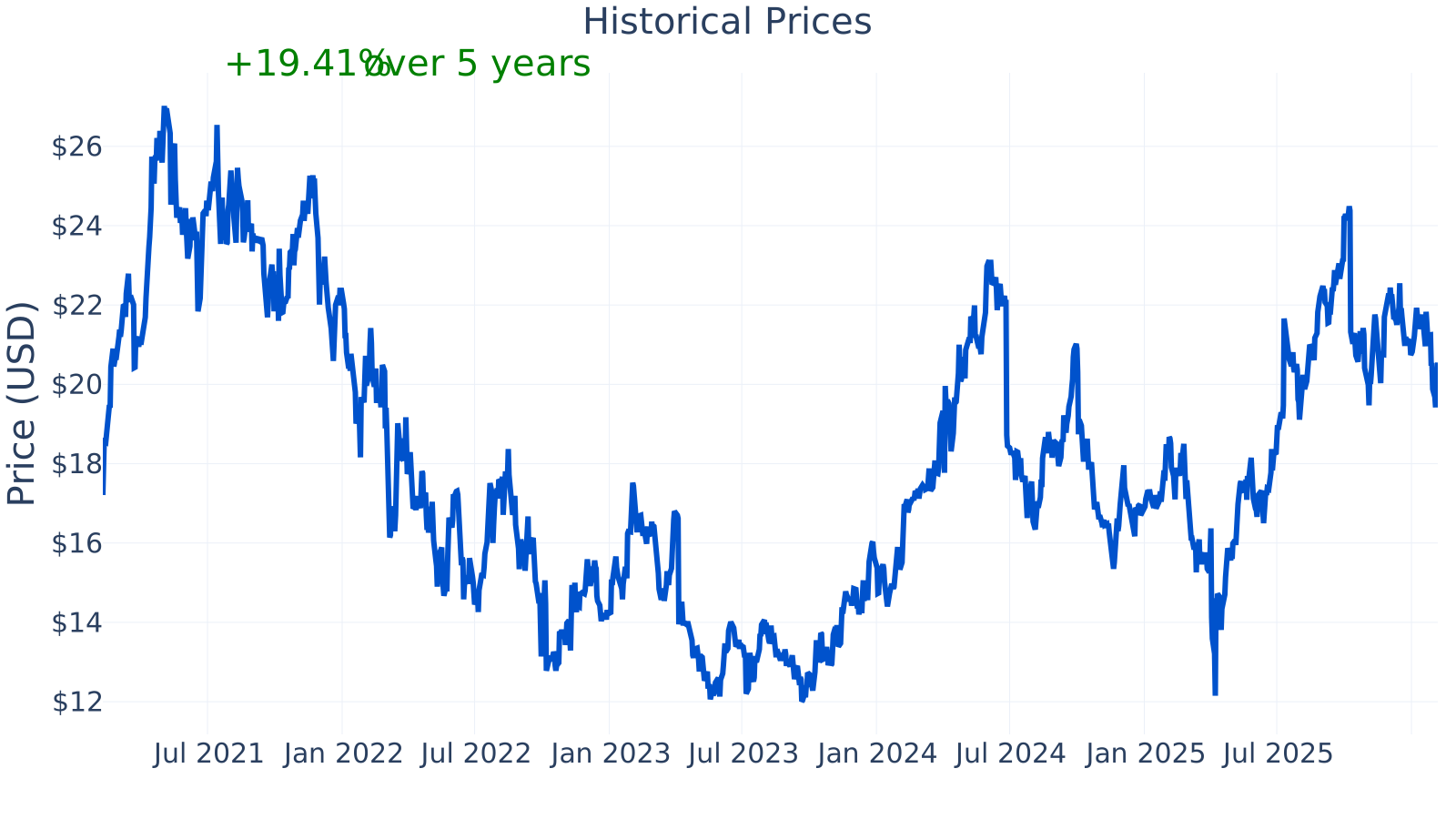
Levi Strauss & Co’s market capitalization is about $8.0B. The stock’s beta (~1.31) suggests it has historically moved more than the overall market (higher volatility than a beta near 1.0). The current P/E ratio (~16.3) is below the industry median shown (~22.8). Recent profit margin (~9.2%) is above the industry median shown (~4.9%). Year-over-year revenue growth (~0.9%) is modest and below the industry median shown (~1.6%). Debt-to-equity (~101%) is close to the industry median shown (~100%). Trailing twelve-month free cash flow (~$324M) indicates the business has recently generated cash after operating needs and capital spending, though cash generation can vary materially by year.
Growth (Medium)
Apparel is a large, mature, and highly competitive industry. Demand tends to track consumer spending and can weaken when shoppers cut back. For a company like Levi’s, long-term growth typically depends less on the overall category expanding quickly and more on execution: brand strength, product innovation, distribution, pricing power, and a strong mix of wholesale and direct-to-consumer sales.
A key long-term strategic direction for many branded apparel companies is growing direct-to-consumer (owned stores and e-commerce). In general, DTC can offer better control over branding, customer data, and merchandising, and it may support higher margins than wholesale—though it also requires ongoing investment in stores, digital experiences, logistics, and marketing. Levi’s filings describe its focus on brand-led growth and channel mix, which fits this broader industry pattern.
Recent year-over-year revenue growth has been uneven. There were periods of strong growth (particularly during the post-pandemic recovery), followed by slower or slightly negative growth in some quarters. The latest value shown is around -4.0% year over year, which highlights that demand and shipments can fluctuate and that growth is not consistently upward each period.
Free cash flow has also been volatile over time, moving from positive to negative and back to positive. For example, the series shown includes a negative period (around -$323M) and later rebounds (over $600M at one point), with the most recent value around $324M. This matters for long-term shareholders because cash generation helps support reinvestment in the business, potential debt reduction, and returning capital (depending on company policy and conditions).
Risks (Medium)
This article is for informational purposes only and does not constitute financial advice. Some content is AI-generated. See Disclaimer


