Stock Analysis · Lennar Corporation (LEN)
Overview
Lennar Corporation is a major U.S. homebuilder. In simple terms, it buys or controls land, builds homes (often through planned communities), and sells those homes to buyers. In addition to building and selling houses, Lennar also operates businesses that support the home purchase and ownership process, such as mortgage services, title services, and insurance-related offerings (typically tied to Lennar’s own home sales).
Its activity is closely tied to the U.S. housing market, which tends to move in cycles. When mortgage rates rise or consumer confidence falls, fewer people can afford homes and demand can slow. When financing becomes easier and demand strengthens, homebuilders can deliver more homes at higher profitability.
Based on how homebuilders typically report their segments in SEC filings, Lennar’s main revenue sources are generally:
- Home sales (homebuilding) — the largest source, driven by the number of homes delivered and the average selling price.
- Financial services — primarily mortgage and title services that are often used by Lennar homebuyers.
- Other / ancillary — smaller items that may include services related to communities and other complementary activities (as described in filings).
The company’s annual revenue has been relatively steady in the mid-$30B range in recent years (about $33.7B in 2022, $34.2B in 2023, $35.5B in 2024, and $34.2B in 2025). Over the same period, net income declined from roughly $4.6B (2022) and $3.9B (2023–2024) to about $2.1B (2025), showing that profitability can change meaningfully even when revenue is relatively stable—often reflecting pricing, incentives, costs, and market conditions.
Key Figures
| Metric | Value | Industry ⓘ |
|---|---|---|
| Date | Feb 23, 2026 | |
| Context | ||
| Sector | Consumer Cyclical | |
| Industry | Residential Construction | |
| Market Cap ⓘ | $28.76B | |
| Beta ⓘ | 1.46 | |
| Fundamental | ||
| P/E Ratio ⓘ | 14.59 | 12.43 |
| Profit Margin ⓘ | 6.08% | 8.48% |
| Revenue Growth ⓘ | -5.80% | -5.40% |
| Debt to Equity ⓘ | 28.76% | 33.34% |
| PEG ⓘ | 2.36 | |
| Free Cash Flow ⓘ | $28.18M | |
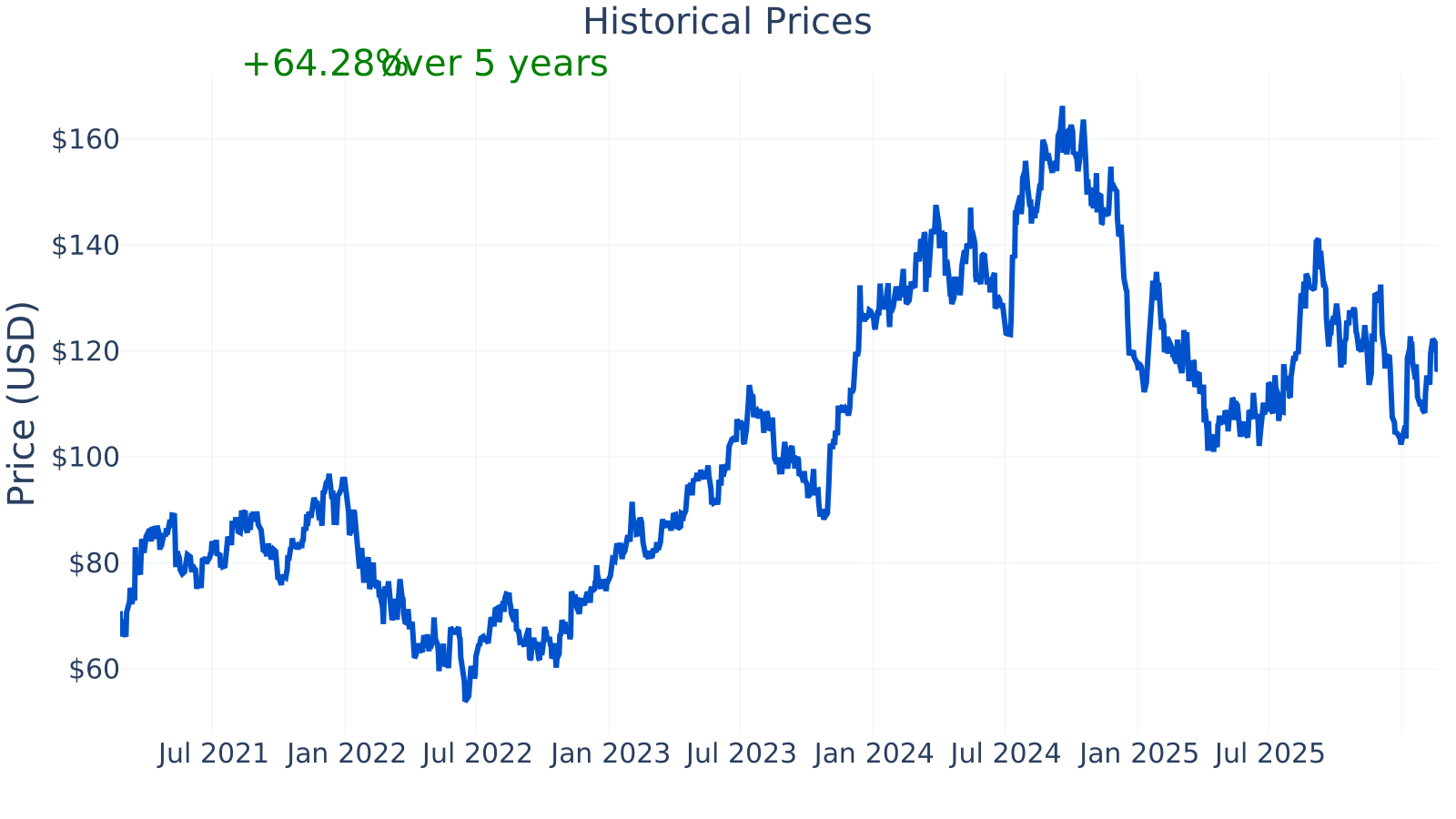
Lennar’s market capitalization is about $28.8B. The stock’s beta of ~1.46 indicates it has historically moved more than the overall market (higher ups and downs). The current P/E ratio is ~14.6, above the residential construction industry median of about 12.4. Recent profit margin is ~6.1%, below the industry median of about 8.5%. Year-over-year revenue growth is around -5.8% (industry median about -5.4%). Debt-to-equity is about 28.8%, lower than the industry median near 33.3%. Trailing twelve-month free cash flow is approximately $28M, which is much lower than the multi-billion-dollar levels seen in some prior periods and can reflect working-capital swings typical for homebuilders (inventory and land spending can absorb cash).
Growth (Medium)
Residential construction is a large, long-running industry supported over time by population growth, household formation, and the need to replace or add housing supply. However, it is also highly cyclical, because affordability depends heavily on mortgage rates, home prices, wages, and lending conditions. That combination typically creates “bursts” of stronger demand followed by slower periods.
Lennar’s long-term growth path is usually shaped by practical drivers: access to lots/land, the pace of home deliveries, pricing power in its markets, and its ability to manage construction costs and incentives. Another structural angle is that large builders often benefit from scale (purchasing power, standardized plans, and operational systems), which can help them stay active through different parts of the cycle.
The year-over-year revenue growth pattern shown here highlights that Lennar moved from strong positive growth earlier in the period to more mixed results and then declines more recently (with the latest reading around -6%). This kind of swing is common for homebuilders and often reflects changes in demand, pricing, and the use of buyer incentives as affordability shifts.
Free cash flow has varied substantially over time, from multi-billion-dollar levels in several years to a much lower recent trailing value. For homebuilders, this can happen when the company is investing more heavily in land and inventory (cash outflows today that may support future home deliveries) or when completed-home inventory and receivables move around. The direction and consistency of cash generation over a full cycle often matters more than any single year.
Potential catalysts for the business (positive or negative) generally come from outside the company: changes in mortgage rates, shifts in housing supply and demand, local market conditions in Lennar’s footprint, and construction input costs. Because these are macro-driven, growth visibility is typically less stable than in many non-cyclical industries.
Risks (High)
This article is for informational purposes only and does not constitute financial advice. Some content is AI-generated. See Disclaimer