Stock Analysis · Leidos Holdings Inc (LDOS)
Overview
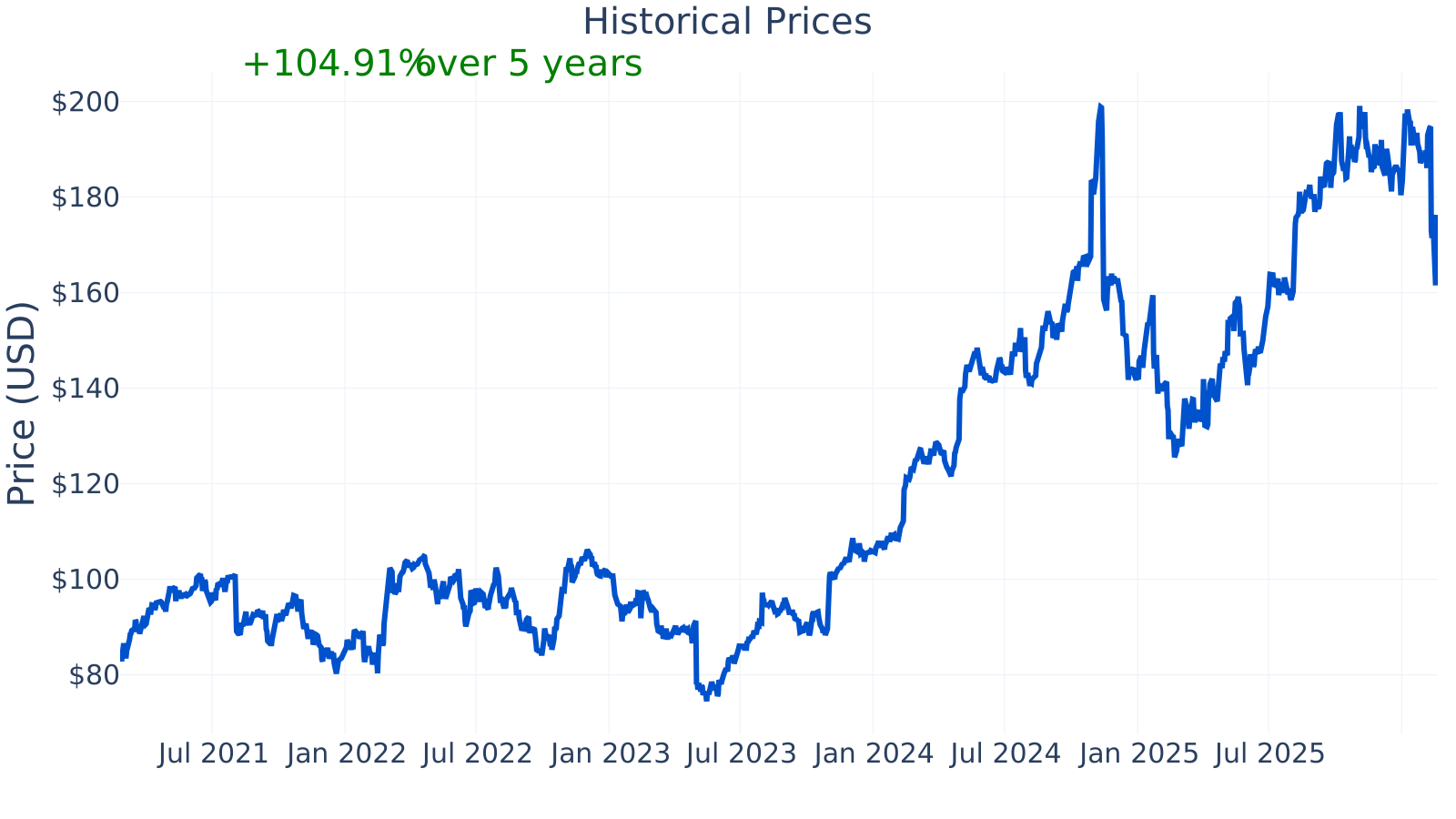
Leidos Holdings Inc. (LDOS) is a U.S.-based services company that designs and runs technology-heavy programs, primarily for government and government-adjacent customers. In simple terms, it helps large organizations (especially federal agencies) operate complex missions such as national security work, digital modernization, IT operations, data and analytics, healthcare and benefits systems, and engineering programs that can include work for air, land, sea, and space domains.
Its business model is largely project- and contract-based. Revenue is generally tied to winning, executing, and renewing multi-year contracts, often with detailed performance requirements and government oversight. This tends to create visibility (because contracts can span years), but it also means results can be sensitive to contract awards, the timing of government spending, and contract-specific cost and performance outcomes.
Main revenue sources are typically discussed by operating segment in company filings. In recent annual reporting, Leidos has described its operations across major segments such as National Security & Digital, Health & Civil, and Commercial & International (names and grouping can evolve over time based on reporting structure). For a long-term understanding, the key point is that the largest share of revenue is historically tied to U.S. federal government work, with smaller portions from state/local, international, and commercial customers. (Exact segment percentages should be taken directly from the latest annual report segment note.)
Looking at the multi-year income flow summary, total revenue rises from about $13.7B (2021) to about $17.2B (2025). Over the same period, operating income and net income also increase materially by 2024–2025 after a weaker 2023, suggesting profitability can swing meaningfully from year to year even when revenue is growing.
Key Figures
| Metric | Value | Industry ⓘ |
|---|---|---|
| Date | Feb 23, 2026 | |
| Context | ||
| Sector | Technology | |
| Industry | Information Technology Services | |
| Market Cap ⓘ | $22.26B | |
| Beta ⓘ | 0.62 | |
| Fundamental | ||
| P/E Ratio ⓘ | 16.21 | 19.56 |
| Profit Margin ⓘ | 8.43% | 4.91% |
| Revenue Growth ⓘ | -3.60% | 5.70% |
| Debt to Equity ⓘ | 120.61% | 78.25% |
| PEG ⓘ | 2.34 | |
| Free Cash Flow ⓘ | $1.62B | |
Leidos has a market capitalization of about $22.3B. The stock’s beta is about 0.62, which is a statistical sign that it has historically moved less than the broader market on average (though this can change). Profit margin is about 8.43% versus an industry median near 4.91%, indicating stronger recent profitability than the typical peer in its comparison group. Revenue growth year over year is about -3.6% versus an industry median near +5.7%, showing that the most recent growth rate has been weaker than the peer median. Debt-to-equity is about 120.6% versus an industry median near 78.2%, meaning the company uses more leverage than the median peer. Trailing free cash flow is about $1.625B, which is a key indicator because it represents cash generated that can be used for debt reduction, reinvestment, dividends, or buybacks.
Growth (Medium)
Leidos operates in markets that are shaped by long-cycle government priorities: defense modernization, cyber security, intelligence, mission IT, and the ongoing digitization of civilian agencies (including large health and benefits systems). These areas have structural demand drivers that tend to persist over time, such as cybersecurity needs, software and infrastructure refresh cycles, data modernization, and the complexity of government operations. That said, growth can be uneven because it depends on procurement timing, program starts and stops, and contract recompetes.
The year-over-year revenue growth trend has been positive for several periods and then turns negative most recently (around -3.6%). This pattern fits a contract-driven company where quarterly and annual comparisons can swing based on the timing of program work, transitions, and the ramp-up or wind-down of large awards.
Free cash flow over the last several years shows variability but an improving direction more recently (from roughly $655M in 2023 to about $1.296B in 2025, with the latest trailing level around $1.625B). For a services business, sustained free cash flow matters because it can provide flexibility during contract cycles (for example, funding working capital needs during transitions) and because it can support shareholder returns or balance sheet actions without depending entirely on external financing.
Potential catalysts for future growth typically come from (1) major contract wins and renewals, (2) expansion in higher-value areas like cyber, digital engineering, and managed services, and (3) operational execution—delivering programs at expected cost and performance so that margins and cash generation remain resilient. The company’s filings are also important for understanding backlog and pipeline indicators (often discussed in annual reports and earnings materials), which can offer context on how much contracted work is already booked for future periods.
Risks (Medium-High)
This article is for informational purposes only and does not constitute financial advice. Some content is AI-generated. See Disclaimer