Stock Analysis · Leggett & Platt Incorporated (LEG)
Overview
Leggett & Platt Incorporated is a manufacturer of engineered components used mainly in everyday “comfort” products and industrial applications. Its products are typically not consumer-branded items; instead, they are parts and systems sold to other businesses (for example, bedding and furniture makers, automotive suppliers, and industrial equipment customers). The company operates across multiple product lines, which can help reduce dependence on any single end-market, but it also ties results to broader cycles in housing-related spending, consumer demand, and industrial production.
In its SEC filings, the company describes its business through operating segments that reflect where revenue is generated. The main sources of revenue are commonly presented along these lines (exact percentages vary by year and are detailed in the company’s annual report):
- Bedding-related components and systems (for mattresses and related products)
- Specialized products (a collection of engineered components used in various end-markets)
- Furniture, flooring, and textile-related components
The company’s recent financial profile shows how profitability has moved through a downcycle and then improved. Total revenue decreased from about $5.15B (2022) to $4.06B (2025). Over the same period, operating income and net income swung from positive results to losses in 2023–2024 and back to profitability in 2025 (with 2025 net income about $235M).
From 2021 to 2025, the flow of revenue to profits highlights two key patterns: (1) revenue has trended lower since 2022, and (2) profitability deteriorated sharply in 2023–2024 (including operating losses), followed by a rebound in 2025. Interest expense is also a visible recurring cost, which matters more when earnings are under pressure.
Key Figures
| Metric | Value | Industry ⓘ |
|---|---|---|
| Date | May 08, 2026 | |
| Context | ||
| Sector | Consumer Cyclical | |
| Industry | Furnishings, Fixtures & Appliances | |
| Market Cap ⓘ | $1.40B | |
| Beta ⓘ | 0.77 | |
| Fundamental | ||
| P/E Ratio ⓘ | 6.40 | 23.21 |
| Profit Margin ⓘ | 5.81% | 3.93% |
| Revenue Growth ⓘ | -11.20% | 5.80% |
| Debt to Equity ⓘ | 161.93% | 100.56% |
| PEG ⓘ | 2.96 | |
| Free Cash Flow ⓘ | $281.00M | |
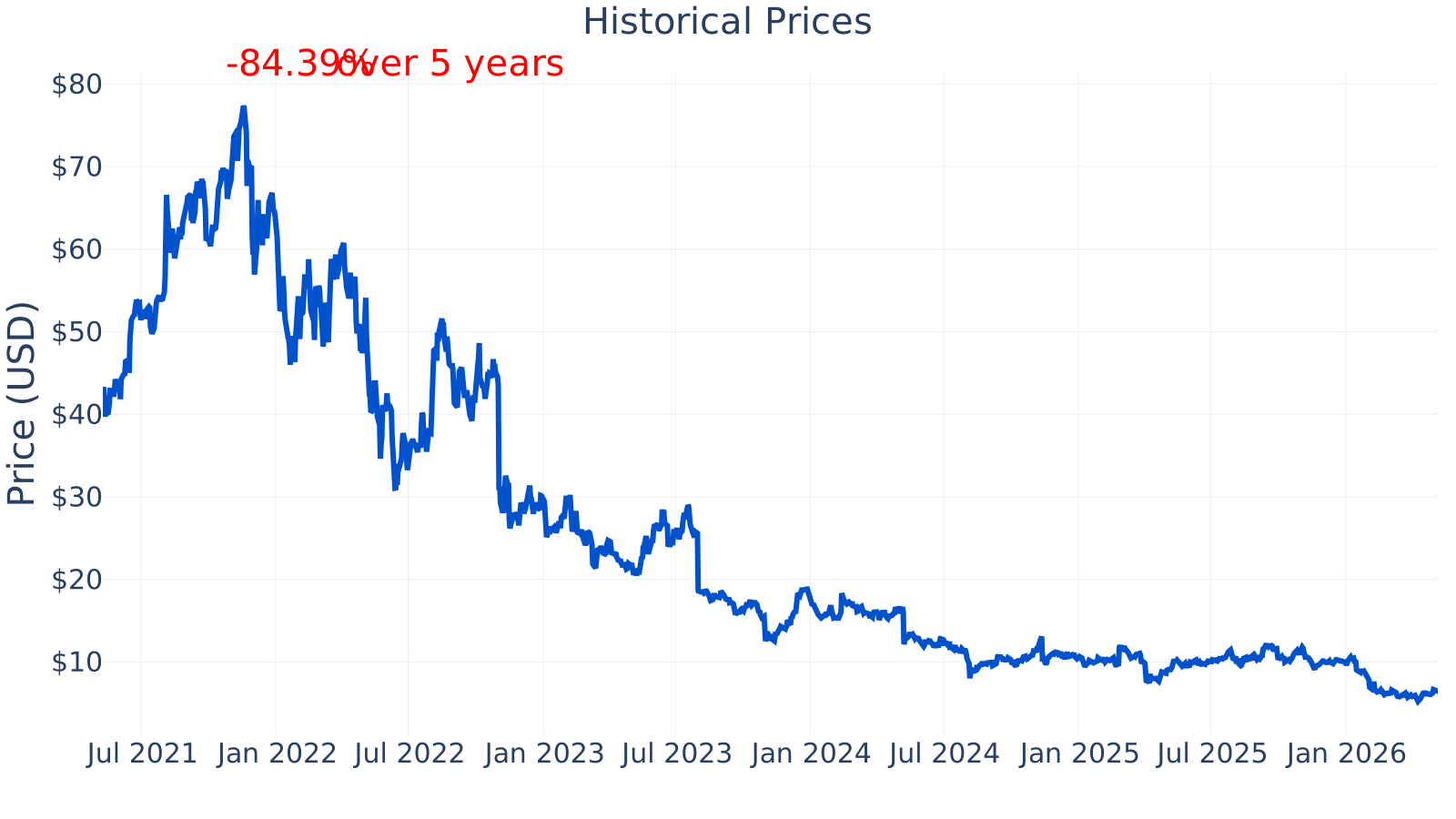
Leggett & Platt’s market capitalization is about $1.4B, placing it in the small-to-mid public company range. The stock’s beta (~0.77) suggests it has historically moved somewhat less than the broader market, though company-specific events can still drive large moves.
On profitability, the latest profit margin is about 5.81%, above the industry median shown (about 3.93%). However, that recent profitability comes after a period of negative margins in 2023–2024, so it is important to view the latest figure as part of a recovery rather than a long, uninterrupted trend.
On growth, the latest year-over-year revenue growth is about -11.2%, compared with an industry median around +5.8%, indicating the company’s recent top-line performance has lagged the group. Financial leverage is also elevated: debt-to-equity is about 162% versus an industry median near 101%.
Finally, the latest P/E ratio is about 6.4 versus an industry median around 23.2. A low P/E can reflect lower market expectations or higher perceived risk, especially when recent earnings have been volatile. Free cash flow over the last twelve months is about $281M, which is a key metric for funding operations, reducing debt, and maintaining shareholder distributions.
Growth (Low to Medium)
Leggett & Platt’s end-markets are closely tied to long-lived consumer and industrial categories (mattresses, furniture components, automotive components, and other engineered products). These markets tend to be mature and cyclical rather than “fast-growing,” meaning results often depend more on execution, pricing, cost control, and market share than on rapid industry expansion.
A major question for long-term growth is whether the company can consistently convert demand recovery into sustained earnings and cash generation. The multi-segment structure can be supportive over time, but it also means management must allocate capital well across very different businesses.
The revenue trend shows a shift from strong growth in 2021 to mostly negative year-over-year changes from late 2022 through 2025, ending with a decline of roughly 11% in the most recent period shown. This pattern is consistent with a prolonged downcycle in some end-markets and/or company-specific volume and pricing pressures.
Free cash flow has remained positive over the periods shown (roughly $220M–$380M), with the latest around $250M–$280M. Positive free cash flow during challenging periods can be an important stabilizer, but it still needs to be weighed against leverage levels and the sustainability of earnings after a volatile 2023–2024.
Potential catalysts (in a neutral, factual sense) often include normalization in bedding and home-related demand, benefits from restructuring or cost actions described in filings, and continued margin recovery. The degree to which these translate into durable growth depends on both the economic environment and company execution.
Risks (High)
Leggett & Platt’s biggest risk is cyclicality: demand for bedding and many home-related products can rise and fall with consumer confidence, housing turnover, and discretionary spending. Industrial and automotive-related demand can also be sensitive to economic slowdowns. This cyclicality can create sharp swings in profits, as seen in the move from positive earnings to losses and back to profitability within a few years.
Another key risk is financial leverage and the cost of servicing debt. When profits compress, interest expense consumes a larger share of operating results and reduces flexibility.
The debt-to-equity ratio has been well above the industry median for much of the period shown and spiked materially in 2024 before improving. The latest level is still elevated at roughly 162% (versus an industry median near 100%), which can increase sensitivity to downturns, refinancing conditions, and covenant or rating pressure (where applicable and as described in filings).
Profit margin history shows meaningful volatility: it declined from mid-single digits in 2021–2022 to negative levels in 2023–2024 (with particularly deep losses in 2024), then recovered to a positive ~5.8% most recently. This kind of swing suggests that operational performance and/or end-market conditions can materially change results over relatively short periods.
Competitive positioning is another important consideration. The company competes largely in business-to-business component categories where customers focus on cost, quality, reliability, and engineering support. Competitive advantages in these markets often come from manufacturing scale, long-standing customer relationships, product know-how, and qualification requirements (especially in automotive-related components). At the same time, many product categories are competitive and can face pricing pressure, customer consolidation, and substitution risks.
Because Leggett & Platt participates in several categories, competitors vary by segment and are often specialized manufacturers (including global and regional suppliers). In bedding components, competition can include other component suppliers and integrated mattress manufacturers that produce more inputs internally; in automotive and industrial components, competition includes diversified suppliers with global footprints. The company’s placement therefore tends to be “strong in selected niches” rather than a single, dominant position across all end-markets, based on how the business is described in its segment reporting and risk disclosures.
Valuation
Valuation is often discussed in terms of how much the market is paying for earnings and cash generation, while considering how stable those earnings are. Leggett & Platt’s latest trailing P/E is about 6.4, below the industry median shown (about 23.2). A lower multiple can occur when the market expects slower growth, assigns higher risk to the business, or doubts that current earnings levels will persist after a rebound.
The P/E history shows the company trading in the low-teens during 2021–2023, then the ratio is not meaningfully displayed through much of 2024–early 2025 (consistent with periods when earnings were negative or otherwise distorted), and later returns to single digits as profitability recovers. This pattern reinforces that earnings have been volatile, which can make single-number valuation comparisons less informative than usual.
Additional context comes from profitability and balance sheet signals: margins recently recovered, but leverage remains higher than the industry median, and revenue growth is currently negative. In other words, the valuation indicators (like P/E) need to be read alongside the question of how durable the recovery is and how much balance sheet risk remains.
Conclusion
Leggett & Platt is a diversified maker of components used in bedding, furniture-related applications, and industrial and automotive markets. The recent record shows a multi-year revenue decline from 2022 through 2025, a sharp profitability downturn in 2023–2024, and a return to positive earnings and margins in 2025. Free cash flow has remained positive over the periods shown, which is a notable stabilizing factor.
The main long-term factors to weigh are the company’s exposure to cyclical demand, the sustainability of the recent profit recovery, and the balance sheet leverage that has remained above the industry median even after improvement. The current valuation metrics show a low P/E relative to the industry median, but the historical swings in earnings and margins suggest that valuation should be interpreted in the context of volatility rather than as a standalone signal.
Sources:
- SEC EDGAR — Leggett & Platt Incorporated — Form 10-K (Annual Report)
- SEC EDGAR — Leggett & Platt Incorporated — Form 10-Q (Quarterly Reports)
- Leggett & Platt Investor Relations — SEC Filings & Reports (company-hosted)
- Wikipedia — “Leggett & Platt” (basic company background)
This article is for informational purposes only and does not constitute financial advice. Some content is AI-generated. See Disclaimer