Stock Analysis · Lattice Semiconductor Corporation (LSCC)
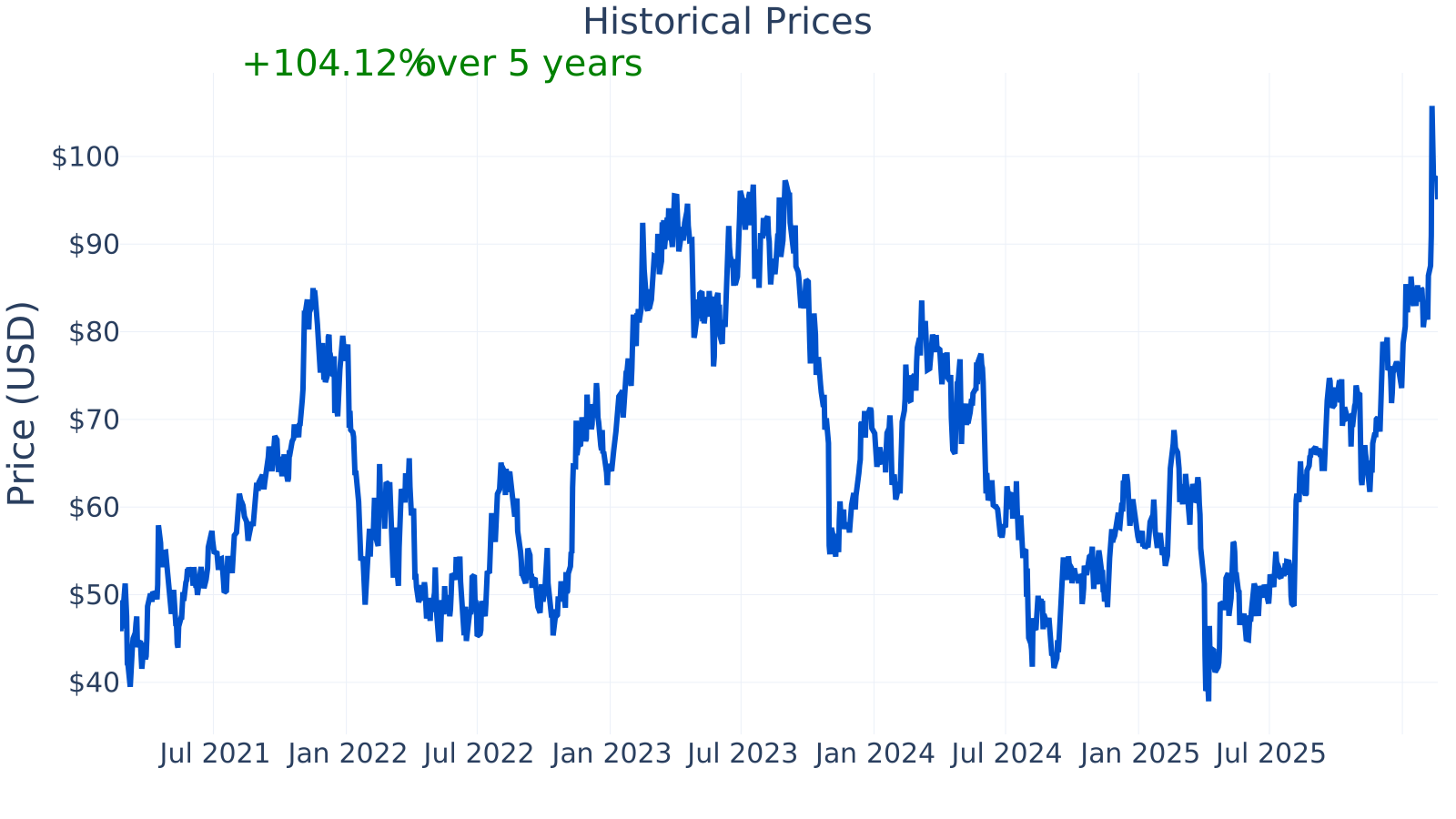
Overview
Lattice Semiconductor Corporation designs and sells a type of chip called a field-programmable gate array (FPGA). In simple terms, an FPGA is a flexible chip that can be configured (and reconfigured) by customers to perform specific tasks. Compared with many “one-purpose” chips, this approach can help customers iterate faster, adapt products after launch, and support multiple product versions with the same underlying hardware.
Lattice focuses primarily on low power, small form-factor FPGAs and related software tools. Its products are commonly used in electronics where power efficiency, compact size, and reliability matter—such as industrial equipment, communications infrastructure, servers/data centers, automotive systems, and consumer devices. Revenue is generally generated from selling chips (devices) and associated software/licensing and development tools, as described in the company’s SEC filings.
Main revenue sources are typically described at a high level (rather than with a detailed public split by product line):
- FPGA and related device sales (the core of revenue)
- Software tools and licensing / related services (smaller portion, generally supporting the hardware business)
From a high-level financial view, the company’s revenue expanded meaningfully from 2021 to 2023, then declined in 2024 and partially stabilized afterward. Operating costs (especially research and development) remained significant, reflecting the ongoing need to invest to keep products competitive.
Across 2021–2023, total revenue rose (from about $515M to about $737M) and net income increased (about $96M to about $259M). In 2024, revenue fell to about $509M and net income dropped to about $61M, showing how profitability can swing when industry demand weakens or when the company’s cost base does not fall as quickly as sales.
Key Figures
| Metric | Value | Industry ⓘ |
|---|---|---|
| Date | Feb 20, 2026 | |
| Context | ||
| Sector | Technology | |
| Industry | Semiconductors | |
| Market Cap ⓘ | $13.01B | |
| Beta ⓘ | 1.67 | |
| Fundamental | ||
| P/E Ratio ⓘ | N/A | 45.38 |
| Profit Margin ⓘ | 0.59% | 10.84% |
| Revenue Growth ⓘ | 24.20% | 15.50% |
| Debt to Equity ⓘ | 10.96% | 25.62% |
| PEG ⓘ | 3.18 | |
| Free Cash Flow ⓘ | $140.36M | |
Lattice’s market capitalization is about $13.0B. The stock’s beta of ~1.67 suggests it has historically moved more than the broader market (higher volatility). The latest year-over-year revenue growth shown is about 24.2% (above an industry median of about 15.5%), while debt-to-equity is ~11.0% (below an industry median near 25.6%), indicating relatively modest balance-sheet leverage. Free cash flow over the trailing twelve months is about $140M. The profit margin shown in the table is ~0.6% versus an industry median near 10.8%, which signals unusually low recent profitability compared with peers (consistent with the sharp earnings compression visible in the later periods).
Growth (Medium)
Lattice operates in the broader semiconductor industry and, more specifically, in programmable logic. Demand drivers for this space often include long-term trends such as increased connectivity, more processing at the “edge” (devices doing more work locally), industrial automation, and higher electronics content in vehicles and infrastructure. In many of these applications, a programmable chip can be valuable because it can be updated as standards evolve or as customers change features.
A key part of Lattice’s strategy is its focus on low-power programmable solutions, which can matter in battery-powered devices, thermally constrained systems, and embedded designs. This positioning can be helpful if customers prioritize energy efficiency and smaller designs, but it also means growth depends on maintaining a strong product roadmap and sustaining design wins (customer adoption in new products) over time.
The year-over-year revenue growth trend shows a classic semiconductor pattern: strong growth through 2021–2022, a slowdown into 2023, then a sharp contraction in 2024 (down more than 20% year-over-year for several quarters), followed by gradual improvement and a return to positive growth in the most recent period (about +24%). This pattern is consistent with cyclical demand and inventory corrections that periodically impact chip suppliers.
Free cash flow rose from roughly $90M (2021 period shown) to more than $230M (2024 period shown), then declined to roughly $121M (2025 period shown), with the latest trailing twelve months around $140M. This suggests cash generation can remain positive even when conditions soften, but it also indicates that cash flow is not immune to downturns in revenue and profitability.
Potential catalysts (in a factual, business-driven sense) typically include broader recovery in semiconductor demand, new product cycles, and additional design wins in end markets like industrial and communications infrastructure. Over time, the company’s ability to keep improving power efficiency and software tooling can influence whether it gains or loses momentum in new customer designs.
Risks (High)
Semiconductors are a cyclical business. Customer demand can change quickly due to macroeconomic conditions, product cycles, and inventory adjustments. For Lattice, the 2024 revenue decline and the sharp reduction in net income highlight how earnings can compress during downcycles. A related risk is operating leverage: research and development and other operating expenses may not fall as fast as revenue during weaker periods, which can pressure profits.
Competition is another important factor. Lattice participates in programmable logic markets where larger rivals have deep engineering resources and broad customer relationships. In FPGAs, major competitors commonly include AMD (Xilinx) and Intel (Altera), and competition can also come from alternative chip types such as microcontrollers/SoCs and ASICs depending on the application. Lattice’s differentiation is often described around low power and smaller devices, while larger competitors tend to offer broader portfolios including higher-end performance segments. The company is not the overall largest supplier in FPGAs; its positioning is more specialized.
Debt-to-equity declined dramatically from around 51% in early 2021 to low single digits through much of 2023–2024, then increased to about 11% most recently—still below the industry median near 21%. Lower leverage can reduce financial risk, but it does not eliminate business-cycle risk.
Profit margin improved strongly through 2022–2023 (peaking above 30% in multiple periods), then fell sharply in 2024–2025, reaching very low levels most recently (around 0.6%). Even allowing for accounting items that can temporarily distort net income, the overall direction suggests the recent environment has been challenging and that restoring prior profitability levels is a key uncertainty to watch.
Operational and supply-chain risks also matter. Like many chip designers, Lattice relies on external manufacturing partners (a “fabless” model), making it exposed to foundry capacity constraints, geopolitical and trade restrictions, and component supply disruptions. In addition, the company’s performance can be influenced by customer concentration and the timing of large orders (topics typically discussed in 10-K risk factors).
Valuation
The price-to-earnings (P/E) ratio has historically been above the semiconductor industry median for extended periods, with notable swings over time. In the most recent points shown, the company’s P/E rises sharply (well above the industry median), which can happen when the stock price holds up better than earnings, or when earnings temporarily fall. In other words, a very high P/E can sometimes reflect depressed recent profits rather than unusually strong expected growth.
The latest metrics table shows the company P/E as 0.0 (while the industry median is about 45.4), which commonly indicates the P/E is not meaningful in that snapshot (for example, due to very low or negative earnings per share in the measurement window used). Because recent profit margin has been unusually low, valuation comparisons that rely on earnings can be harder to interpret without additional context such as normalized profitability across a cycle and cash-flow strength.
Given the combination of cyclical revenue, sharply changing margins, and historically elevated P/E readings, the main question for valuation context is whether profitability returns toward earlier levels and whether revenue growth becomes steadier across cycles. Without that, single-number valuation indicators can be misleading.
Conclusion
Lattice Semiconductor is a specialized chip designer centered on low-power programmable devices. The business has demonstrated it can scale revenue and profits in favorable industry conditions (notably 2021–2023), while the more recent period shows how quickly results can weaken when demand slows and margins compress.
From a long-term perspective, the company sits in markets supported by structural trends like connectivity, automation, and ongoing electronics proliferation, and it maintains meaningful investment in research and development. At the same time, risks are material: competition from larger programmable-logic suppliers, substitution by other chip types, and the inherent cyclicality of semiconductors. Recent profitability volatility is a key item to monitor, alongside whether revenue growth continues to recover and whether cash generation remains resilient.
Sources:
- SEC EDGAR — Lattice Semiconductor Corporation Form 10-K (Annual Report)
- SEC EDGAR — Lattice Semiconductor Corporation Form 10-Q (Quarterly Report)
- Lattice Semiconductor Investor Relations — SEC Filings & Annual Report materials
- Wikipedia — “Lattice Semiconductor” (company background)
This article is for informational purposes only and does not constitute financial advice. Some content is AI-generated. See Disclaimer


