Stock Analysis · Las Vegas Sands Corp (LVS)
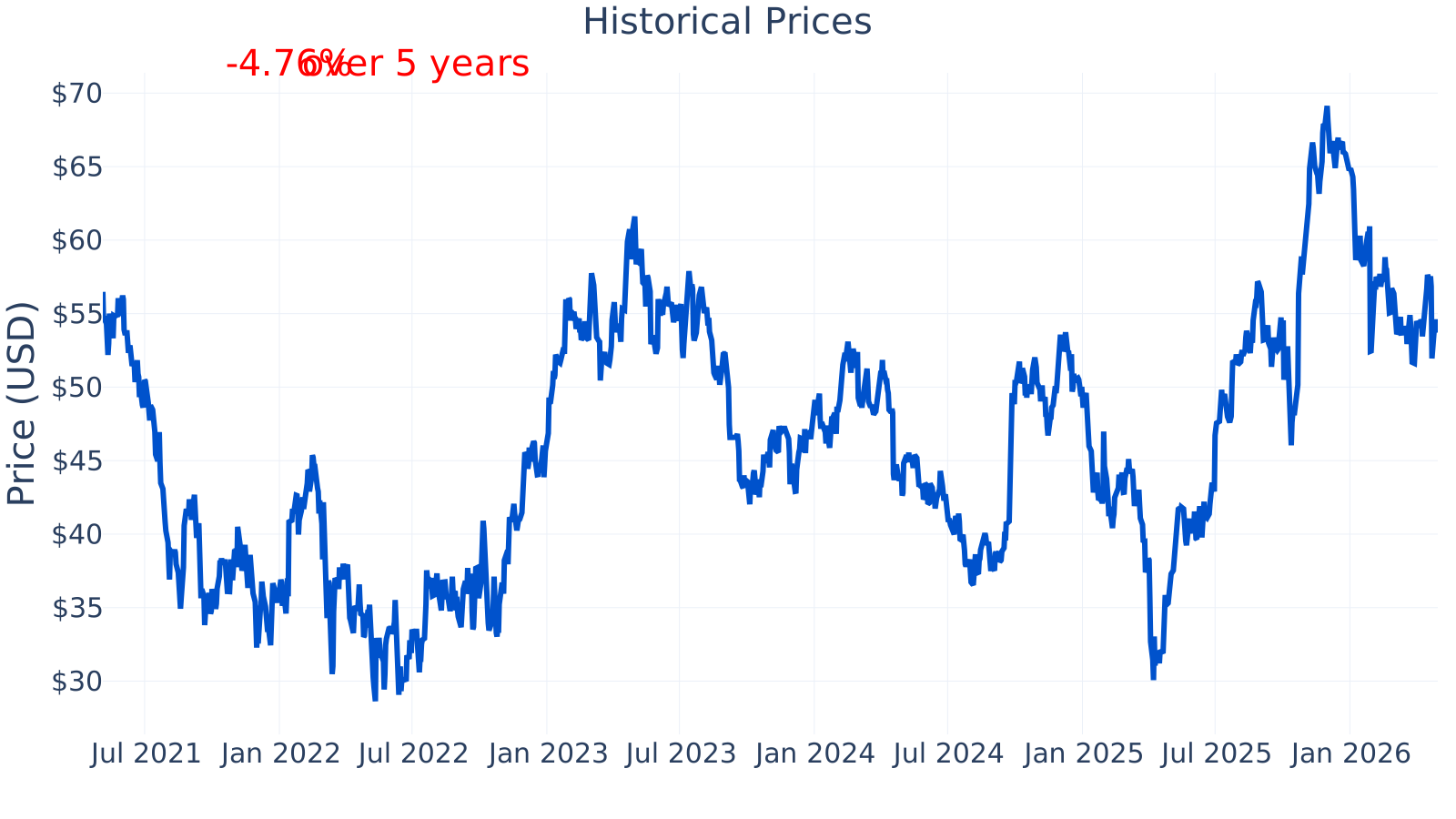
Overview
Las Vegas Sands Corp (LVS) is a resort and casino company focused on large, integrated destinations that combine gaming with hotels, restaurants, retail, convention space, and entertainment. After selling its Las Vegas operations, the company’s business is concentrated in Asia, where it operates major properties in Macau and Singapore.
In simple terms, LVS earns money when visitors stay at its hotels, gamble in its casinos, attend conventions, shop, and spend on dining and entertainment. Because many costs (property operations, staffing, maintenance, interest on debt) are relatively fixed, profitability can swing meaningfully when visitor volumes rise or fall.
Across its resorts, the main revenue streams typically include gaming and non-gaming categories such as rooms, food and beverage, retail, and convention/event-related income. Exact percentages can vary by property and year, and are usually detailed in company filings by reporting segment and line item rather than as one fixed mix.
From 2021 to 2025, total revenue increased substantially (from about $4.2B to about $13.0B) and the company moved from losses to positive net income (from about -$1.0B to about $1.6B). Interest expense remained large (roughly $0.6B–$0.8B per year in the period shown), which highlights the importance of financing costs for overall results.
Key Figures
| Metric | Value | Industry ⓘ |
|---|---|---|
| Date | May 04, 2026 | |
| Context | ||
| Sector | Consumer Cyclical | |
| Industry | Resorts & Casinos | |
| Market Cap ⓘ | $35.64B | |
| Beta ⓘ | 0.89 | |
| Fundamental | ||
| P/E Ratio ⓘ | 19.85 | 19.89 |
| Profit Margin ⓘ | 13.41% | 4.08% |
| Revenue Growth ⓘ | 25.30% | 3.45% |
| Debt to Equity ⓘ | 1310.33% | 370.23% |
| PEG ⓘ | 0.97 | |
| Free Cash Flow ⓘ | $2.32B | |
LVS has a market capitalization of about $35.6B and a beta of about 0.89, which indicates it has historically moved somewhat less than the broader market on average (though single stocks can still be volatile). The company’s trailing P/E ratio is about 19.85, close to the industry median (about 19.89).
Profitability and growth metrics stand out versus the industry median in the table: LVS shows a profit margin of about 13.41% versus an industry median near 4.09%, and year-over-year revenue growth of about 25.30% versus an industry median near 3.45%. At the same time, leverage is notably higher: debt-to-equity is about 1,310% versus an industry median around 370%, which can amplify both outcomes and risks.
Growth (Medium)
The resorts and casinos industry is closely tied to travel demand, consumer spending, and tourism flows. For LVS specifically, the long-term growth question is strongly connected to visitation trends and policy/regulatory stability in its core markets (Macau and Singapore), as well as its ability to keep properties attractive through ongoing reinvestment.
The year-over-year revenue growth pattern shows a sharp rebound after earlier declines and very strong growth through parts of 2023, followed by more mixed growth in 2024 and a re-acceleration into 2025 and early 2026 (about 25.26% in the most recent point shown). This kind of path is consistent with a business that can recover quickly when travel and visitation improve, but also one where growth rates can cool once the rebound phase normalizes.
Free cash flow (a rough measure of cash generated after operating needs and capital spending) shifted from negative levels in 2022 and 2023 to positive levels later, reaching about $2.32B in the most recent period shown. For a capital-intensive operator of large resorts, sustained free cash flow matters because it supports reinvestment in properties and provides financial flexibility (for example, to reduce debt or fund future development).
Potential catalysts for future growth generally come from higher visitation, improved spending per visitor (both gaming and non-gaming), and continued ramp-up of convention and premium tourism demand. However, because LVS is concentrated in a small number of major properties and jurisdictions, growth can be uneven from year to year.
Risks (High)
LVS faces meaningful concentration risk: results depend heavily on a limited set of large resorts in Macau and Singapore. Any adverse change in local travel patterns, economic conditions, regulation, taxation, licensing terms, or geopolitical factors could affect revenue and profitability. The business is also sensitive to shifts in consumer discretionary spending, which can weaken during economic slowdowns.
The leverage profile is a central risk consideration. Debt-to-equity rose significantly over time and reaches about 1,310% at the most recent point shown, well above the industry median (about 370%). Higher leverage can increase exposure to refinancing risk and interest costs, and it can reduce flexibility if operating conditions weaken.
Profit margins improved materially from negative levels in 2021–2022 to solidly positive levels more recently, reaching about 13.41% versus an industry median near 4.21%. While this outperformance is a positive sign of operating strength, margins in this industry can move quickly with changes in volume, pricing, and operating costs (labor, utilities, promotions, and maintenance).
Competitive dynamics are also important. LVS competes with other large integrated resort operators, particularly in Macau (for example, operators with major resort portfolios there) and, more broadly, with global casino and hospitality companies for premium customers and convention business. Competitive advantages in this space tend to come from property location, scale, brand strength, loyalty programs, convention capacity, and the ability to continuously refresh amenities. LVS is widely viewed as a major player in integrated resorts, but it is not insulated from competitive reinvestment cycles and shifting customer preferences.
Valuation
On earnings multiples, LVS’s latest P/E ratio (about 19.85) is roughly in line with the industry median (about 19.89). Historically in the period shown, the company’s P/E moved from not meaningfully displayed values earlier to elevated levels in late 2023 (above 50) and then moderated into the high-teens to high-20s range, ending around 24.26 in the most recent point. This pattern suggests the market’s valuation has shifted alongside the company’s return to profitability and changing expectations about normalization and growth.
Whether the current valuation is “high” or “low” depends heavily on how durable current profitability proves to be and how investors weigh the trade-off between (1) improved margins and cash generation and (2) elevated leverage and jurisdiction concentration. With a P/E close to the industry median, the pricing appears to reflect a broadly similar earnings multiple to peers, while company-specific differences (like higher debt levels and geographic focus) become key drivers of how that multiple is interpreted.
Conclusion
Las Vegas Sands is a large, Asia-focused integrated resort operator whose results have rebounded strongly compared with the earlier period shown, with revenue rising meaningfully and profit margins turning solidly positive. Recent free cash flow is also positive, which can matter for a business that requires substantial ongoing investment in major properties.
At the same time, the risk profile is elevated due to high leverage (well above the industry median in the latest reading) and heavy reliance on a small number of jurisdictions and flagship resorts. From a long-term perspective, the key factors to monitor are the stability and growth of visitation and spending in its core markets, ongoing reinvestment needs, and how financing costs and debt levels evolve over time.
Sources:
- SEC EDGAR — Las Vegas Sands Corp filings (Form 10-K, Form 10-Q)
- Las Vegas Sands — Investor Relations materials (annual reports and shareholder information)
- Wikipedia — “Las Vegas Sands” (basic company background and history)
This article is for informational purposes only and does not constitute financial advice. Some content is AI-generated. See Disclaimer


