Stock Analysis · La-Z-Boy Incorporated (LZB)
Overview
La-Z-Boy Incorporated (LZB) is a home furnishings company best known for La-Z-Boy recliners and upholstered furniture. It operates across manufacturing, wholesale distribution, and retail—selling furniture through a mix of company-owned stores, independent dealers, and other channels. The business is closely tied to consumer spending on big-ticket home goods, which tends to rise when housing activity and household budgets are strong and slow down when consumers delay discretionary purchases.
Based on the company’s reporting structure in its SEC filings, revenue is primarily generated from these major areas (largest to smaller, exact mix can change by year):
- Retail segment: sales through company-owned La-Z-Boy Furniture Galleries® and other company-operated stores (direct-to-consumer).
- Wholesale segment: sales to independent La-Z-Boy Furniture Galleries® dealers and other wholesale customers.
- Joybird segment: e-commerce-focused upholstered furniture brand (direct-to-consumer).
The overall income flow over time shows how revenue is split between product costs, operating expenses, and what remains as profit. In the most recent fiscal year shown, operating expenses increased notably versus prior years, which coincided with lower net income versus the earlier peak years in the series.
Key Figures
| Metric | Value | Industry ⓘ |
|---|---|---|
| Date | Mar 02, 2026 | |
| Context | ||
| Sector | Consumer Cyclical | |
| Industry | Furnishings, Fixtures & Appliances | |
| Market Cap ⓘ | $1.47B | |
| Beta ⓘ | 1.27 | |
| Fundamental | ||
| P/E Ratio ⓘ | 17.86 | 19.49 |
| Profit Margin ⓘ | 3.93% | 3.93% |
| Revenue Growth ⓘ | 3.80% | 3.80% |
| Debt to Equity ⓘ | 100.56% | 100.34% |
| PEG ⓘ | 2.01 | |
| Free Cash Flow ⓘ | $158.21M | |
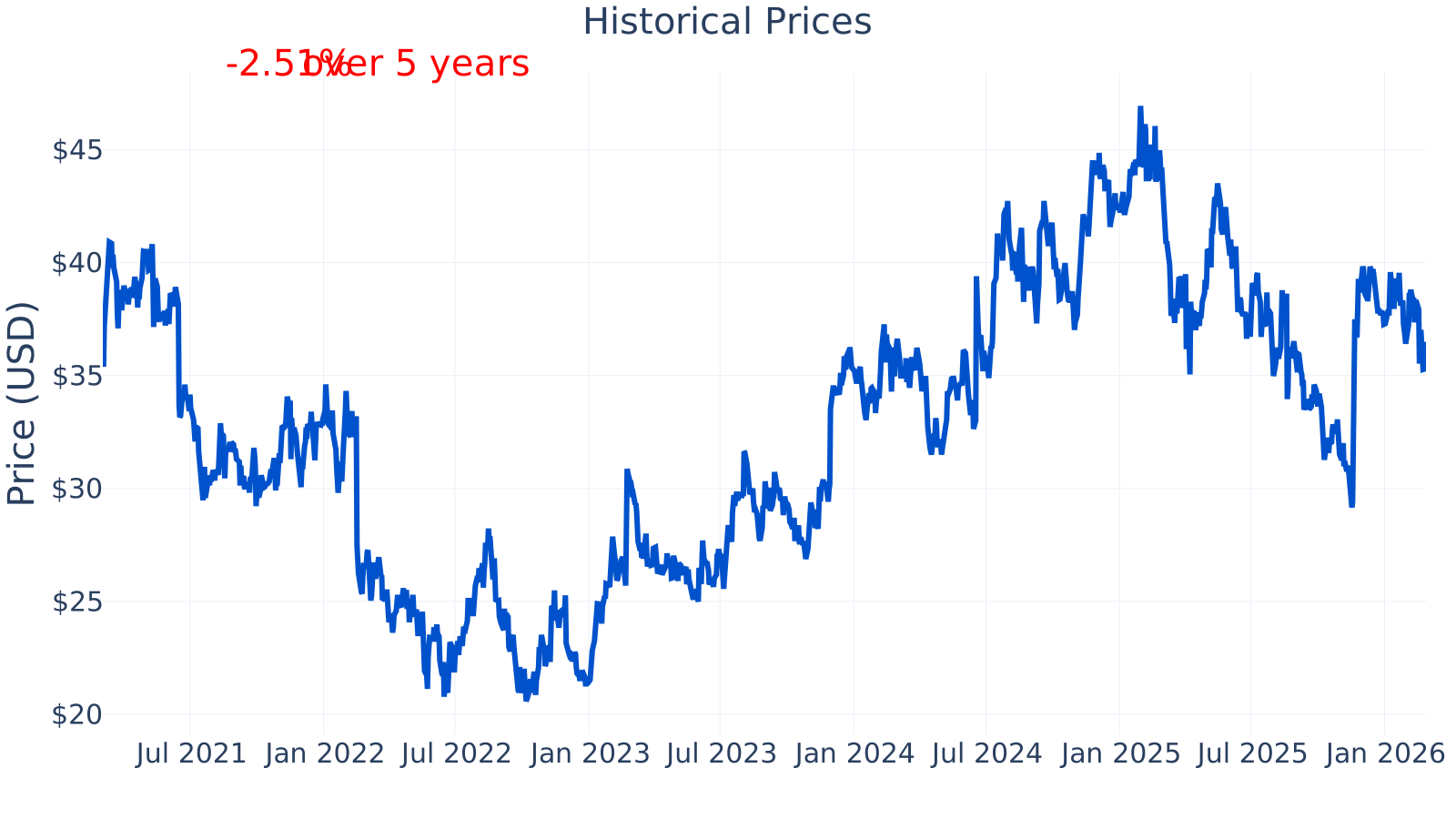
La-Z-Boy’s market capitalization is about $1.47 billion, placing it in the small-to-mid cap range. The stock’s beta of ~1.27 suggests it has historically moved more than the overall market on average (both up and down).
On profitability, the latest net profit margin is ~3.93%, in line with the industry median shown. Recent year-over-year revenue growth is ~3.8%, also aligned with the industry median in the table.
Leverage (debt relative to equity) is shown at roughly 101%, similar to the industry median displayed. Free cash flow over the trailing twelve months is about $158 million, which can matter because cash generation helps fund operations, store investments, and shareholder returns without relying solely on borrowing.
Growth (medium)
Home furnishings is generally considered a mature, highly competitive consumer category. Demand is cyclical: it often benefits when consumers move, renovate, or feel financially confident, and it can weaken when interest rates and housing turnover are unfavorable or when households postpone big purchases. That backdrop means growth tends to come more from execution (brand strength, merchandising, store productivity, supply chain efficiency, and channel mix) than from an industry that expands rapidly every year.
The company’s strategy, as reflected in its segment structure and long-running brand positioning, emphasizes a mix of retail presence (company-owned stores), wholesale distribution (dealer network), and direct-to-consumer via Joybird. In practical terms, this approach can support growth by expanding customer reach and capturing more of the value chain through retail—while also exposing results to retail operating costs.
Recent revenue growth has stabilized into low single digits (about 3.8% in the latest point shown), after a period that included declines and then a return toward modest growth. This pattern fits a cyclical category where results can swing with consumer demand and promotional intensity.
Free cash flow in the series trends upward overall, reaching about $158 million most recently (after lower levels earlier in the period). In a business like furniture—where inventory, manufacturing, and retail operations can absorb cash—more consistent free cash flow can be an important operational signal, even if it varies year to year.
Potential catalysts tend to be macro-driven (housing turnover, consumer sentiment, financing conditions) and company-driven (retail execution, cost control, product cycles, and improvements in the e-commerce/direct channel). Because the category is not typically “hyper-growth,” sustained margin improvement and steady cash generation can be just as important as topline expansion.
Risks (medium)
The biggest risk is cyclicality. Furniture is a discretionary purchase, so demand can fall when consumers feel pressure from inflation, higher borrowing costs, or weakening housing activity. This can lead to higher discounting across the industry and lower profitability.
Competition is another key factor. The company competes with a wide range of players: large furniture manufacturers, other branded upholstery companies, big-box and online retailers, and regional furniture chains. Competitive pressure can show up through promotions, delivery speed expectations, and the cost of customer acquisition online.
La-Z-Boy does have identifiable competitive strengths, particularly brand recognition in recliners and upholstered furniture and a long-established distribution footprint (wholesale dealer relationships plus company-owned retail). However, the broader furniture market remains fragmented, and leadership depends on the specific subcategory (for example, upholstered reclining) and channel rather than a single dominant industry position across all home furnishings.
Debt-to-equity was around the mid-40% to ~50% range for multiple periods shown, then jumps to roughly 101% at the latest point displayed (near the industry median). This kind of step-change can be important to monitor in filings because higher leverage can reduce flexibility in a downturn, especially in a cyclical category.
Net profit margin has moved down from the ~6–7% range earlier in the series to about 3.93% most recently. That indicates a less favorable profitability environment versus the earlier peak period, even though the latest margin is slightly above the industry median shown. In furniture, margin pressure can come from promotions, freight and input costs, and fixed-cost absorption in manufacturing and retail when volumes soften.
Valuation
The latest price-to-earnings (P/E) ratio is about 17.86, compared with an industry median of about 19.49 in the table. Over the period shown, the company’s P/E moved from higher levels earlier (above 20x at times) down to mid-single digits during parts of 2022–2023, and then back into the mid-to-high teens more recently. This pattern often reflects both changes in the stock price and changes in earnings across the cycle.
Interpreting valuation for a cyclical consumer business requires context: when earnings are temporarily depressed, a P/E can look higher even if the stock price has not risen much; when earnings are temporarily strong, a P/E can look low. The current multiple appears broadly in the range of the industry median provided, which suggests the market is not assigning an extreme premium or discount relative to the peer set shown, while profitability has recently been lower than the earlier peak years in the margin series.
Conclusion
La-Z-Boy is a well-known, established home furnishings company with a multi-channel model spanning wholesale, company-owned retail, and an e-commerce brand. The business operates in a cyclical, competitive industry where results can fluctuate meaningfully with consumer demand and housing-related conditions.
The recent picture shows modest revenue growth, profit margins that have compressed versus earlier years, and free cash flow that has improved in the period displayed. Leverage appears to have risen at the latest point shown, which is a factor to track alongside margins and demand conditions. Valuation, as represented by the P/E ratio, sits near the industry median provided, implying a pricing level broadly consistent with peers in the same classification.
Sources:
- SEC EDGAR — La-Z-Boy Incorporated, Form 10-K (Annual Report)
- SEC EDGAR — La-Z-Boy Incorporated, Form 10-Q (Quarterly Report)
- La-Z-Boy Incorporated Investor Relations — SEC Filings
- La-Z-Boy Incorporated Investor Relations — Earnings Materials (press releases / presentations, when hosted by the company)
- Wikipedia — “La-Z-Boy” (company overview/background)
This article is for informational purposes only and does not constitute financial advice. Some content is AI-generated. See Disclaimer