Stock Analysis · LCI Industries (LCII)
Overview
LCI Industries (LCII) manufactures and supplies components used mainly in recreational vehicles (RVs), along with adjacent end-markets such as marine, manufactured housing, and other specialty transportation. In simple terms, it sells many of the “parts and systems” that go into an RV (for example, chassis-related components, doors and windows, awnings, leveling systems, furniture, and other accessories) and also sells certain aftermarket products tied to RV ownership and maintenance.
The company’s results tend to move with RV production volumes and broader consumer spending, because RV makers are important customers. When RV demand rises, manufacturers usually build more units and order more components; when demand cools, the opposite happens. LCII has also aimed to reduce dependence on new RV builds by expanding products and categories that can be sold across multiple vehicle or housing markets and through aftermarket channels.
Main revenue drivers (high-level, based on the company’s segment reporting):
- OEM (Original Equipment Manufacturer) sales to RV manufacturers and other vehicle/housing producers (typically the largest share of revenue for LCII)
- Aftermarket and non-OEM channels (replacement parts, accessories, and products sold after the initial vehicle sale, including distribution/retail-oriented channels)
- Adjacent end-markets beyond RVs (such as marine and manufactured housing), which help diversify demand
Over the last several years shown below, revenue and profit levels have moved through a cycle: strong results in 2021–2022, a sharp pullback in 2023, and a gradual recovery in 2024–2025.
From 2021 to 2025, total revenue moved from about $4.47B (2021) to $5.21B (2022), then down to $3.78B (2023), and back up to about $4.12B (2025). Over the same period, operating income peaked in 2022 (about $553M), fell sharply in 2023 (about $123M), and improved by 2025 (about $280M), illustrating the company’s sensitivity to industry volumes and pricing/mix.
Key Figures
| Metric | Value | Industry ⓘ |
|---|---|---|
| Date | Feb 23, 2026 | |
| Context | ||
| Sector | Consumer Cyclical | |
| Industry | Recreational Vehicles | |
| Market Cap ⓘ | $3.58B | |
| Beta ⓘ | 1.31 | |
| Fundamental | ||
| P/E Ratio ⓘ | 20.67 | 26.87 |
| Profit Margin ⓘ | 4.57% | 2.07% |
| Revenue Growth ⓘ | 16.10% | 11.90% |
| Debt to Equity ⓘ | 21.60% | 116.31% |
| PEG ⓘ | 1.09 | |
| Free Cash Flow ⓘ | $278.33M | |
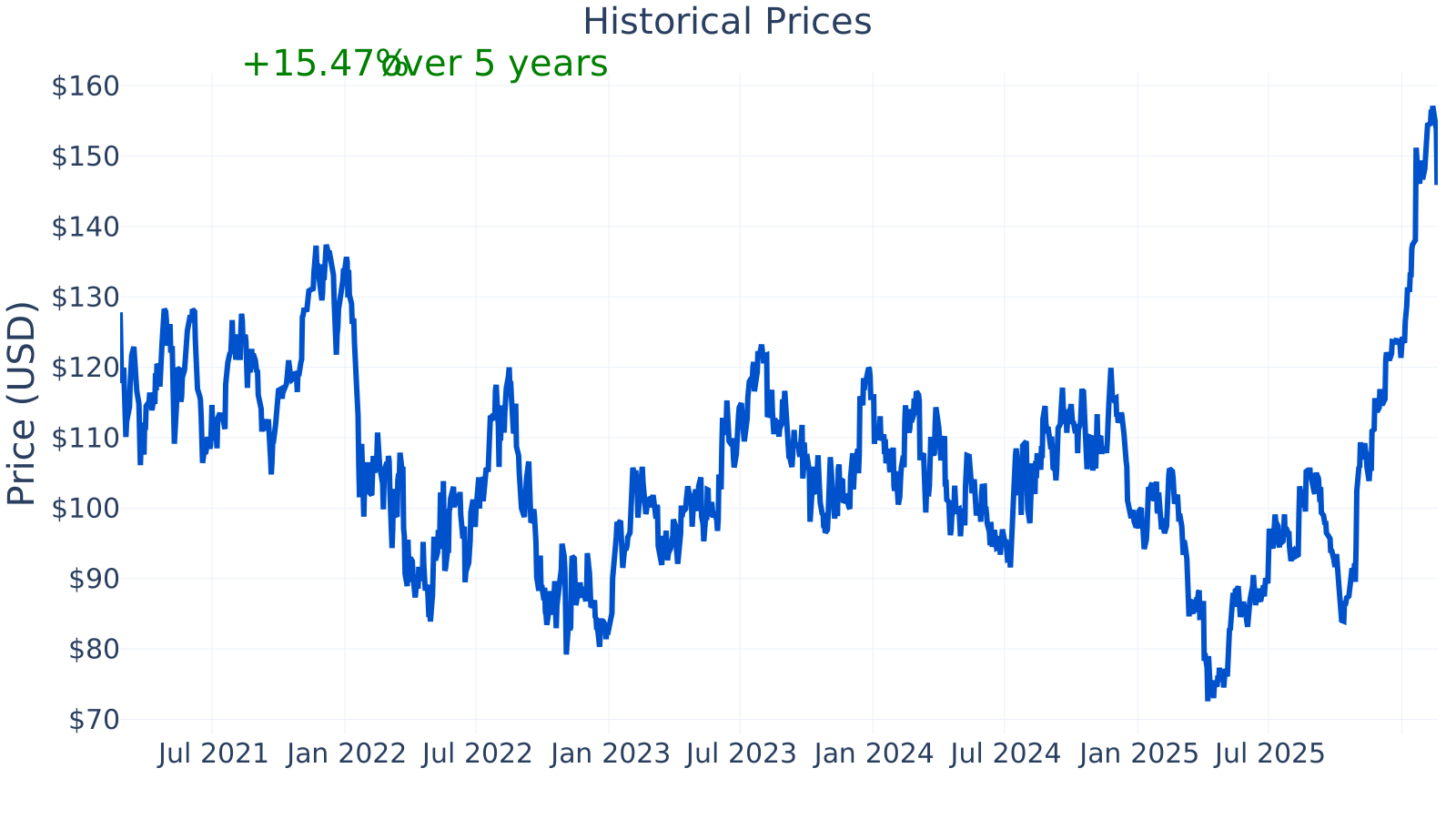
LCI Industries has a market capitalization of about $3.6B and a beta of 1.315, which is consistent with a stock that has tended to swing more than the broader market. Profit margin is about 4.57% versus an industry median near 2.07%, while revenue growth year-over-year is about 16.1% versus an industry median near 11.9%. Debt-to-equity is about 21.6% compared with an industry median around 116.3%, suggesting meaningfully lower balance-sheet leverage than many peers. Free cash flow over the trailing twelve months is about $278M.
Growth (Medium)
LCII operates in the recreational vehicle supply chain, which is a consumer-discretionary area that tends to be cyclical. Over long periods, RV ownership and outdoor recreation trends can support demand, but year-to-year results are often driven by interest rates, consumer confidence, dealer inventory levels, and broader economic conditions. That makes the “industry growth” less like a steady upward line and more like cycles of expansion and contraction.
A key element of LCII’s strategy is diversification: selling components that can be used across multiple end-markets (not only RVs), and growing channels that are less dependent on new RV production (aftermarket and other non-OEM routes). If executed well, that approach can reduce the size of earnings swings across cycles, even if it does not eliminate cyclicality.
The year-over-year revenue growth pattern shows a large surge in 2021–2022, followed by contraction through 2023, and then a return to growth in 2025. The most recent point shown is about 16.1% year-over-year, which is above the industry median shown in the table (11.9%). This suggests LCII is participating in a recovery phase, though the history also highlights how quickly growth can reverse in this category.
Free cash flow has been positive in most of the periods shown, with a notable dip into negative territory in 2022 (around -$101M) and then a rebound to strong positive levels in 2023–2025 (roughly $377M–$437M in the periods shown). For a manufacturing and components supplier, sustained positive free cash flow can matter because it helps fund capital spending, dividends, and acquisitions without relying as heavily on new borrowing.
Potential catalysts for future results are typically linked to (1) RV wholesale/retail demand normalization after down-cycles, (2) dealer inventory restocking, (3) product innovation and content-per-unit gains (selling more components per RV), and (4) expanding sales into non-RV markets to broaden the addressable customer base.
Risks (High)
The largest risk factor is cyclicality. RVs are big-ticket purchases that are sensitive to financing costs and household budgets. When industry volumes fall, an RV component supplier can see lower factory orders, less operating leverage (fixed costs spread over fewer units), and pressure on pricing. This is visible in the company’s profit history, where net income dropped sharply in 2023 compared with 2022 before recovering in 2024–2025.
Debt-to-equity trends downward over much of 2021–2024 and ends at about 21.6% at the most recent point shown, below the industry median (about 93.99% on the same date, and higher in many earlier periods). Lower leverage can reduce financial strain during downturns, but it does not remove operational exposure to industry slowdowns.
Profit margin also reflects the cycle. LCII’s margin was higher earlier in the period (often in the mid-to-high single digits), dropped notably through 2023 (down to low single digits at points), and then improved into 2024–2025, reaching about 4.57% most recently. While that recent level is above the industry median shown (about 2.87% at the most recent point on the chart), margins in this space can change quickly with volume, product mix, and competitive pricing.
Competition is another central risk. LCII operates among multiple component categories, so it competes with a range of suppliers (some specialized and some diversified). The company’s competitive advantages commonly relate to scale, broad product catalog, deep relationships with OEM customers, and the ability to bundle multiple components and systems. However, OEM customers can have significant negotiating power, and competitors can win share through pricing, technology, or specialized product performance.
Other practical risks include supply chain disruptions and input-cost volatility (materials, freight), product quality or warranty exposure, and integration risk if growth involves acquisitions. Because the customer base includes manufacturers, changes in a small number of large customers’ production schedules can also affect quarterly results.
Valuation
LCII’s latest price-to-earnings (P/E) ratio is about 20.7, below the industry median shown in the table (about 26.9). The historical P/E range shown varies widely over time, which often happens when earnings move up and down through a cycle: if earnings fall sharply, the P/E can rise even if the stock price does not rise much; when earnings recover, the P/E can compress.
In this context, P/E comparisons are most useful when paired with an understanding of where the company is in the cycle. The company’s recent return to positive year-over-year revenue growth and improving margins helps explain why valuation metrics may look different now than during the 2023 earnings trough. The PEG ratio shown in the table (~1.09) is a summary indicator that relates P/E to expected growth; it can be sensitive to growth assumptions, so it is typically read as a directional signal rather than a precise measure.
Conclusion
LCI Industries is a major supplier of RV components with additional exposure to adjacent markets and aftermarket channels. The business has clear cyclical characteristics, and its financial results have shown that pattern: strong performance in 2021–2022, a steep downturn in 2023, and improvement through 2024–2025.
From a long-term perspective, the most notable fundamentals in the figures shown are (1) a recent return to revenue growth, (2) profit margin recovery versus the lows of 2023, (3) meaningful free cash flow generation in recent periods, and (4) comparatively low debt-to-equity versus the industry median. The main uncertainties remain how durable the current recovery is, how volatile demand becomes in the next cycle, and how effectively the company sustains differentiation across a broad set of component categories against capable competitors.
Sources:
- SEC EDGAR — LCI Industries, Inc. filings (Form 10-K, Form 10-Q, Form 8-K)
- LCI Industries — Investor Relations materials and press releases
- Wikipedia — “LCI Industries” (company overview/background)
This article is for informational purposes only and does not constitute financial advice. Some content is AI-generated. See Disclaimer


