Stock Analysis · LCI Industries (LCII)
Overview
LCI Industries (LCII) manufactures and supplies components used mainly in recreational vehicles (RVs), along with adjacent end-markets such as marine, manufactured housing, and other specialty transportation. In simple terms, it sells many of the “parts and systems” that go into an RV (for example, chassis-related components, doors and windows, awnings, leveling systems, furniture, and other accessories) and also sells certain aftermarket products tied to RV ownership and maintenance.
The company’s results tend to move with RV production volumes and broader consumer spending, because RV makers are important customers. When RV demand rises, manufacturers usually build more units and order more components; when demand cools, the opposite happens. LCII has also aimed to reduce dependence on new RV builds by expanding products and categories that can be sold across multiple vehicle or housing markets and through aftermarket channels.
Main revenue drivers (high-level, based on the company’s segment reporting):
- OEM (Original Equipment Manufacturer) sales to RV manufacturers and other vehicle/housing producers (typically the largest share of revenue for LCII)
- Aftermarket and non-OEM channels (replacement parts, accessories, and products sold after the initial vehicle sale, including distribution/retail-oriented channels)
- Adjacent end-markets beyond RVs (such as marine and manufactured housing), which help diversify demand
Over the last several years shown below, revenue and profit levels have moved through a cycle: strong results in 2021–2022, a sharp pullback in 2023, and a gradual recovery in 2024–2025.
From 2021 to 2025, total revenue moved from about $4.47B (2021) to $5.21B (2022), then down to $3.78B (2023), and back up to about $4.12B (2025). Over the same period, operating income peaked in 2022 (about $553M), fell sharply in 2023 (about $123M), and improved by 2025 (about $280M), illustrating the company’s sensitivity to industry volumes and pricing/mix.
Key Figures
| Metric | Value | Industry ⓘ |
|---|---|---|
| Date | Feb 23, 2026 | |
| Context | ||
| Sector | Consumer Cyclical | |
| Industry | Recreational Vehicles | |
| Market Cap ⓘ | $3.58B | |
| Beta ⓘ | 1.31 | |
| Fundamental | ||
| P/E Ratio ⓘ | 20.67 | 26.87 |
| Profit Margin ⓘ | 4.57% | 2.07% |
| Revenue Growth ⓘ | 16.10% | 11.90% |
| Debt to Equity ⓘ | 21.60% | 116.31% |
| PEG ⓘ | 1.09 | |
| Free Cash Flow ⓘ | $278.33M | |
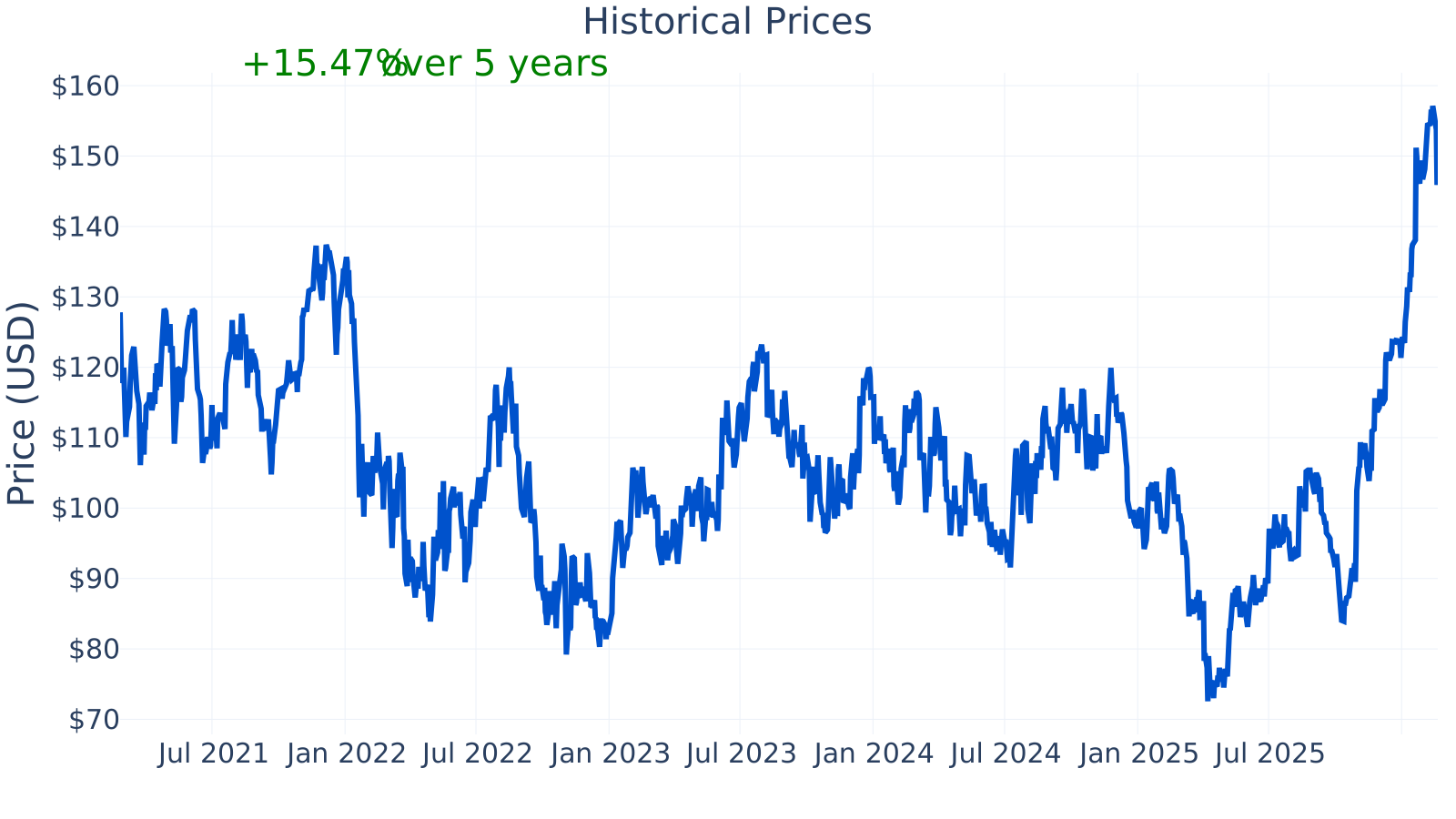
LCI Industries has a market capitalization of about $3.6B and a beta of 1.315, which is consistent with a stock that has tended to swing more than the broader market. Profit margin is about 4.57% versus an industry median near 2.07%, while revenue growth year-over-year is about 16.1% versus an industry median near 11.9%. Debt-to-equity is about 21.6% compared with an industry median around 116.3%, suggesting meaningfully lower balance-sheet leverage than many peers. Free cash flow over the trailing twelve months is about $278M.
Growth (Medium)
LCII operates in the recreational vehicle supply chain, which is a consumer-discretionary area that tends to be cyclical. Over long periods, RV ownership and outdoor recreation trends can support demand, but year-to-year results are often driven by interest rates, consumer confidence, dealer inventory levels, and broader economic conditions. That makes the “industry growth” less like a steady upward line and more like cycles of expansion and contraction.
A key element of LCII’s strategy is diversification: selling components that can be used across multiple end-markets (not only RVs), and growing channels that are less dependent on new RV production (aftermarket and other non-OEM routes). If executed well, that approach can reduce the size of earnings swings across cycles, even if it does not eliminate cyclicality.
The year-over-year revenue growth pattern shows a large surge in 2021–2022, followed by contraction through 2023, and then a return to growth in 2025. The most recent point shown is about 16.1% year-over-year, which is above the industry median shown in the table (11.9%). This suggests LCII is participating in a recovery phase, though the history also highlights how quickly growth can reverse in this category.
Free cash flow has been positive in most of the periods shown, with a notable dip into negative territory in 2022 (around -$101M) and then a rebound to strong positive levels in 2023–2025 (roughly $377M–$437M in the periods shown). For a manufacturing and components supplier, sustained positive free cash flow can matter because it helps fund capital spending, dividends, and acquisitions without relying as heavily on new borrowing.
Potential catalysts for future results are typically linked to (1) RV wholesale/retail demand normalization after down-cycles, (2) dealer inventory restocking, (3) product innovation and content-per-unit gains (selling more components per RV), and (4) expanding sales into non-RV markets to broaden the addressable customer base.
Risks (High)
This article is for informational purposes only and does not constitute financial advice. Some content is AI-generated. See Disclaimer